The Clive Building Doorman Helps the Narrator
ChowringheeThe Clive Building Doorman Helps the Narrator is a small but decisive episode in which a struggling basket seller mistakes an act of kindness for a familiar business arrangement. The doorman secures an order the narrator could not win alone, then shocks him by rejecting the commission offered in return. His help ends not with a sale but with tea, consolation, and a story about survival, turning a transaction into an encounter that renews the narrator’s faith in other people.
The Doorman and the Failed Sales Call
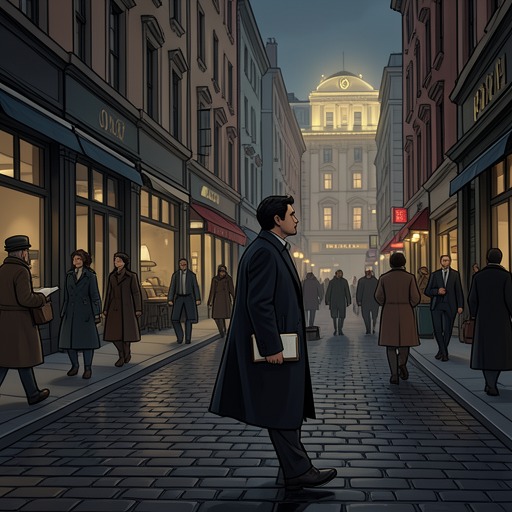
The narrator arrives at an office trying to sell wastepaper baskets, making his pitch in English and emphasizing that they are strong and durable. The woman in the office dismisses him, gestures for him to leave, and leaves him trudging away tired. His advertising phrases have failed; he has neither an order nor any reason to expect that the call will improve.
At a bench near the entrance sits the company doorman. He is conspicuous in a very large moustache, an enormous turban, and a white uniform bearing the company name on its chest; he is chewing tobacco. Rather than simply watching the narrator go, he asks how much the seller earns on each basket. The question reveals his interest in the narrator’s situation and opens the way for a second attempt at the sale.
When the woman again says that the office wants no baskets, the doorman refuses to accept that answer as final. He points out that William Ghosh has none, another employee’s basket is broken, and the director’s is wearing out, so the office ought to keep replacements in reserve. These specific needs overturn the woman’s refusal. She agrees to buy six, and the narrator hurries back to Chhatawala Lane to collect them before returning to the office. The doorman’s intervention is practical and immediate: he gives the sale a reason the customer can accept, and the narrator leaves with an order rather than another rejection.
Payment and the Misread Commission
Once the baskets have been delivered, the narrator expects that the doorman may want part of the proceeds. His expectation comes from experience: he knows enough doormen like this one to anticipate that a commission might be required, and this time he has prepared for it. The scene therefore carries two understandings of the same assistance. To the narrator, help at the point of sale can belong to a familiar exchange; to the doorman, helping the tired seller is not a claim on the sale’s proceeds.
The doorman also helps resolve the payment itself. He returns to the woman and speaks on the narrator’s behalf, stressing that the seller is poor and must go from office to office. Later he tells the narrator that the payment has been settled, hands him a voucher, and asks whether he can sign it or will need to leave a thumbprint. When the narrator signs in English, the doorman laughs in surprise. The moment registers a small difference between the narrator’s precarious position and the education or ability that his signature demonstrates, without changing the fact that he needs the money from the sale.
With the money in hand, the narrator offers the doorman one rupee and fifty annas, inviting him to take what he wants as his commission. The offer makes sense within the narrator’s expectations, but the doorman’s reaction makes clear that he has understood it as an insult. He turns pale, his upright figure trembles, and his friendly expression disappears. The narrator initially thinks the amount has disappointed him and is ready to explain that he has earned no more than a rupee and a half from the six baskets. He then realizes that he has wholly misread the man: the doorman had not arranged the purchase to make money for himself.
A Reversal of Expectation
The doorman’s anger gives the scene its sharp reversal. The narrator has been prepared to share his earnings because he assumes that assistance is likely to carry a price. The doorman instead makes plain that he acted out of sympathy for a poor man who has to travel from office to office. What the narrator had treated as the likely cost of doing business becomes evidence of generosity offered without payment. The embarrassment is not resolved by a bargain; it is resolved by the narrator recognizing that his suspicion has misjudged the person who helped him.
The emotional consequence is immediate. The narrator cannot hold back his tears, and the encounter leads him to conclude that the world has not been stripped of all goodness. This response gives the episode significance beyond the six baskets: after dismissal and exhaustion, the narrator has encountered help that does not demand a share of his earnings. The doorman does not erase the narrator’s poverty or make his work secure, but he interrupts the assumption that every useful act must conceal self-interest.
Tea, Encouragement, and the Story of Sir Hariram
After rejecting the commission, the doorman has the narrator sit down for a cup of tea. He places a hand on the narrator’s shoulder and invokes Sir Hariram Goenka, whose bronze statue stands in front of the governor’s house. Sir Hariram, he explains, also had to struggle to survive. The comparison connects the narrator’s present hardship with a life of struggle that, in the doorman’s telling, did not prevent later greatness.
The doorman says he sees the same fire in the narrator’s eyes and predicts that he will one day be as great as Sir Hariram. The narrator looks at him again, still unable to stop crying. The prediction is encouragement rather than a promise grounded in any visible change in the narrator’s circumstances: what the doorman can offer is recognition, a cup of tea, and confidence in a future the exhausted seller cannot yet see for himself. In the scene’s final movement, the man who first helped secure a sale becomes a source of moral and emotional support. The narrator’s recollection preserves the doorman not for the order alone, but for the unexpected kindness that made him believe goodness remained possible.