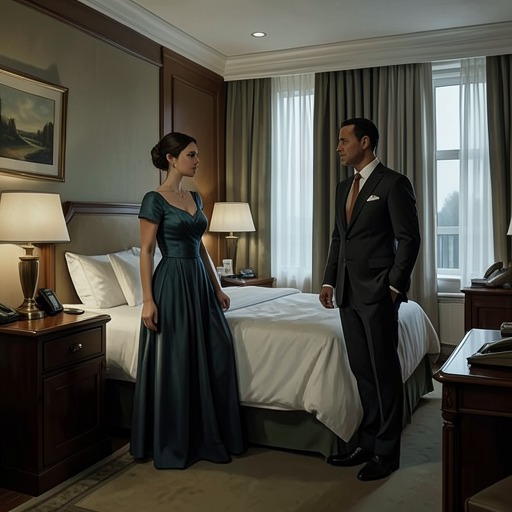
Sreelekha Devi Leaves Home and Reconciles with Her Husband
ChowringheeSreelekha Devi Leaves Home and Reconciles with Her Husband is a late-night episode in which a famous actress’s private marital rupture becomes a practical and emotional test for the Hotel Shahjahan’s receptionist. Sreelekha Devi asks him to find her husband, then goes out to meet the man she fears may have come to hurt her. The receptionist cannot hear their conversation, but sees her weeping as her husband tries to comfort her; they leave together, and he is left to reckon with the hotel bill.
The Actress and the Hotel
Sreelekha Devi calls the reception desk herself and identifies herself by name. The call places the scene within the hotel’s ordinary machinery of rooms, instructions, and messages, but her question makes clear that this is not a routine request: she wants to know whether anyone has come looking for her. The receptionist has been told not to disclose her room number and to send her husband away if he appears. The instructions establish that her stay is meant to keep the couple apart, at least for the moment, and make the receptionist an intermediary in a conflict whose details he does not know.
Her question is informed by a pattern she describes from experience: whenever she has left home in anger, her husband has come to the hotel. Rather than accept the receptionist’s assurance that nobody comes at such a late hour, she asks him to consult Sata Bose and insists that he go out and check while she remains on the line. Her insistence turns the hotel employee from a keeper of information into an agent in the encounter. She is not simply waiting to be found; she is actively testing whether the familiar pattern has begun again.
The Husband Outside
The receptionist finds a man standing on Chittaranjan Avenue, dressed in an expensive Indian suit. He recognizes him from newspaper photographs as Sreelekha Devi’s husband. The public images that make the man identifiable also frame him as the spouse of a famous film star, yet what the receptionist encounters is a solitary figure waiting in the street, not a public celebrity in a scene of glamour.
When approached, the husband reacts angrily. He protests that he is not inside the hotel but standing quietly in the street, and challenges the receptionist for coming to pick a quarrel. The exchange does not resolve what he wants or how he feels; it only makes the strain of the situation visible. After reporting that he is there, the receptionist receives Sreelekha Devi’s instruction to send him to her room and to charge her as if it were a double room. The change is decisive: the original instruction was to turn the husband away, but she now chooses to receive him, and accepts the cost of making space for him.
Fear, Meeting, and Departure
The invitation does not mean that Sreelekha Devi feels safe. She comes down to the reception desk without makeup, her hair untidy and her face showing the fatigue of the night, and asks the receptionist to accompany her to the door. She says she is afraid that her husband may have brought acid to throw in her face. The possibility is expressed as a fear, not established as a fact; the receptionist does not know what the husband has brought or what he intends to do. Her fear nevertheless makes the reconciliation more complicated than a simple, untroubled reunion.
She does not answer when the receptionist asks whether going out is really necessary. Instead, she walks straight to the entrance, and he follows. At the door she tells him not to come any farther. From a distance, he watches her approach her husband, who has turned to face the street. He cannot hear what they say. He sees what appears to be her sobbing and her husband trying to calm her, but the decisive conversation remains private, beyond the reach of the hotel employee and the reader.
The couple then get into a car. Without speaking, the husband starts it and drives away; only after the car has disappeared down the street does the receptionist realize that Sreelekha Devi has left the hotel. Their departure, following her invitation and the husband’s attempt to comfort her, gives the episode its apparent reconciliation. Yet the scene offers no account of what was said, no explanation of their quarrel, and no promise about what will follow. Its resolution is visible in their shared departure, while its emotional terms remain withheld.
The Unpaid Account and the Scene’s Limits
Once the car is gone, the receptionist’s attention turns abruptly to the room charge. Because he is responsible for ensuring that the bill is paid, he worries that the price of the night will be deducted from his salary. He had not thought to ask Sreelekha Devi for payment amid the uncertainty and escorting her to the door. The personal crisis therefore leaves a concrete burden with the hotel worker who helped mediate it: the actress and her husband depart together, but the question of payment stays behind.
That shift from a frightened woman and a waiting husband to the prospect of a wage deduction places intimate reconciliation inside the hotel’s economy of service. The receptionist has followed instructions, checked the street, carried the invitation, and escorted the actress; none of this exempts him from responsibility for the account. The scene does not expose the couple’s private history so much as show how little of it the employee can know. He sees a familiar pattern, a change of instruction, fear, tears, and a car receding into the dawn. The outcome looks like a reunion, but the conversation that makes sense of it belongs to the couple alone.