Sohrabji Sells His Bar
ChowringheeSohrabji’s decision to sell his bar begins with a visit from his daughter and ends not in escape from the trade but in a return to it under someone else’s authority. Her distress makes him confront the families affected by the customers’ drinking; the failed sale proceeds then leave him needing work, and he goes back behind a bar as an employee. The episode turns an ordinary commercial decision into a test of responsibility that Sohrabji cannot settle, even after giving up ownership.
The Visit and What His Daughter Sees
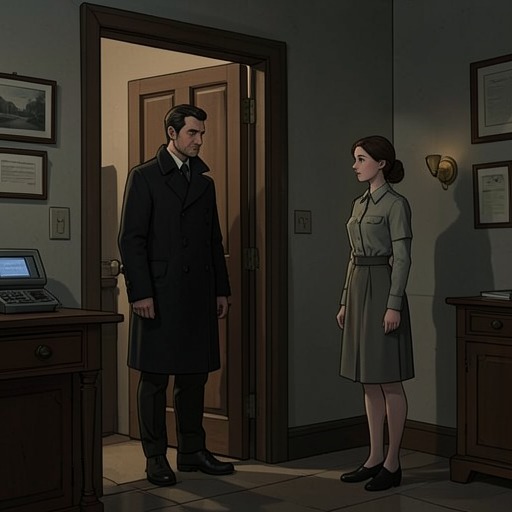
Sohrabji’s daughter arrives unexpectedly at the bar, hoping to surprise her father and take him home. She is due to leave for a long time in only a few days. The bar confronts her with a scene she has never witnessed before: men at different stages of drunkenness, including one who has been lying on the floor and gets up to demand another long drink. At the sight of his daughter, the drink measure in Sohrabji’s hand trembles and spills some of its contents onto the table. Her presence briefly interrupts the bar’s routine, but it does not stop the customers from seeking more alcohol.
She asks her father to come with her. Sohrabji takes her hand and walks out with her, trembling, but tells her to go home. He says he cannot close the bar then because the customers will wreck it. His answer places the demands of the business between father and daughter: even as he accompanies her to the street, he insists that he must return to keep the establishment open. When he gets home, she has already gone to bed.
A Question About Responsibility
Early the next morning, while the mother is still asleep, Sohrabji enters his daughter’s room quietly and asks whether there is something she wants to tell him. She admits that she is afraid. The men she saw in his bar, she says, must have mothers, sisters, wives, and daughters waiting and weeping at home; she wonders whether those women will ever forgive them. Her concern carries the effects of the bar beyond its customers and its owner. It makes visible the absent households whose distress is hidden while the customers drink.
Sohrabji has never considered the matter in that way, and at first he cannot answer. His daughter’s question remains with him after she leaves. She travels by train to Bombay and then sails to England, while he stays behind, seeing the sadness on her face and recalling the question in her eyes. Her departure does not resolve the confrontation; it removes her from the room but leaves her challenge present in his thoughts.
Selling the Bar, Losing the Proceeds
Sohrabji tries to defend himself by reasoning that customers come of their own accord, order their own drinks, and could leave after one. If he refused them service, he tells himself, they would simply go to another bar. He also argues that their wives and daughters might stop them, and that he only sells drinks. These explanations shift responsibility toward the drinkers and their families, but they do not persuade him. The harder he argues his case to himself, the more insistently his daughter’s question returns.
His unease takes the form of fear and dreams: he imagines the mothers, sisters, wives, and daughters of the customers cursing him through their tears, and fears that their curses might reach his own family, including his daughter. In desperation, he sells the bar. That night he writes to his daughter, still asking how the blame can be his if the customers come voluntarily and damage their own families. The letter preserves the unresolved contradiction: the sale is an action prompted by the question of his responsibility, while his written defense continues to deny that responsibility.
He plans to put the sale proceeds in a bank and support his small family with them. Two days after he deposits the cheque, the bank fails. Sohrabji wonders whether this loss is connected to the curses and weeping that have been haunting him, but the episode does not establish that it is. The immediate consequence is material: the money he hoped would provide security is gone, his daughter’s education still needs to be paid for, and he needs a job. Without education, he sees little prospect of finding other employment.
Return Behind the Bar
Sohrabji is forced back to work behind a bar, now as an employee rather than its owner. He tells the narrator that he is no longer responsible for anything, reasoning that a curse directed at the bar will not affect him. The distinction offers him a boundary between selling drinks as a business owner and serving them for wages, but it does not mean he has escaped the work. The bar remains, and he returns to it because his family still needs support.
When Sohrabji makes this claim, his eyes are closed, perhaps in prayer. He insists that working there cannot be wrong when he has a family to maintain. Yet his earlier inability to convince himself, and the fear that followed his daughter’s departure, keep that reassurance from sounding settled. Selling the bar changes his position but not the pressure shaping it: he is still caught between earning a living and the harm he has been made to see. The episode’s ending is therefore a constrained return, not a moral resolution. His daughter’s question has altered how he understands the business, but poverty and obligation bring him back to the same kind of work with a new explanation for why he bears no responsibility.