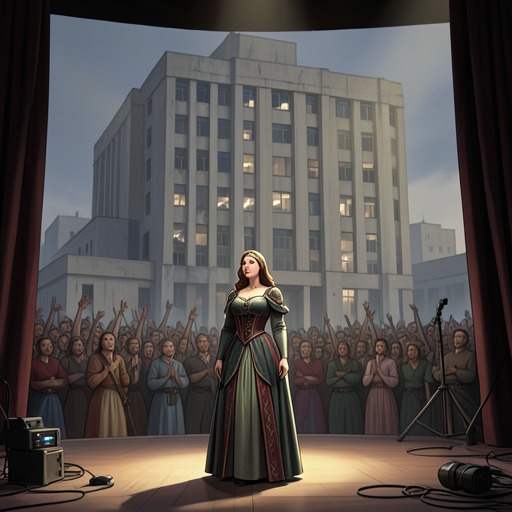
Connie's First Song-and-Dance Performance at the Shahjahan
ChowringheeConnie’s first song-and-dance performance at the Hotel Shahjahan turns a philanthropic banquet into a staged encounter between an audience hungry for spectacle and a performer whose work depends on managing that appetite. The show proceeds through deliberate misdirection: the narrator announces Connie, a tiny, top-hatted figure appears instead, and the real Connie eventually takes the stage. As the performance grows more physically provocative, the guests’ restraint gives way to excitement, while the narrator and hotel staff keep the evening moving from the edges of the stage.
The banquet and the staged introduction
The performance takes place during a formal banquet organized by the Sociedad Filantrópica, an international organization that has recently opened a Calcutta section. Agarwalla, Langford, and Khan Bahadur Huq welcome guests at the counter, dressed in different combinations of Indian, Western, and Mughal styles. The gathering presents itself as service to humanity: its attendees are described as putting aside personal troubles and pleasures to spend the evening in the interests of society, the nation, and the world. Against that high-minded framing, the entertainment will make the guests’ appetite for bodily spectacle unmistakable.
The hotel’s preparation is exacting and labor-intensive. Bose-da has the banquet room ready, and Nityahari’s three hundred and fifty boar heads are set out for the feast. As the hour advances toward ten, Ram Singh, Tobarak Ali, and the other glass boys work frantically amid tobacco smoke and the clatter of dinner plates. The narrator is called upon when Bose-da, suffering from a severe cold and coughing too much to speak, can no longer carry the announcement. Marco Polo agrees to give the younger employee his chance. The narrator takes the microphone as Gómez’s band plays, signals for the orchestra to stop, and addresses the assembled guests beneath the bright lights.
The introduction is itself part of the act. The narrator praises the French chef’s cooking and the wines before presenting Connie as an extraordinary woman. In the room, however, the announcement immediately creates an expectation the show will manipulate. The lights go out; a brief murmur of anticipation falls silent, then a spotlight searches across the stage without settling on its subject. The uncertain light makes the audience wait for Connie while withholding her from view.
The false Connie and the real entrance
When the light finally intensifies, there is no woman onstage. Instead, a half-metre-tall performer in evening dress struts beneath a tall top hat, carrying a cane. He climbs onto a chair and begins an introduction that breaks down into hesitation over whether the announced performer is a man or a woman, before insisting on Connie’s stage identity. The audience responds with boos and demands for Connie, treating the substitution as an insult rather than recognizing it as a planned deception.
The narrator supports the ruse by pretending to be as bewildered as the guests. He reports that he had seen Connie in her dressing room only minutes earlier, dressed and ready, and that she had sent him to announce her. His feigned confusion helps extend the audience’s uncertainty; the little performer then takes the lowered microphone and claims that a mistaken pill explains the appearance. The excuse sustains the comic confusion, but it does not quiet the room. The performer dances, and protest rises again.
The reversal comes when a spotlight finds Connie seated on a man in the front row, her arms around his neck. She wears a tiara and necklace, and a multicolored robe covers her from neck to ankles. She draws the captive guest toward the stage and greets the audience. He struggles free and returns to his seat out of breath. The narrator resumes his role as emcee, presenting the guests as kings for Connie’s performance. The language of royal privilege turns the banquet’s male audience into participants in the show, even as Connie controls the entrance, the captive guest, and the attention fixed upon her.
Audience participation and bodily spectacle
Connie’s first dance in the heavy, long robe gives the crowd less movement than it expects. She answers the audience’s curiosity about her measurements by inviting someone to measure her, first addressing a mathematics teacher and then an experienced accountant; neither invitation receives a response. The jokes make measurement part of the performance while exposing the audience’s interest in her body. Her playful address keeps the men in the room implicated as spectators, rather than allowing their desire to remain unspoken.
The narrator announces that the dance is about to begin after the dwarf has finally been removed. Connie smiles at him, sheds the heavy robe, and dances to Gómez’s band as it plays a rhythm intended to stir the audience’s animal passions. She moves off the stage and sits on one guest’s lap, then takes a handkerchief from a neighboring man to wipe away sweat. When another guest calls to her from behind, she flies in his direction and sits on his lap as well. The stage is no longer a fixed boundary: Connie carries the performance among the diners, making proximity and touch part of the spectacle.
In a later routine, the lights dim and the sound of a necklace fills the room. When the lights slowly return, Connie appears wearing no clothing beneath hundreds of balloons. Colored lights mingle with the balloons’ colors as she dances among the guests, handing one man a pin and inviting him to burst a balloon. Another guest is invited to do the same. As the balloons disappear, more of her body is exposed, and the narrative registers a mounting frenzy among the men. The act makes the crowd’s participation literal: the guests help uncover the performer, one puncture at a time.
The interruption and its aftermath
When only three balloons remain, older guests push forward to burst them. The lights go out as the last balloons pop. In the darkness Connie slips on the carpet and falls while trying to escape. The narrator helps her stand; she asks for her robe, and he hands it to her. She runs out of the banquet room. When the lights come back, the narrator describes recovering his awareness; one of Connie’s shoes is nearby, while Gómez and his assistants put their instruments away with their eyes lowered. The performance ends not with a composed curtain call but with a fall, a hurried exit, and the visible traces of the act left behind.
The first act is subsequently declared over. At the narrator’s signal, the electricians switch off the lights to preserve Connie’s modesty; when they come back on, she is backstage, wrapped in a robe and breathing hard. She asks where Harry is, and the response is that no ordinary person can keep him under control and that anger may have taken him anywhere. The exchange carries the scene beyond the public show into its unsettled backstage circumstances. The banquet has demanded an orderly succession of food, music, and entertainment, but the workers must manage a performer catching her breath and an absent, angry Harry as well.
The sequence sets the banquet’s charitable self-image against the practical and bodily terms of its entertainment. Connie controls entrances, jokes, movement through the room, and the invitations that turn guests into actors in her routine; yet the exposure and the fall also show the cost and vulnerability built into the spectacle. The narrator’s microphone work, Bose-da’s direction, Gómez’s band, the electricians’ cues, and the staff’s continuing labor all help make the performance appear seamless. Its final darkness briefly conceals Connie, but the abandoned shoe and the hurried request for her robe leave the backstage reality in view.