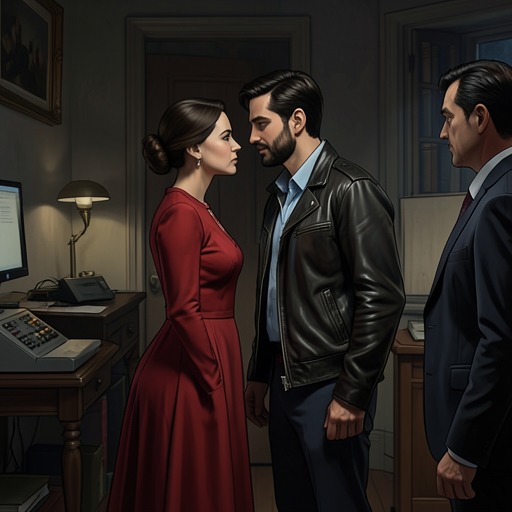
Lambreta Bursts Drunk into Shankar's Room and Connie Takes Him Away
ChowringheeLambreta’s drunken intrusion into Shankar’s room exposes the violence concealed beneath his comic stage act and the humiliation that fuels his anger. After performing for Calcutta’s banquet guests, he waits for Shankar on the rooftop with a bottle of liquor, follows him into his room, and threatens to retaliate against the people he calls animals. Connie’s arrival changes the scene: she quiets Lambreta, then lets Shankar see that the public’s mockery has wounded both of them.
Setting: From banquet spectacle to the rooftop
The disturbance follows a lavish Hotel Shahjahan banquet hosted by the newly established Calcutta branch of the international Philanthropic Society. Its organizers and prominent guests presented the evening as a sacrifice of personal pleasure in service of humanity. Satyasundar Bose punctured that polished account for Shankar, pointing out that the city’s charity parties repeatedly drew the same guests and that newspaper accounts, including prepared speeches and summaries, were effectively written before the event began. The contrast matters to Lambreta’s later outburst: the people gathered to perform concern for humanity have, in his view, treated him as less than human.
The banquet’s carefully staged entertainment included Connie’s appearance. Shankar introduced her to the audience in language that presented her as a singular spectacle, and the lights went out before a wandering spotlight searched the stage. At first Connie could not be seen; instead, Lambreta appeared in evening dress, with an unusually tall top hat and a cane. The visual switch between the anticipated female performer and the tiny man in formal costume made the audience’s attention part of the act. The episode later turns that attention from amusement into cruelty.
After the performance, Lambreta was still dressed in his costume when Shankar found him sitting on the rooftop floor with a bottle. He spoke to himself and drew Shankar’s attention to the moon. Shankar, exhausted and not in the mood to look at it, asked whether Lambreta was going to bed. Lambreta followed him without invitation into his room. There, the clown who had made hundreds of Calcutta residents laugh earlier in the evening seemed to have vanished; his eyes appeared frightening, and his presence made the room feel unsafe.
The intrusion and its threat
Lambreta said he had been waiting for Shankar and warned him not to invite anyone to sit on Connie’s lap again. Shankar could not understand the accusation: he had not done so. Lambreta’s warning therefore establishes a grievance that is personal and protective, even as his drunkenness makes it difficult for Shankar to follow his reasoning. Rather than explain himself calmly, Lambreta widened his attack, condemning the people of Calcutta as animals and insisting that their parents had been animals too.
He then danced in his peculiar style and sang about everyone being animals, directing Shankar toward a brothel or, at least, a hotel as proof. The performance was no longer a controlled number for banquet guests. In Shankar’s room, its gestures and language came with menace: Lambreta seemed ready to break things, and Shankar had to go for Gurberiya because he could see no other way to manage him. Even the man assigned to deal with the disturbance responded with alarmed humor, wondering whether God was causing trouble; Gurberiya was convinced that Lambreta was an avatar of the Creator.
The scene’s shifts in scale sharpen its unease. Onstage, Lambreta’s height, costume, cane, and dancing made him an entertaining spectacle. In the cramped private room, the same performer was an intoxicated man with a bottle, a grievance, and the capacity to frighten the hotel worker trying to sleep. His words turn the audience’s dehumanizing gaze back on Calcutta, but they do not make him safe: his threat to smash the people he calls animals is itself an expression of uncontrolled violence.
Connie intervenes
When Connie came up to the rooftop, Gurberiya objected to a woman arriving so late, expecting the sensual figure from the performance. Instead, Connie appeared in a nightgown and silk sleeping cap. The difference between her stage image and her private appearance is central to the interruption. The woman who had entertained the city’s elite only hours before was now concerned with locating Lambreta and asking whether he had attacked Shankar.
Shankar explained that Lambreta refused to leave and was spilling whisky on his bed. Connie apologized, entered the room, and called Lambreta Harry. The name revealed to Shankar that Lambreta had another name, while Lambreta’s startled look showed that Connie’s arrival had altered the balance of the encounter. He clutched the bottle to his chest and continued to protest, threatening to soak Shankar’s pillows with beer and wash his jacket in rum. His anger was directed not only at Shankar: he complained that he alone was being blamed, although someone had called him a chimpanzee and the bystanders had said nothing.
Connie asked Shankar to wait outside. He did so, and in less than a minute she had calmed Lambreta. The abruptness of the change is significant, but the account does not disclose exactly what she said or did. When Connie invited Shankar back in, Lambreta was quiet. He then left for his own room, sobbing like a child and repeating the hurt caused by being called a chimpanzee. Connie followed to speak to him, but he shut the door in her face. His anger had subsided enough for him to withdraw, but not enough for him to accept comfort.
Aftermath and significance
Left on the rooftop, Connie stood still and began to cry. She told Shankar that people were brutal and explained that a man had asked, in front of Harry, whether her clown was a man or a trained chimpanzee. The insult turns the episode’s earlier spectacle into its moral center: Lambreta’s costume and performance may invite attention, but the audience’s comparison strips him of personhood. His drunken rage is not excused by this injury, yet the revelation makes its source legible and shows why Connie had intervened with such urgency.
Shankar apologized for disturbing Connie, explaining that he had called her because Lambreta had refused to remain in his own room. Connie accepted that explanation and recognized that Shankar had worked hard all day before being troubled by Harry. Her response places the incident within the hotel’s overlapping burdens: a performer’s public exposure and private hurt, a colleague’s exhausted attempt to keep order, and a woman repeatedly summoned to contain the consequences. The scene moves from staged laughter to an unguarded disclosure of humiliation, without turning that disclosure into a neat reconciliation. Lambreta retreats behind a closed door; Connie is left crying; Shankar has witnessed the distance between the clown presented to the banquet and the injured man the audience refused to see.