opening meditation
Cosmic Origin
The narrator begins with the [Big Bang](entity:expression-recall-expression-big-bang-18a298bdd823) and the mystery of space expanding into itself. Scientific cosmology becomes a theological pressure point: if the universe contains everything, what could lie beyond it, and what kind of God could govern such immensities?
early in the story
Pemberton's Urban Ministry
Thomas Pemberton, an Episcopal priest in [New York City](entity:location-recall-location-new-york-city-65df0a129d4c), moves through a life of parish duties, hospital visits, social dinners, and private despair. He addresses God through notes, emails, and observations, treating the city as both his parish and his investigative field.
early in the story
Moira's Invitation
At a dinner party Pemberton recognizes his attraction to Moira, a quiet and apparently self-contained woman. Their mutual glance leads to lunch at the [Metropolitan Museum of Art](entity:location-recall-location-metropolitan-museum-5d395d33ba18) and eventually to an affair, exposing Pemberton's hunger for an authentic life beyond his marriage.
shortly after Moira's invitation
The Affair with Moira
Moira visits Pemberton's apartment and submits to a sexual relationship that quickly unsettles his idealized image of her. Instead of liberation, intimacy brings dependence, guilt, and the recognition that both lovers are acting inside lives structured by illusion and power.
early in Pemberton's investigation
The Stolen Vestments
Pemberton discovers that church robes, altar candlesticks, and pantry goods have been stolen from [St. Timothy's Episcopal Church](entity:location-recall-location-st-timothy-s-episcop-e61688d18f8e). His amateur investigation turns the parish's decline into a mystery and prepares the larger symbolic theft that follows.
after the vestment thefts
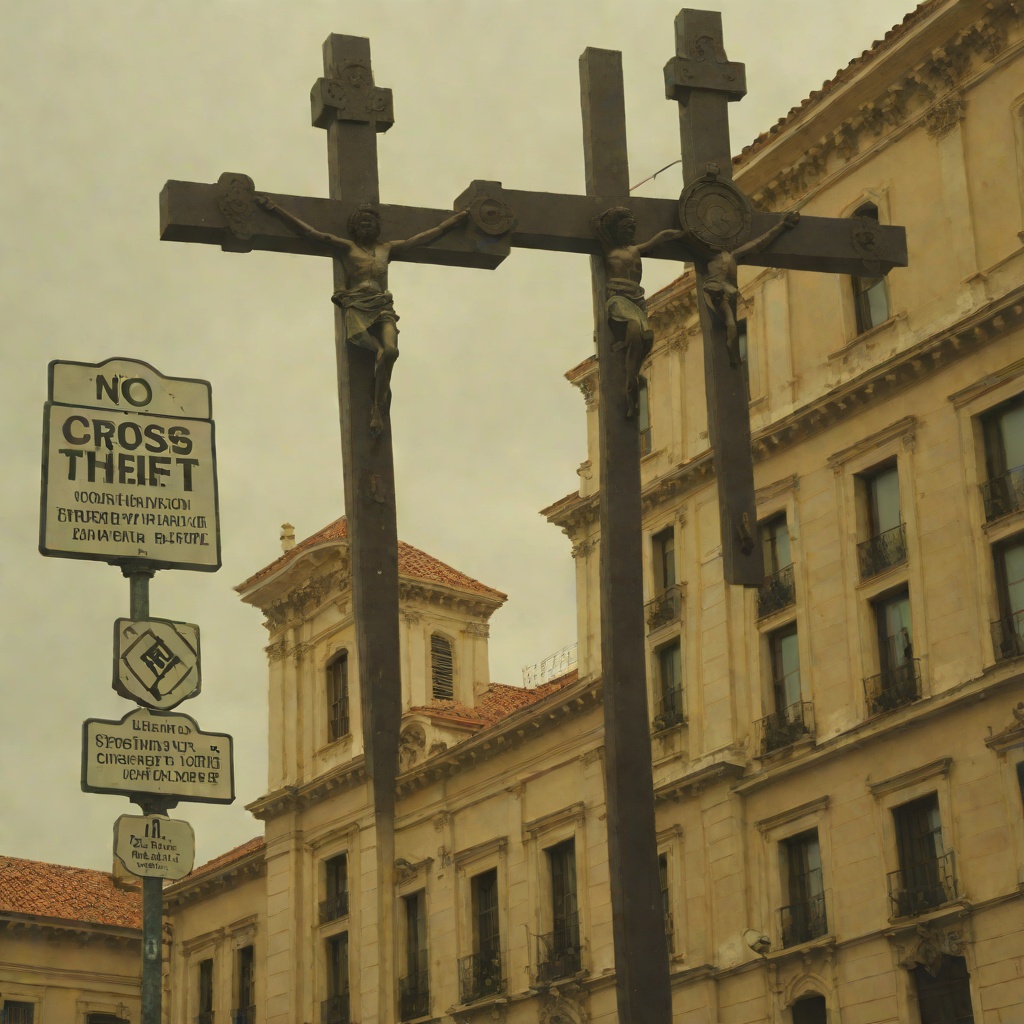
The St. Timothy's Cross Heist
Intruders break into [St. Timothy's Episcopal Church](entity:location-recall-location-st-timothy-s-episcop-e61688d18f8e) and steal its large brass cross. The police regard it as nearly worthless scrap metal, while Pemberton begins to imagine that the thieves may have carried Christ into a place where he is needed.
during the cross investigation
Pemberton's Hospital Ministry
Pemberton visits a terminal parishioner who angrily rejects his pastoral presence. Nearby he observes a Black congregation praying over its hospitalized minister, an image of faith that intensifies his longing for conviction while deepening his suspicion of inherited religious formulas.
after the hospital visit
Theological Doubt
Pemberton drafts a sermon asking whether faith must be blind and whether God is merely a story told by frightened human beings. He questions Christian exclusivity, religious authority, and the possibility of speaking truthfully about a God too vast for doctrine.
shortly after the theft
The Cross Appears
Rabbi Joshua Gruen calls Pemberton to the roof of the [Synagogue of Evolutionary Judaism](entity:location-recall-location-synagogue-of-evoluti-044361faabee), where the stolen cross lies beside the pediment. An anonymous caller had warned that the roof was burning, and the cross now appears as an assault, a warning, or an enigmatic sign.
immediately after the cross's appearance
The Interfaith Investigation
Pemberton and Joshua examine competing explanations for how the cross reached the synagogue roof. They consider anti-Semitism, Orthodox Jewish opposition, and Christian supersessionism, while Sarah Blumenthal insists that the congregation must refuse the identity of victim.
after the cross controversy
Pemberton's Defiant Sermon
Pemberton preaches that Christianity must confront what the Holocaust did to its story of Christ. He proposes radical forms of Christian repentance and argues that a civilization capable of Auschwitz cannot simply return to inherited consolations.
after the defiant sermon
The Bishop's Examination
Pemberton faces ecclesiastical scrutiny for his theological provocations. He argues that intellect cannot be excluded from faith, that biblical narratives are constructed stories, and that Christian doctrine has been shaped by political struggles for institutional power.
before Pemberton's formal removal
The Newark Sermon
Pemberton later identifies a sermon in Newark as a possible final cause of episcopal action. There he asks what ritual or moral response Christianity owes the murdered Jews of Europe, refusing to let the Holocaust remain only a Jewish theological problem.
after the bishop's scrutiny
Pemberton's Personal Collapse
His marriage has failed, his parish has been weakened, and his own beliefs have become unstable. Pemberton nevertheless continues to pray and to investigate the stolen cross, treating detection as a humble discipline through which revelation might still arrive.
following the cross investigation
The Evolutionary Synagogue
Pemberton becomes increasingly involved with the [Synagogue of Evolutionary Judaism](entity:location-recall-location-synagogue-of-evoluti-044361faabee), whose members study biblical sources, contradictions, and the historical formation of doctrine. The congregation seeks a faith intellectually honest enough to survive modern knowledge.
during Pemberton's association with the synagogue
Sarah's Religious Program
Sarah explains that the synagogue retains the Shema, Kaddish, [Shabbat](entity:rule-recall-rule-shabbat-24ebe1cb46fa) reflection, and study while treating many inherited practices as historically contingent. She believes religious life must return through irreverence to unmediated awe.
midway through the modern narrative
The Holocaust Archive Story
The novel turns to Sarah's father, who recounts his childhood in a Lithuanian Jewish ghetto. His memories connect Pemberton's spiritual crisis to the historical catastrophe that destroyed European Jewish life and made inherited Christian theology morally suspect.
during World War II
The Ghetto Childhood
Sarah's father remembers being a child in the [Kovno Ghetto](entity:location-recall-location-kovno-ghetto-8f5044aecddc), where his parents were forced into labor and he studied secretly from salvaged books. He experiences the ghetto as both a prison and a distorted continuation of ordinary life.
during the ghetto's early years
The Burning of the Ghetto Hospital
German forces burn the ghetto hospital with patients and staff inside, killing more than sixty people, including children. The atrocity destroys Sarah's father's belief that the council's negotiations can preserve any shared humanity with the occupiers.
after the hospital burning
The Parents Disappear
Sarah's father returns from a day in which his parents fail to come home. He is told that they may have joined the Resistance, but he knows they are probably dead and nevertheless continues waiting for them.
shortly after becoming an orphan
Yehoshua's False Identity
The [Kovno Ghetto Council](entity:organization-recall-organization-kovno-ghetto-cou-2984b05bcae1) gives the boy the name Yehoshua Mendelssohn and places him with the tailor Srebnitsky, whose own grandson Yehoshua was murdered. The borrowed name preserves his life while binding him to another family's loss.
during Yehoshua's concealment
Srebnitsky's Skepticism
Srebnitsky teaches the boy to read the Bible critically, exposing contradictions and human authorship. His skeptical theology offers Yehoshua a strange consolation: God must be sought in creation and consciousness rather than accepted through unquestioned scripture.
during Yehoshua's ghetto life
The Grundig Radio
Josef Barbanel secretly installs a [Grundig radio](entity:object-recall-object-grundig-radio-178982c66d4e) in the [Council Runners](entity:organization-recall-organization-council-runners-305fc6b5b0d5)' dormitory. British broadcasts connect the isolated children to the wider war, while Yehoshua begins to imagine numbers as universal truths through which God might still be recognized.
late in Yehoshua's time with the tailor
Srebnitsky's Commission
S.S. Major Schmitz commissions Srebnitsky to make a uniform. The tailor accepts the work because survival requires usefulness, yet the commission also brings the enemy into intimate contact with the hands that have kept him alive.
immediately before the tailor's execution
Srebnitsky's Defiance
When Schmitz refuses to pay, Srebnitsky slashes the newly tailored uniform and calls the officer a thief of Jewish labor and life. The act is both rage and calculated sacrifice: he refuses murder but publicly rejects submission.
the following dawn
Hanging of Srebnitsky
The Germans hang Srebnitsky before the ghetto population and display his body as a warning. Yehoshua witnesses the execution, understands the tailor's act as self-sacrifice, and carries the memory of his ordinary care for him beyond the spectacle of death.
after Srebnitsky's execution
Yehoshua Joins the Runners
The Council gives Yehoshua a runner's cap and recruits him into the [Council Runners](entity:organization-recall-organization-council-runners-305fc6b5b0d5). He now carries warnings, summonses, and secret messages, becoming both a child entrusted with adult knowledge and an instrument of the ghetto's fragile administration.
during Yehoshua's service as a runner
Barbanel's Secret Archive
Josef Barbanel secretly records the ghetto's regulations, deaths, crimes, and testimonies. His archive transforms desperate survival into historical resistance, insisting that the victims' experience must outlast the regime that intends to erase it.
late in the ghetto's existence
Yehoshua's Archive Smuggling
Yehoshua carries sections of Barbanel's archive out of the ghetto through an abandoned viaduct and across the river. Disguised as a Lithuanian boy, he delivers the documents to Father Petrauskas at [Church of St. Theresa](entity:location-recall-location-church-of-st-theresa-bd6e1e6d81db).
before the ghetto's liquidation
The Jewish Partisans Arrive
[Jewish partisans](entity:organization-recall-organization-jewish-partisans-2576ec23d088) secretly enter the ghetto and urge the council to let residents escape into the forests. Their offer creates a moral crisis: remaining may preserve communal order, while leaving offers freedom at the price of nearly certain hardship and danger.
after the partisans' meeting
The Partisan Escape
The council informs selected residents that escape is possible, and roughly two hundred fifty people leave in stages. Yehoshua remains because he is bound to the council, to Barbanel and Greta, and to the lingering presence of his dead parents.
near the end of the occupation
Liquidation of the Ghetto
As the German front collapses, the ghetto is sealed and then emptied by force. Residents are driven from their homes, marched across the bridge, and loaded into boxcars; Yehoshua loses his runner's cap and understands that his identity has been stripped away.
immediately after the ghetto's liquidation
The Boxcar Journey
Yehoshua travels in a packed freight car among the living, dying, and dead. Through a narrow opening he reports glimpses of farms and roads, preserving a connection to the world outside even as the deportees are reduced to anonymous bodies.
interwoven historical reflection
Einstein's Childhood
The novel imagines Albert Einstein's childhood in [Ulm](entity:location-recall-location-ulm-31809e47debc) and [Munich](entity:location-recall-location-munich-a2858688fbfd), his experience of paving stones, music, schooling, and authoritarian discipline. His scientific thought becomes another route toward the mystery of creation and another challenge to traditional religious language.
interwoven historical reflection
Wittgenstein's Philosophy
Ludwig Wittgenstein is presented through numbered propositions, memories of [Vienna](entity:location-recall-location-vienna-bce4fdda6904), the Great War, poverty, silence, and philosophical isolation. His insistence on the limits of language frames the novel's recurring question of what can be said about God and what must remain silent.
throughout the intellectual narrative
The Anthropological Crisis
Scientific ideas about relativity, quantum mechanics, neutrinos, dark matter, and the anthropic principle are repeatedly connected to theology. The novel treats modern science not as a replacement for awe but as evidence that the universe exceeds every inherited image of God.
during World War I
Ben's Trench Survival
The narrator recounts his father Ben Doctorow's service as a naval observer in the trenches. When German troops overrun his position, Ben survives by shouting orders in Yiddish, exploiting the soldiers' assumption that he is a German officer.
during World War II
Ronald's B-17 Mission
The narrator's brother Ronald flies a B-17 mission over Germany. After the aircraft is crippled by fighters and the crew suffers heavy losses, Ronald takes the controls, helps the plane continue, and later bails out into a storm.
later in the same World War II mission
Ronald's Bailout
Ronald parachutes into darkness and lands among the bones of an earlier war. French civilians rescue him, hide him, and help him return to the Allied lines, while the narrator reflects on how individual experience resists transmission through conventional war stories.
after Joshua's investigation begins
Pemberton's Search Abroad
Joshua travels to [Vilnius](entity:location-recall-location-vilnius-68a17096d19d) to recover the ghetto diary and is attacked outside an abandoned synagogue. Pemberton later follows the trail, questioning priests, diplomats, caretakers, and former witnesses in an increasingly urgent effort to recover historical evidence.
during Joshua's search in Vilnius
The Beating of Joshua Gruen
Joshua is found with a fractured skull, broken ribs and arms, a collapsed lung, and pneumonia. His assault turns the search for the archive into a personal tragedy and leaves Sarah widowed while Pemberton inherits the unfinished investigation.
shortly after the beating
Joshua's Death
Joshua dies after surgery and a coma. Sarah's loss becomes the emotional center of her continuing religious work, while Pemberton's friendship with Joshua and his love for Sarah become inseparable from the duty to recover her father's historical record.
after Joshua's death
The Priest's Secret
A Lithuanian caretaker reveals that Father Petrauskas hid Jewish writings in a locked chest. The priest had sheltered Jews and preserved their testimony, but Soviet soldiers later removed the chest as potentially valuable intelligence.
after Pemberton's Vilnius search
Recovery of the Archive
Pemberton traces the chest through [Moscow](entity:location-recall-location-moscow-b59c72aac896) and negotiates its release from [KGB](entity:organization-recall-organization-kgb-7a6cfca0c71a) holdings. The recovered materials include Barbanel's diary, German orders, witness testimonies, and a dossier identifying Schmitz as the ghetto commander.
at JFK Airport after the recovery
The Archive Opens
At [JFK Airport](entity:location-recall-location-jfk-airport-9a6174ef2246), customs officials and a Justice Department attorney open the chest under controlled conditions. The papers and photographs confirm the scale of the ghetto's destruction and provide evidence capable of reopening the case against Schmitz.
after the archive's recovery
Schmitz's Death
Pemberton learns that Schmitz has died peacefully in a Yonkers nursing home before the evidence can bring him to trial. The discovery frustrates the possibility of legal closure and exposes the gap between historical truth and justice enacted in time.
after Schmitz's death
The Closure Man
A retired New York Times editor decides to become a [closure man](entity:concept-recall-concept-closure-man-fb4633011dcf), pursuing uncompleted stories about unpunished war criminals. He travels to [Cincinnati](entity:location-recall-location-cincinnati-dc980234df99) to confront a former S.S. sergeant, believing that direct action can complete what journalism leaves unresolved.
during the closure man's Cincinnati mission
The Cincinnati Bicycle Killing
The retired editor accidentally—or perhaps instinctively—rides into the elderly former S.S. sergeant and kills him. The victim's identity as a suspected Kovno executioner turns an apparent accident into a morally ambiguous act of vigilante closure.
after the Cincinnati killing
The Guatemalan Colonel's Death
Emboldened by the bicycle death, the [closure man](entity:concept-recall-concept-closure-man-fb4633011dcf) targets a Guatemalan colonel operating a restaurant in [Queens](entity:location-recall-location-queens-6c6ea4959925). He confronts the man, spits in his face during a struggle, and later learns that the colonel died from the impact.
late in Pemberton's spiritual crisis
Pike in the Desert
Pemberton and the narrator discuss Bishop James Pike, who rejected major Christian doctrines, sought the historical Jesus, and died in the Israeli desert after becoming lost. Pike's fate becomes a warning against confusing spiritual authenticity with a literal return to origins.
after recovering the archive
Pemberton Leaves the Church
Pemberton formally resigns from the priesthood, abandoning his clerical identity while retaining his hunger for God. The decision leaves him uncertain how to inhabit ordinary life without the collar, cross, and institutional permission that once authorized his compassion.
after Pemberton's resignation
Deconsecration of St. Timothy's
[St. Timothy's Episcopal Church](entity:location-recall-location-st-timothy-s-episcop-e61688d18f8e) is deconsecrated and becomes a theater. Pemberton's former sacred space survives as a performance venue, confirming the novel's sense that religious forms do not disappear but are transformed into other kinds of public storytelling.
after leaving the priesthood
Pemberton's Conversion Studies
Pemberton begins studying Judaism with a rabbi other than Sarah. He embraces the intellectual and ethical seriousness of [Evolutionary Judaism](entity:concept-recall-concept-evolutionary-judaism-e3c744a1b458) and considers the [Mikvah](entity:rule-recall-rule-mikvah-1d80baaad7ea), while recognizing that his conversion is inseparable from both Sarah and his desire to repair Christian history.
during Pemberton's conversion studies
The EJ Debate
At a crowded synagogue meeting, congregants debate whether ritual practices such as [Kashrut](entity:rule-recall-rule-kashrut-314014a32e17), the [Minyan](entity:rule-recall-rule-minyan-7c1274a9e5a5), and traditional blessings are essential or merely inherited forms. Sarah argues that Judaism must preserve ethical seriousness while remaining open to historical knowledge.
during the EJ debate
Murray Seligman's Speech
Murray Seligman, once Pemberton's awkward classmate at the [Bronx High School of Science](entity:location-recall-location-bronx-high-school-of-f5e5759d1336) and now a Nobel Prize-winning physicist, unexpectedly argues for a larger conception of God than the ancient titles Lord or King can contain. His appearance becomes a possible sign in Pemberton's theology.
after Seligman's speech
The Urban Sign
Pemberton interprets the cross on the synagogue roof and Seligman's appearance as signs that reveal themselves through ordinary modern culture rather than supernatural spectacle. He believes revelation must now be democratic, cryptic, and discoverable in the streets.
after the EJ synagogue debates
The Wedding Decision
Pemberton and Sarah decide to marry in a civil ceremony. Their union joins grief, religious reconstruction, and personal desire, while Sarah's choice of Joshua's sister as best woman acknowledges the dead husband whose absence made the marriage possible.
at the wedding reception
The Wedding Prayer
At the reception Pemberton delivers a final Christian prayer before completing his conversion. He condemns the century's killers, confesses humanity's complicity, asks for a remade God, and pleads for a place on which frightened people can stand.
after the wedding
Pemberton's Conversion
Pemberton completes his movement from Christianity toward Judaism, describing the new faith as Christianity without Christ and as a return to one God without mythological overburden. His conversion is both a theological reorientation and an act of historical reparations.
late in the novel
The City of Birds
The narrator imagines [Valdemingomez](entity:location-recall-location-valdemingomez-ca0c75c83c7a) as a [City of Birds](entity:concept-recall-concept-city-of-birds-9d0839fc6d4a), where storks, hawks, gulls, ravens, and songbirds thrive among human refuse. The vision reverses the hierarchy of civilization, suggesting that life adapts beyond human meanings and may constitute its own form of communal intelligence.
near the ending
The City as Over-Brain
Observations of ants and [Central Park](entity:location-recall-location-central-park-552b924273db) crowds lead the narrator to imagine [New York City](entity:location-recall-location-new-york-city-65df0a129d4c) as an [urban over-brain](entity:concept-recall-concept-urban-over-brain-79ce272d4886). Individuals retain private wills, yet their movements create a collective intelligence that is invisible to any single participant.
near the ending
The Movie as Organism
The narrator imagines [movies as a life form](entity:concept-recall-concept-movies-as-a-life-form-e4b44c6b1648) that has forced humanity to invent, reproduce, and feed it with images. Cinema absorbs cities, landscapes, and human experience, turning reality into a sequential planetary organism.
final movement
The Modern City
The novel surveys the modern city as a vast accumulated creation of infrastructure, institutions, commerce, memory, and danger. Its beauty appears as the work of an [unremarked God](entity:concept-recall-concept-unremarked-god-94f3708f7fef), yet its fragility reveals how easily civilization can become a machinery of exclusion and violence.
ending projection
The Apocalyptic City Film
The narrator imagines a future film in which megacities overflow, climate catastrophe and economic collapse destroy ordinary institutions, and religious prophets call for the city's destruction. At the brink of totalitarian rule, the story introduces a progressive Jewish couple as possible protagonists of a new sacred narrative.