Apostolic Constitution governing the conclave
ConclaveThe Apostolic Constitution governing the conclave is the procedural framework for electing a new Pope and one of the principal instruments through which the novel stages a conflict between institutional rules and urgent judgment. It governs the ballot itself, sets limits on how a stalled election may proceed, and authorizes discussion in exceptional circumstances. Its authority is not merely ceremonial: characters invoke its provisions both to include an elector and to resist changes that might leave the eventual Pope’s legitimacy in doubt.
The Constitution as a procedural rulebook
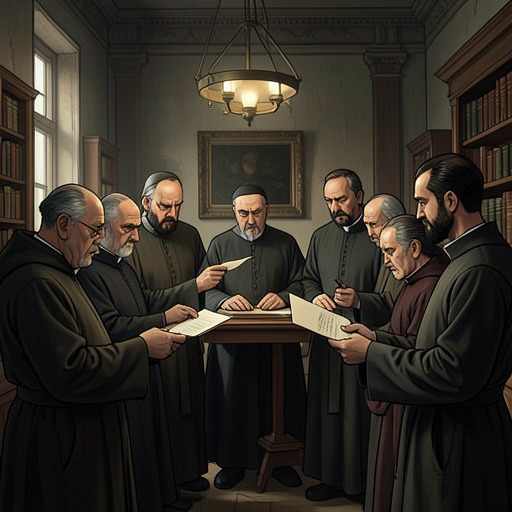
The Constitution is repeatedly consulted as a working manual. As dean, Jacopo Baldassare Lomeli explains the ballot to the assembled cardinal-electors by directing them to Chapter Five, paragraph sixty-six. He tells them to write one candidate’s name on the ballot, conceal their choice, and make their handwriting unidentifiable. The ballot is then folded, displayed, carried to the altar, and deposited according to a prescribed sequence.
The Constitution also specifies the oath accompanying each vote. An elector calls Christ as witness and judge, affirms that the vote is given to the candidate he believes should be elected before God, places the ballot in the receptacle, bows at the altar, and returns to his seat. By reading the procedure aloud, Lomeli turns the rules into a common ritual: a private choice is made secret, but its submission is public and formally ordered.
Its provisions also allow a vote to be postponed if a member of the conclave objects. After an unusually long day, following a meditation that has unsettled the assembly, Lomeli asks whether anyone wants to delay the first ballot until the next day. The cardinals decide to proceed. The rule creates room for a pause without requiring one, placing the choice in the hands of the assembled electors rather than making the timetable wholly automatic.
Admission and the force of legal interpretation
The Constitution’s rules determine who may participate as well as how voting is conducted. When the status of Vincent Benítez is challenged, Lomeli points to a recent revision of canon law concerning in pectore appointments. He then cites paragraph thirty-nine: a cardinal-elector who arrives re integra, before a new pastor has been elected, may join the election at the stage it has reached. On that basis, Lomeli declares Benítez legally entitled to vote.
The episode shows the Constitution operating through interpretation as well as text. Lomeli’s opponent distinguishes papal infallibility in doctrine from the validity of appointments; Lomeli answers that the question is governed by canon law and that the cited provision applies. The rule does not settle the dispute by itself: its force depends on whether the circumstances meet its terms and on who is entitled to interpret them. In the novel, that argument makes procedural inclusion a direct test of the conclave’s legitimacy.
Deadlock and the timetable of election
The Constitution prescribes what happens if no candidate obtains the required support. During the first ballot, thirty-four cardinals receive at least one vote, and no candidate comes close to the seventy-nine needed to win. Lomeli’s tally shows Tedesco with twenty-two, Adeyemi with nineteen, and Lomeli himself with five; Bellini finishes behind Adeyemi, while thirty-eight votes are distributed among other candidates. The fragmented result makes the rules governing subsequent ballots immediately consequential.
Lomeli consults paragraph seventy-four and sees how long the process could last. The electors must continue seeking a two-thirds majority, for as many as thirty ballots over twelve days. Only after that period may they use a different system in which a simple majority can elect the Pope. The prospect alarms him: an election could continue far beyond the duration of any modern conclave he knows, prolonging uncertainty while the Church lacks its new leader.
Later, Lomeli uses the same timetable to explain why he does not want to become a candidate. He says he lacks the spiritual depth for the office and cannot win, but also stresses the danger of an extended deadlock. If the cardinals fail to decide, the Constitution requires pauses between further rounds of voting; only after the full sequence can the threshold change. The procedural schedule therefore shapes not just the mechanics of election but the political and pastoral pressure surrounding it.
Emergency, deliberation, and legitimacy
The Constitution’s authority becomes most difficult to navigate when coordinated attacks in Europe strike while the conclave is in progress. Lomeli confronts the contrast of black smoke from the bombed Roman piazza and black smoke from the Sistine chimney. Suspending the conclave would express respect for the victims but prolong the leadership vacuum; accelerating the vote would breach the Constitution. He fears that a Pope elected through a process whose legality could be questioned would face challenges to his decrees from the beginning of his pontificate.
Rather than simply suspend or accelerate the election, Lomeli seeks authorization to address the crisis. He invokes paragraphs five and six, which permit certain matters or problems to be discussed in special circumstances if a majority of the assembled cardinals agrees. He puts the question to a vote despite Tedesco’s attempt to interrupt. Many electors support hearing the information; a smaller group, including Tedesco, raises its hands against. The proposal carries, and no one leaves when Lomeli says that those unwilling to listen are free to do so.
This sequence reveals the Constitution as both a constraint and a means of action. Lomeli cannot treat emergency as permission to discard the election rules, but he can use the Constitution’s own provisions to convene discussion and obtain collective authorization. Its procedures preserve the distinction between responding to an extraordinary event and bypassing the legal basis on which the new Pope will govern.
Institutional accountability and narrative significance
The Constitution’s procedural world sits beside a wider institutional struggle over information and accountability. A prepared timeline of the late Pope’s final evening records his supper with Janusz Woźniak, his reading, the discovery that he had no vital functions, the emergency treatment, and the time he was pronounced dead. Woźniak later tells Lomeli that after the death Cardinal Tremblay took control and privately asked what the Pope had discussed at supper; Woźniak withheld details because he was frightened and believed he was not supposed to know about the matter. These scenes do not establish that the Constitution governs the handling of the Pope’s death, but they contrast formal procedure with the fragility of accounts shaped by shock, secrecy, and personal authority.
A similar tension appears in the financial records hidden in the late Pope’s bed. They list apartments occupied by Curia members and report that the Apostolic See’s property holdings had a potential value exceeding €2.7 billion, against a stated book value of €389.6 million, with paid occupancy estimated at 56 percent. In recalling the late Pope’s pontificate, Aldo Bellini describes demands for transparent accounts, outside tenders, receipts, and professional scrutiny of Curia files, followed by leaks and growing isolation. These details broaden the novel’s concern with governance: written rules can define authorized action, but effective accountability also depends on accurate information and on people willing to disclose it.
Across the conclave, the Constitution gives opposing pressures a shared point of reference. It supplies a fixed ballot ritual, a threshold for election, a possible route through deadlock, and procedures for participation and emergency discussion. Yet the chapters also show that its protections depend on interpretation, cooperation, and confidence that the rules have been followed. The eventual question is not simply whether the electors can choose a Pope, but whether they can do so through a process credible enough to sustain his authority.