Sheng Di Di Xun Nan
ConclaveMichelangelo’s painting of Saint Peter’s crucifixion gives Jacopo Baldassare Lomeli a visual and spiritual point of orientation at a moment of uncertainty. Its gaze draws him into prayer; its image of a saint enduring violence without surrendering his composure becomes, for Lomeli, a sign that the conclave must continue.
The Painting and Its Gaze
The fresco depicts roughly fifty figures watching as Saint Peter’s cross is hauled upright. Peter alone looks beyond the scene, not straight at the viewer but from the corner of his eye. Lomeli reads this sidelong glance as a challenge to the living: the saint seems to have noticed someone passing and dares him not to turn away. The painting’s composition makes its historical violence feel present without showing Lomeli a simple, direct address.
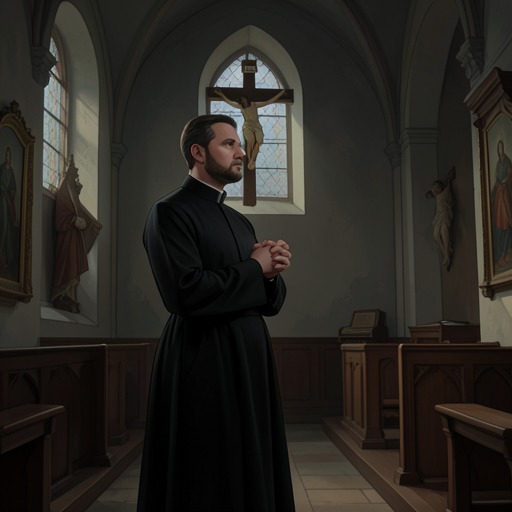
The connection is immediate and unusually powerful for him. He removes his biretta and kneels before the fresco, turning contemplation into prayer. He asks Saint Peter, guardian of the heavenly kingdom and shepherd of Christ’s flock, to lift him from sin, protect him from adversaries, and show him what to do. The prayer places Lomeli’s personal uncertainty within the language of the Church’s founder and its spiritual duties.
A Sign Read in the Image
When Lomeli returns to the painting, he interprets details that had previously seemed ordinary in a new way. The dark forms near its top, once understood by him as clouds, now appear to be smoke. He imagines a fire beyond the frame, unseen but legible through its consequences, and reads it as a symbol of violence, battle, and strife. This interpretation makes the painting’s darkness speak to the danger facing the present world without claiming that the fresco depicts that danger literally.
Peter’s posture supplies the counter-image. Although he is being raised feet-first, he strains to keep his head upright and level. Lomeli sees this effort as resistance: Peter refuses to let violence dictate his inward balance, using his remaining strength to express faith and humanity. The saint’s physical composure becomes an ethical example, not a denial of suffering.
Prayer and Resolve
Lomeli spends at least ten minutes kneeling and praying, so absorbed that he does not hear the cardinals being led away through the Sala Regia to the minibuses, or notice O’Malley enter and come up behind him. The scene marks a change from searching for direction to believing he has found it. Lomeli experiences peace and certainty, and concludes that he knows what he should do.
He then shares his reading of the fresco with O’Malley, urging him to take strength from it. Lomeli presents Peter’s example as a sign for the present: even while evil threatens to turn the world upside down, believers must keep their reason and faith in Christ. His conclusion is practical as well as devotional: the work God expects of them remains to be completed, and the conclave will go on.
Narrative Significance
The painting links private prayer to public responsibility. Lomeli’s encounter begins in silence before an image and ends in a declaration to O’Malley about continuing the election. The fresco does not resolve the surrounding danger; it gives Lomeli a way to meet it without surrendering either faith or judgment. Its central contrast—violence overturning the world while Peter struggles to remain upright—becomes the pattern through which Lomeli understands the task ahead.