Letter of appointment
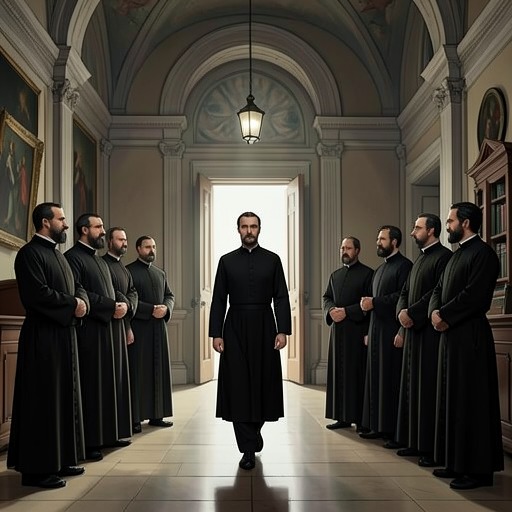
ConclaveThe Letter of appointment is the late Pope’s secret authorization naming Vincent Benítez as a cardinal. Addressed to the Archdiocese of Baghdad and kept there at the Pope’s request, it turns Benítez’s unexpected arrival into a matter not just of identity but of canon law: the document supports his credentials, while the election rules determine whether he may join a conclave already underway.
Purpose and custody
The appointment belongs to the practice of creating a cardinal in pectore, or privately, without disclosing the person’s name. When an unlisted archbishop arrives during the preparations for the election, he says he was made a cardinal in this way. Archbishop Mandorff reports that Benítez carries a letter from the late Pope addressed to the Baghdad archdiocese, where it had been kept secret at the Pope’s request. The letter is part of a package of documents that also includes a seal of office.
The secrecy explains why Benítez was absent from the organizers’ list, but it also makes verification essential. Mandorff treats the letter, seal, and Benítez’s position as archbishop serving in Baghdad as mutually reinforcing signs that the claim is genuine. The document is thus both a private record of papal intent and practical evidence in an urgent institutional dispute.
Authentication and admission
Jacopo Baldassare Lomeli examines the papers and judges them to look authentic. He initially considers whether the newcomer could be an impostor, but the evidence changes the question from whether Benítez has credentials to whether those credentials can be recognized under the conclave’s rules. Lomeli concludes that the cardinals have no choice but to admit him if the appointment was indeed the Pope’s intention.
A further challenge comes from Aldo Bellini, who privately asks whether admission is necessary. Lomeli answers not by claiming that a pope’s appointments are covered by doctrinal infallibility, but by invoking canon law. He cites paragraph thirty-nine of the Apostolic Constitution: a cardinal-elector who arrives re integra, before a new pope has been elected, may participate at whatever stage the election has reached. On this interpretation, Benítez is legally a cardinal and may enter the conclave.
Consequences and significance
The letter makes a concealed decision consequential after the Pope’s death. Because the appointment was withheld even from close associates, the document must bridge the gap between the Pope’s private intention and the election’s public procedure. Its authority does not rest on secrecy alone: it must be supported by credible papers and applied through a rule governing late-arriving electors.
The episode presents the letter as an instrument of institutional continuity, but also as a test of judgment. Lomeli’s decision honors the late Pope’s documented intention while relying on a specific legal provision rather than personal preference. By allowing Benítez to participate, the letter changes the composition of the election and gives effect to a cardinal’s appointment that would otherwise have remained unknown.