Secret Files of the Pope
ConclaveThe late Pope’s hidden archive is a concealed collection of financial records and investigative papers found inside the bedposts of his room. Its significance lies not only in the evidence it preserves—on Church property, clerical wealth, and alleged vote-buying—but in what its discovery forces Jacopo Baldassare Lomeli to do: breach the seals on the papal apartment, weigh the limits of secrecy, and place the documents before his fellow electors.
Discovery and Physical Form
Searching the bed after praying for guidance, Lomeli first checks beneath the frame and mattress, then examines the carved bedposts. On the right side of the headboard, a small carved disc in the oak beading moves under his fingers. Pressing it does not immediately reveal the mechanism; when he takes hold of the post to climb down from the mattress, its top comes away in his hand.
Inside the hollow post is a cavity with a flat, unvarnished base and a tiny wooden knob. The knob draws out a fitted, plain wooden case about the size of a shoebox. Within it, Lomeli finds several dozen rolled documents: bank statements, money transfers, apartment addresses, and pages marked in the late Pope’s small, angular handwriting. He later finds concealed compartments in the bedposts on the opposite side of the headboard and at the foot of the bed, drawing out a second, third, and fourth container. The archive is therefore not a single misplaced file but a deliberately distributed cache.
Property and Financial Records
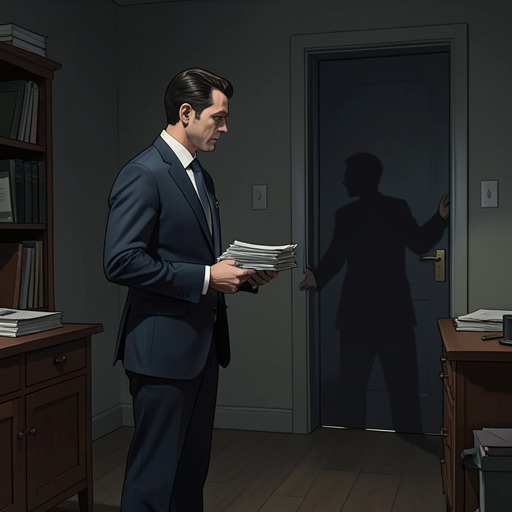
One document lists official apartments occupied by serving and retired members of the Curia, based on information prepared for the late Pope by the Administration of the Patrimony of the Apostolic See. The cardinal-electors’ names are underlined. Lomeli’s apartment in the Palace of the Holy Office is listed at 445 square metres; the figures for Aldo Bellini, Joshua Adeyemi, and Joseph Tremblay are 410, 480, and 510 square metres respectively. Against these conspicuously large residences, the late Pope’s own accommodation at Casa Santa Marta is listed as just 50 square metres.
An attached report, marked for the Pope’s eyes only and signed by Special Commissioner D. Labriola, estimates the total area of the Administration’s property at 347,532 square metres. It gives a potential value exceeding €2.7 billion, against a stated book value of €389.6 million, and says that only 56 per cent of the property appears to be in paid occupancy. The report concludes that much of the income may not be properly declared. These figures turn the question of clerical living standards into a question of institutional accounting and potentially missing revenue.
The archive also contains summaries of personal bank records from the Vatican Bank. Lomeli discovers that his own balance is €38,734.76, a figure he had not known; he regards it as all the money he has in the world. Bellini’s recorded balance is €42,112, Adeyemi’s €121,865, and Tremblay’s €519,732. The papers show sharply varying fortunes: Goffredo Tedesco has only €2,821, while the Archbishop Emeritus of Palermo, Calogero Scozzazi, is listed with €2,643,923. The archive also notes that several cardinals from Africa and Asia had deposited substantial sums during the preceding twelve months. A pencilled quotation from the Gospel of Mark accompanies the records, setting the Church’s financial conduct against the scriptural image of a house of prayer turned into a den of robbers.
The Case Against Tremblay
The records become politically decisive when Lomeli connects the bank statements to the allegation that Tremblay bought support in the conclave. He tells Bellini that Tremblay secured votes on the first ballot by paying electors, mostly cardinals from Africa and South America, and says the listed names include Cárdenas, Diène, Figarella, Garang, Papouloute, Baptiste, Sinclair, and Alatas. Lomeli alleges that Tremblay paid in cash to make the transfers harder to trace and that the payments occurred during the last year, when Tremblay may have anticipated the end of the late Pope’s pontificate. Lomeli says he has seen the relevant bank statements; Bellini considers whether the payments might have had legitimate purposes rather than immediately accepting the accusation.
The archive’s evidentiary force is therefore substantial but not self-interpreting. It contains financial records that Lomeli treats as proof, but the implications still require judgment, and the allegations directly affect the election. The documents expose a potential offence against the Church while also creating a risk that private information may be used as a weapon in the contest for office.
The Late Pope’s Campaign for Transparency
Bellini places the cache within the late Pope’s wider struggle to reform the Curia. The pontificate began with a refusal to wear the full regalia of office and a decision to live at Casa Santa Marta rather than the Apostolic Palace. At an early meeting with the prefects of the congregations in the Sala Bologna, the Pope demanded financial transparency, properly maintained accounts, disclosure, outside tenders for building work, and receipts. Bellini recalls that the Administration of the Patrimony had not even been accustomed to keeping receipts. The Pope then brought in accountants and management consultants to examine its files, giving them offices on the first floor of Casa Santa Marta.
That scrutiny provoked resistance and leaks, according to Bellini, who recalls reports about associates diverting funds intended for the poor to renovate apartments or travel first class. Tedesco and his allies also attacked the Pope over his comments on gay people, divorced couples, and the promotion of women. Bellini describes a bitter contrast: the Pope grew more popular with the wider world as he became more isolated within the Holy See, and by the end trusted very few people. The hidden financial files thus emerge from a reform effort that had generated both investigative records and deep internal distrust.
Disclosure and Consequences
After reading the papers, Lomeli returns the first case to its compartment and replaces the top of the bedpost. He continues searching and finds three more containers, extending the discovery beyond the initial property and bank records. The archive has entered the conclave’s crisis not through an official report but through a concealed object in the late Pope’s private room, and Lomeli must decide whether possessing such material creates a duty to disclose it.
He eventually circulates a report to the electors after breaking the seals on the papal apartment. When challenged, he acknowledges both actions and explains that he investigated because an offence that could incur excommunication may have been committed and concealed. He says he has tried to handle the matter responsibly and leaves his fellow electors to decide what weight to give the information. The disclosure divides the room: some cardinals express dismay but leave with signs of approval, while Giulio Sabbadin argues that Lomeli has surrendered a weapon that could have been used to control Tremblay and has instead strengthened Tedesco. Archbishop Fitzgerald, a prominent Tremblay supporter, objects that the report gives Tremblay no opportunity to defend himself. The archive’s consequences are thus immediate and contested: evidence intended to expose possible corruption also raises questions about fairness, secrecy, and the political use of disclosure.