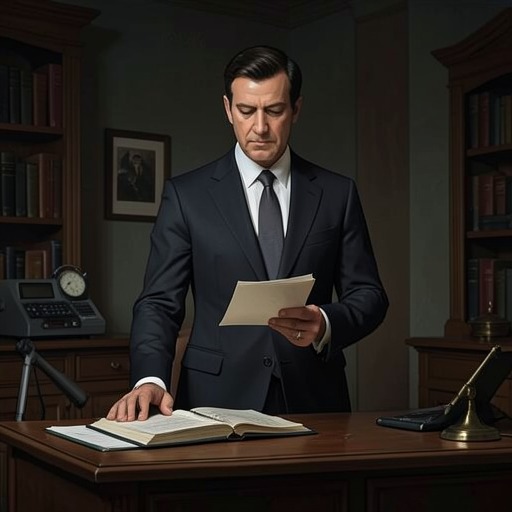
Death of the Pope and declaration of sede vacante
ConclaveThe Death of the Pope and declaration of sede vacante marks both the end of the Pope’s life and the beginning of a contested transfer of authority. In the early hours, Jacopo Baldassare Lomeli reaches the Pope’s bedroom expecting a medical emergency and finds a deathbed vigil instead. The ritual that follows is precise: Archbishop Woźniak removes the Fisherman’s Ring, Joseph Tremblay breaks its seal, and announces that the throne of the Holy See is vacant. Yet the declaration does not settle the meaning of the death. Lomeli will later confront an official timeline, a private account of the night, and evidence that the late Pope had been investigating the Church’s finances.
The deathbed and the vigil
Shortly before two in the morning, Lomeli leaves his apartment in the Palace of the Holy Office and hurries through the darkened Vatican toward the Pope’s bedroom. He has been summoned by the Prefect of the Papal Household and expects confusion. At Piazza Santa Marta, however, the scene is quiet: an ambulance waits at a discreet distance. Seeing its driver on the phone, Lomeli understands that it has come not to take a sick man to hospital but to remove a body. His anxious prayer had asked that the Pope be spared and that he be taken instead; the ambulance makes the loss plain before he enters the room.
The bedroom, which Lomeli has never seen before, is crowded with officials and clergy. The Renaissance papal bed, with a crucifix above it, occupies almost the whole small room. Aldo Bellini and Joseph Tremblay kneel beside it, while the Pope lies beneath a white counterpane, his hands folded over a plain iron pectoral cross. The bedside contains ordinary traces of a life interrupted: the Pope’s spectacles and a scuffed travel alarm clock. Lomeli’s attention to these details holds the institutional office and the private person together at the moment of death.
After the liturgy, the four cardinals remain around the bed in silent prayer, while the others kneel in the sitting room. Lomeli recalls that his last private audience with the Pope had been on 17 September, after the Mass commemorating the Impression of the Stigmata upon St Francis. He wonders whether the Pope had already sensed that death was near and that his mission would remain unfinished, and whether this might explain an earlier, uncharacteristic irritation. The vigil thus includes not only formal mourning but Lomeli’s recognition that their association had ended without a final private conversation.
The ring and the declaration
The transition from prayer to official action begins when Tremblay calls on Archbishop Woźniak to bring him the Holy Father’s ring. Woźniak has difficulty removing it, working it back and forth over the knuckle before carrying it to Tremblay. From a silver box, Tremblay takes shears and cuts through the ring’s seal, which depicts St Peter hauling in a fisherman’s net. The destruction of the seal is the concrete act that accompanies the formal announcement: “Sede vacante,” Tremblay declares, “The throne of the Holy See is vacant.”
The sequence makes the vacancy both a legal and a material fact. The ring’s broken seal signals that the deceased Pope’s authority has ended; Tremblay’s words name the resulting condition of the Holy See. Lomeli then spends several minutes in contemplative farewell and helps Tremblay lay a thin white veil over the Pope’s face. The vigil dissolves into whispering groups, and mourning gives way to the business of the transition.
The official account and the disputed memory
The death is followed by the construction of an official chronology. Tremblay tells Lomeli that errors in the first confusion after an unexpected papal death can generate malicious rumours. He invokes the death of Pope John Paul I, saying that the Church spent decades trying to convince the public that he had not been murdered because no one wanted to admit that a nun had discovered his body. To avoid discrepancies, he presents Lomeli with a freshly printed document headed “Timeline.”
The timeline gives a sequence of events: at 7:30 p.m. the Pope ate with Woźniak in the reserved area of the Casa Santa Marta dining room; at 8:30 he retired to his apartment to read and meditate on Chapter 8 of The Imitation of Christ, “Of the dangers of intimacy”; and at 9:30 he went to bed. At 11:30 Woźniak checked on him and failed to observe vital functions. Dr Giulio Baldinotti began emergency treatment at 11:34, using cardiac massage and defibrillation, and the Pope was pronounced dead at 12:12 a.m. The precision of the printed schedule presents the death as an orderly sequence even as the events surrounding it become a matter of scrutiny.
Later, Woźniak gives Lomeli a different kind of account: not a medical chronology, but a recollection of what happened after he found the Pope dead. He says he summoned the doctor, who in turn summoned Tremblay, as required by the rule that the Camerlengo be the first member of the Curia officially notified of a papal death. Tremblay took control of the situation. About an hour later, he asked Woźniak whether the Pope had seemed preoccupied at supper. Woźniak admits that he had been frightened and had said only that the Pope seemed agitated, withholding details of what he knew. He then saw Tremblay whispering with Monsignor Hector Morales and suspects that Tremblay was persuading the secretary not to speak about a meeting.
The two accounts do not by themselves establish that the official timeline is false or that the death was mishandled. They do, however, place the declaration of vacancy beside questions about who knew what, when they knew it, and how the first account of the night was assembled. Lomeli’s concern is shaped by the lesson Tremblay himself draws from the earlier papal death: discrepancies, even when born of confusion, can become the ground for lasting suspicion.
The hidden papers and the unfinished pontificate
The Pope’s death also gives a later discovery its significance. In the headboard of the papal bed, Lomeli finds a concealed wooden case containing financial documents: bank statements, money transfers, apartment addresses, and the Pope’s handwritten notes. One list compares official apartments occupied by current and retired Curia members. Lomeli’s own apartment in the Palace of the Holy Office is listed as 445 square metres; the entries include Bellini’s at 410, Joshua Adeyemi’s at 480, and Tremblay’s at 510. The Pope’s own accommodation at the Casa Santa Marta is listed as 50 square metres.
An attached report estimates the overall area of the Administration of the Patrimony of the Apostolic See’s property at 347,532 square metres, with a potential value exceeding €2.7 billion but a stated book value of €389.6 million. It gives a paid occupancy rate of only 56 percent and says that much income appears not to have been properly declared. These papers make the death more than the closing of a pontificate: they reveal an investigation left unfinished, one that implicates the administration of Church property and bears on the officials who will take part in the succession.
Bellini later describes the pontificate as a war that began when the Pope rejected full regalia and chose to live at the Casa Santa Marta rather than the Apostolic Palace. He recalls the Pope demanding financial transparency, proper accounts, disclosure, outside tenders, and receipts, then bringing in accountants and management consultants to examine files. The effort provoked hostility within the Curia and was followed by leaks about the misuse of funds. Bellini also describes attacks by Goffredo Tedesco and his allies over the Pope’s views on gay people, divorced couples, and the promotion of women. In Bellini’s account, the Pope became more loved beyond the Vatican even as he grew more isolated within the Holy See and came to trust almost no one. The ring-breaking declaration establishes that the office is vacant; the concealed papers and Bellini’s recollection show how much unfinished conflict the dead Pope leaves behind.