Election of Pope Innocent XIV
ConclaveThe election of Pope Innocent XIV concludes the conclave’s contest not with the victory of one of its established front-runners, but with Vincent Benítez’s election on the eighth ballot. Its decisive turn is both numerical and ceremonial: Benítez receives the required majority, accepts the papacy after a long silence, and chooses the name Innocent. The moment brings a previously obscure candidate to the centre of the Church while leaving Jacopo Baldassare Lomeli, who had also received votes, in the role of the official who confirms the result and asks the new pope to accept it.
Background: an unsettled election
The voting began in a crowded field. On the first ballot, thirty-four cardinals received at least one vote, and the support was dispersed among candidates, friends, and fellow countrymen. Tedesco, Adeyemi, Bellini, and Tremblay emerged as the main contenders, but none held a clear lead. Lomeli’s own name appeared repeatedly enough to alarm him: in a field so divided, even a modest tally could make him a plausible candidate. The initial result left no one close to the seventy-nine votes needed for election.
The scale of the deadlock was visible in the first-ballot figures: Tedesco received twenty-two votes and Adeyemi nineteen, while Lomeli received five and thirty-eight votes went to others. Bellini, whom his allies had expected to lead, finished behind Adeyemi. Lomeli worried that his own support might have drawn votes away from Bellini, weakening the candidacy that he and others had hoped would prevail. Under the rules he was consulting, the cardinals could be required to continue balloting for as many as thirty rounds over twelve days before a different majority threshold became available.
The next results changed the balance without producing a winner. In the second ballot, Adeyemi gained sixteen votes from candidates who had fallen away, a striking increase, while Tedesco added seven. Bellini’s support barely shifted, and Benítez moved from one vote to two. Later, following the revelation that destroyed Adeyemi’s standing, he lost thirty-two votes; Tremblay gained eleven, Bellini eight, Lomeli six, Tedesco four, and Benítez three. The changing totals made the election a process of alliance and transfer as much as a contest between fixed candidates.
The movement toward Benítez
Lomeli’s personal tally rose as the election proceeded, but his candidacy did not become the solution. In one later count, he had twelve votes and Bellini fifteen. Giulio Sabbadin argued that even a transfer of Bellini’s support to Lomeli would leave Lomeli behind Tremblay and Tedesco. He presented Tremblay as the practical choice: a combined twenty-seven votes from Bellini’s and Lomeli’s supporters, added to Tremblay’s forty, would bring him to sixty-seven, twelve short of the two-thirds majority. Bellini accepted the force of that calculation despite his reservations about Tremblay, reasoning that if the Holy Spirit worked through the conclave, the electors had to accept the direction of the vote.
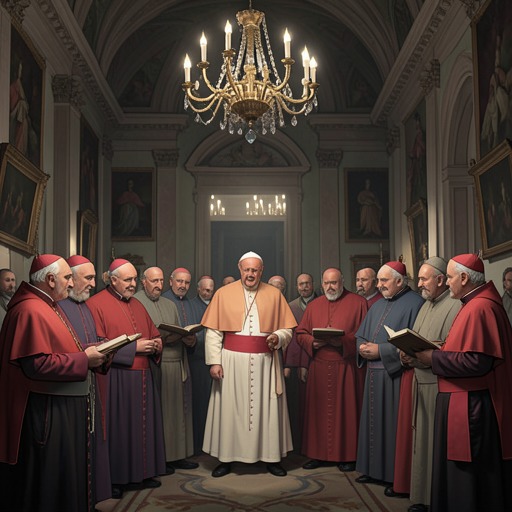
That expectation did not determine the final outcome. On the eighth ballot, Newby announced the result to the assembled cardinals. Benítez received ninety-two votes, Lomeli twenty-one, and Tedesco five. The figures established that the necessary majority had been achieved. Lomeli, who had marked the ballots and received votes himself, applauded vigorously; his response helped prompt the Conclave to rise in an ovation. Tedesco clapped slowly, while Benítez remained seated, his head bowed in prayer. The contrast between the acclaim around him and his stillness made the victory appear less like a personal triumph than an office being laid upon a reluctant recipient.
Acceptance and the choice of name
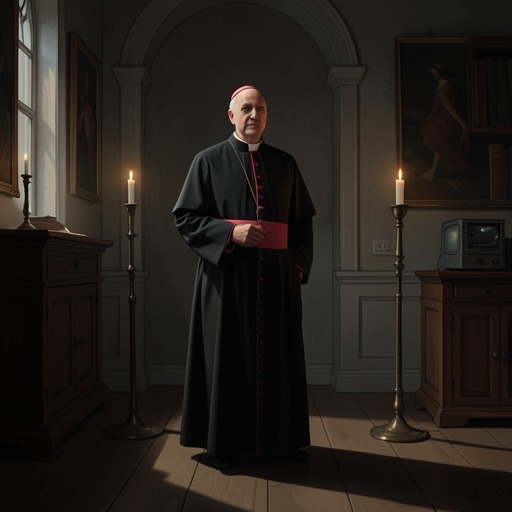
As Dean, Lomeli went to the altar with his copy of the Apostolic Constitution. He announced that the necessary majority had been reached, summoned the officials required for the next stage, and then crossed the aisle to Benítez. In the prescribed question, he asked whether Benítez accepted his canonical election as Supreme Pontiff. Benítez did not initially respond or look up. The silence held the assembled cardinals in suspense, and Lomeli feared that he might refuse.
Lomeli answered the pause by citing the Constitution’s appeal to the elected candidate not to refuse the office for fear of its burden, but to submit to divine will and trust that God would sustain him. Benítez raised his head, stood, and accepted. Applause and expressions of pleasure followed. The exchange made the constitutional procedure more than a formality: the election had produced a majority, but the papacy still required the elected cardinal’s spoken acceptance.
Asked what name he wished to use, Benítez paused before answering, apparently deciding it then. He chose Innocent. The choice drew on an old tradition of taking a papal name from a virtue rather than from a saint, one that had fallen out of use generations earlier. Thirteen popes had borne the name, but none in the previous three centuries. Lomeli understood its resonance amid bloodshed and read it as a declaration of intent: a name that could suggest both a return to tradition and a departure from it. The choice also suited the impression Benítez had made on him, though it did not erase the political and institutional weight of the office.
Consequences and significance
With the choice of name, Benítez became Pope Innocent XIV, the long-awaited Third World Pope. Lomeli privately gave thanks, interpreting the outcome as another instance of divine guidance. The election thus resolves the immediate contest while retaining the uncertainty that had marked it: the cardinals had not simply transferred power to an obvious front-runner, and the result’s meaning remained open to competing hopes about tradition, change, and the Church’s direction.
The scene also reverses Lomeli’s apparent trajectory. He had accumulated enough votes to become a serious presence in the count, and the cardinals around him had presumed that he might be elected. Yet he is the one who formally asks Benítez to accept and then kneels before him. Benítez, in turn, tells Lomeli that he had voted for him in every ballot and would need his advice, asking him to continue as Dean. Lomeli takes his hand and responds that his first advice is not to promise offices yet, then calls for witnesses to draw up the deed of acceptance. The conclave ends in election, but its immediate aftermath is already a question of how the new pope will govern and whom he will trust.