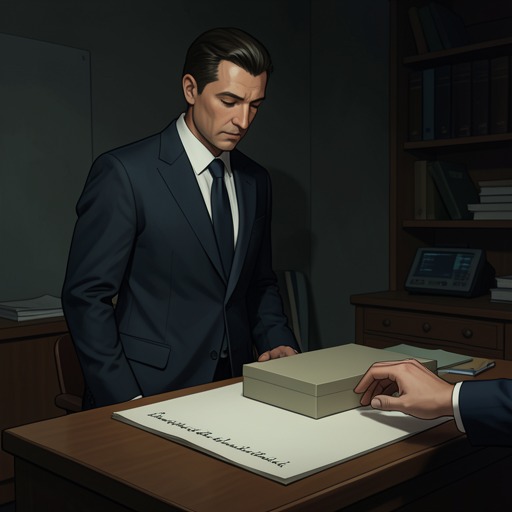
Luomei entered the residence of the late pope
ConclaveJacopo Baldassare Lomeli’s search of the late Pope’s sealed apartment is the moment when a private prayer and a difficult decision lead to material evidence. After weighing whether his duty is only to manage the cardinals’ deliberations or to intervene in their outcome, Lomeli uses a pass key he has kept for months to enter the apartment. The search leads from the Pope’s familiar belongings and an emptied desk to a hidden case in a bedpost, where financial documents substantiate the late Pope’s suspicion that Church property income was not being properly reported.
The Decision to Enter
For several hours Lomeli lies fully dressed on his bed, turning over the pass key Sister Agnes had lent him after he locked himself out of his room. His prayers become a conversation with himself: he asks whether stewardship of the conclave requires him merely to arrange deliberations or also to affect their outcome. He does not expect a sudden revelation; he believes the signs have already been given and that he must decide how to act. Twice he approaches the door and retreats. The key’s presence is itself significant: he had never returned it, and had kept it in his nightstand drawer.
On his third attempt, Lomeli leaves his room after midnight, when the rules require Casa Santa Marta to be empty apart from the cardinals. The nuns have gone to their quarters, while security personnel are either in parked cars or patrolling the perimeter; doctors are on standby in the nearby Palazzo San Carlo, and an emergency is to be reported by pressing a fire alarm. Lomeli first checks that the corridor is deserted, then walks to the late Pope’s apartment. The red votive candles outside the door mark the threshold he is about to cross, and he hesitates once more before turning the key.
Breaking the Seals and Searching the Rooms
Tremblay had sealed the apartment with ribbons and red wax discs bearing the Apostolic Camera’s crossed keys and parasol. The seals are intended as symbols rather than a physical barrier: when Lomeli pushes the door, the wax breaks and the ribbons come free. He crosses himself, enters, and closes the door behind him. The act is deliberate, but the scene does not present it as a casual disregard for procedure; it follows hours of prayer and hesitation over what his responsibility requires.
Inside, the apartment appears as it did on the night the Pope died. Lomeli recognizes the lemon-coloured curtains, blue sofa, armchairs, coffee table, prie-dieu, and desk, beside which rests the Pope’s battered black briefcase. The case holds everyday belongings—a razor, peppermints, a breviary—and a copy of The Imitation of Christ. The Vatican press office had identified the book as the last the Pope read before his heart attack. A yellowing bus ticket from his home city, more than twenty years old, marks the passage “Of the dangers of intimacy.” Its advice to avoid the wealthy and celebrities and to keep company with the poor and devout sits among the few personal traces Lomeli finds.
The desk search yields no concealed paperwork. Its central drawer contains familiar practical objects, including a spectacles case, lens cleaner, aspirin, a calculator, a penknife, and an old wallet with a ten-euro note; another drawer holds signed postcards the Pope gave visitors. The other drawers contain no papers either. Lomeli knows that the Pope had used his predecessors’ office in the Apostolic Palace, walked there each morning with his briefcase, and brought work home to study. He remembers seeing the Pope sign documents at this desk. The empty drawers therefore suggest either that the Pope had stopped working in his final days or that someone had cleared the papers away; Lomeli considers the possibility that his private secretary, Monsignor Morales, had done so.
The Bed and the Hidden Case
Lomeli turns to the bedroom and the old, ungainly bed the Pope had chosen to have moved from the papal apartment to Casa Santa Marta. Generations of popes had slept in it, and its size would have required disassembly to get it through the apartment door. As he had on the night the Pope died, Lomeli kneels and prays with his forehead against the mattress, holding the bed frame. The passage describes a change in his state: he enters in despair and rises with the conviction that the dead Pope has shown him what to do, while leaving open whether this was inspiration or his own imagination.
His first practical thought is to look for a concealed drawer. He feels beneath the frame and lifts the mattress, then turns to the bedposts after those attempts fail. At the right post beside the headboard, a small carved disc feels loose. When Lomeli presses it and takes hold of the post, its top comes away in his hand. The discovery is not a drawer under the mattress but a precisely fitted wooden case hidden inside the post: a small knob set into an otherwise empty cavity releases a plain case about the size of a shoebox.
What the Documents Reveal
Inside the case are several dozen rolled documents. Lomeli unrolls columns of figures, bank statements, money transfers, apartment addresses, and pages annotated in the Pope’s small, angular handwriting. One list concerns official apartments occupied by serving and retired members of the Curia and appears to have been prepared for the Pope by APSA, the Administration of the Patrimony of the Apostolic See. It records Lomeli’s apartment in the Palace of the Holy Office as 445 square metres; the listed apartments of Aldo Bellini, Joshua Adeyemi, and Joseph Tremblay are 410, 480, and 510 square metres respectively. At the foot of the list, the Pope sets his own accommodation at Casa Santa Marta against those figures: 50 square metres.
An attached assessment, marked for the Pontiff’s eyes only, quantifies the concern behind the papers. It estimates the total surface area of APSA property at 347,532 square metres and its potential value at more than €2.7 billion, against a stated book value of €389.6 million. The assessment also identifies a paid occupancy rate of only 56 percent and concludes that much of the income appears not to be properly declared. The documents thus give concrete form to the late Pope’s suspicion: the question is not merely the size of individual apartments, but the gulf between the Church’s property holdings, their stated value, and the revenue recorded from them.
A Pontificate of Transparency and Isolation
The concealed records connect the apartment search to the late Pope’s campaign for financial accountability. Bellini recalls that the Pope began his pontificate by refusing full regalia and choosing to live at Casa Santa Marta rather than the Apostolic Palace. At his first meeting with the congregation prefects in the Sala Bologna, he demanded transparent finances, proper books, disclosed accounts, outside tenders for building work, and receipts. He then brought in accountants and management consultants to examine the files and placed them in offices on the first floor of Casa Santa Marta. The investigation described in the hidden papers belongs to that same effort to make the Curia’s financial practices visible.
Bellini also explains why that effort left the Pope increasingly isolated. Leaks brought public embarrassment over alleged misuse of money intended for the poor, including spending on renovated apartments and first-class travel. Meanwhile, Goffredo Tedesco and his allies attacked the Pope’s remarks on gay people, divorced couples, and women, treating them as grounds for accusations of heresy. Bellini describes the resulting paradox: the Pope was admired more by the outside world as trust within the Holy See diminished. By the end, Bellini is unsure that the Pope trusted even him, and Lomeli adds that he, too, may not have been trusted. The hidden case therefore reveals not only a financial discrepancy but also the paper trail of a pontiff’s lonely attempt to confront institutional opacity.