Election Mass Sermon of Lomei
ConclaveLomeli’s election Mass homily is the first sustained public expression of his conviction that the Church’s unity depends not on enforced uniformity but on the service of different people, mutual tolerance, and a faith able to live with doubt. He abandons a prepared text and speaks from the heart, turning the solemn occasion into a challenge to the cardinal-electors: they should seek not an infallible-seeming leader but a Pope who can acknowledge sin, ask forgiveness, and carry on.
From formal address to unscripted speech
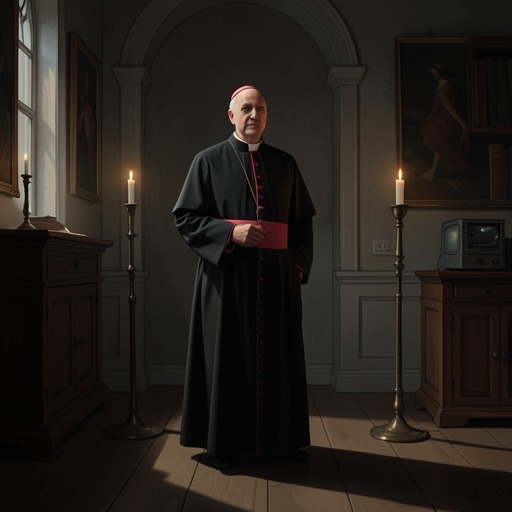
Lomeli begins by reading his prepared homily automatically. Its opening describes the moment as one of great responsibility in the Church’s history. The words seem to him to lose their force in the vast basilica; applause comes only when he praises the late Holy Father’s pontificate, and he must wait for it to subside. The rest of the script offers what he sees as a succession of platitudes. After turning through its pages, he leaves the homily on his throne and faces the microphone again.
The change is both rhetorical and personal. Lomeli tells the congregation that they already know the conventional material and asks to speak from the heart. He pauses to gather his thoughts, but feels calm and certain about what he wants to say. The prepared pages remain behind him, a visible alternative to the argument he chooses to make in his own words.
Diversity as a form of unity
Lomeli builds his case through Paul’s Letter to the Ephesians. He recalls the Church’s varied forms of service—apostles, prophets, evangelists, pastors, and teachers—and stresses that they become one not by performing identical roles but by serving together and building up the body of Christ. The Church’s diversity, in his account, is not a problem to be overcome; it is part of what God has given it.
He extends the image of the Church as a body whose different members each have their own work. Rather than fear this variety, the faithful should recognize that every limb is needed. No person or faction should seek to dominate the rest. The appeal is especially consequential in the setting of a papal election: the cardinals are not simply choosing a captain for one party, but taking part in a collective act whose strength depends on their capacity to work together.
Doubt, tolerance, and the kind of Pope required
Lomeli interprets Paul’s image of the body growing into Christ as a model of collective wisdom. Truth and love hold the community together, while tolerance allows its different members to serve without being forced into a single mould. He connects this to Paul’s instruction that believers should be subject to one another out of reverence for Christ, making humility toward fellow members a condition of unity rather than a concession to weakness.
From that argument he turns to what he calls the sin he has come to fear most: certainty. In his view, certainty is the enemy of both unity and tolerance. He invokes Christ’s cry of abandonment on the cross to argue that doubt is not simply a defect to be purged from faith. Faith remains living because it coexists with doubt; without uncertainty and mystery, he argues, there would be no need for faith.
His conclusion makes the political and spiritual stakes explicit. Lomeli asks that the Church receive a Pope who doubts and, through that doubt, keeps the Catholic faith alive and capable of inspiring the world. He also asks for a Pope who sins, seeks forgiveness, and continues. The prayer rejects the expectation that a leader must appear beyond human frailty, presenting the capacity to acknowledge failure and persist as part of pastoral fitness.
Reception and counterpoint
After the homily, Lomeli retrieves the prepared text he did not deliver and hands it to Monsignor Epifano, leaving the status of the unused document uncertain. A traditional silence of a minute and a half follows. Lomeli cannot tell how the cardinals have received his words, and the quiet may reflect shock; he nevertheless feels closer to God than he has for many months and prays that he has had the courage to say what was in his heart.
The homily’s argument soon meets a direct counterpoint. In a later address, Vittorio Scavizzi objects to Lomeli’s use of Paul as an argument for doubt. Scavizzi describes the Church as the Barque of St Peter beset by competing ideologies and urges the electors to choose a captain who will ignore doubters and hold the rudder fast. Where Lomeli makes diversity and doubt conditions of a living unity, Scavizzi emphasizes doctrinal steadiness against forces he sees as threats. The two speeches turn the election’s disagreement into a contest over what unity requires: room for difference and uncertainty, or firm resistance to them.