First ballot of the conclave
ConclaveThe first ballot of the conclave is the opening test of the electors’ competing expectations, and its result unsettles the apparent contest among the leading candidates without producing a winner. Jacopo Baldassare Lomeli votes for Aldo Bellini, but discovers that he himself has attracted support; Bellini finishes behind Goffredo Tedesco and Joshua Adeyemi, while Joseph Tremblay remains close behind. With no candidate near the 79 votes needed for election, the ballot reveals both the election’s uncertainty and the difficulty of coordinating the many votes scattered among the cardinals.
The vote begins
After a long day of proceedings and a meditation that had sharply affected the assembly, Lomeli offers the cardinals the option of delaying the vote until the following day. The Apostolic Constitution permits postponement if a member objects. Cardinal Krasinski argues that stopping would look odd while the world watched the Sistine chimney, and no one else speaks against proceeding. Lomeli therefore announces the first ballot.
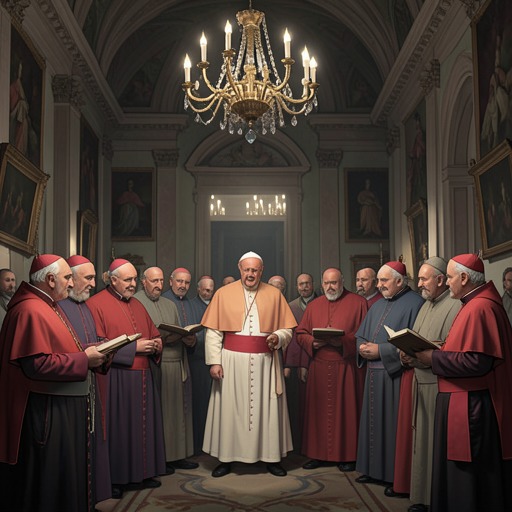
The procedure is formal and public within the chapel. The cardinals are to fold and display their ballots, carry them to the altar, swear that their choice is the one they believe should be elected before God, and place the papers in the urn. Three scrutineers, selected by lot the previous week, oversee the count: Cardinal Lukša, Cardinal Mercurio, and Cardinal Newby. Lomeli writes BELLINI on his own ballot in capital letters and casts it at the altar. A silver chalice serves as the urn’s lid; as the votes are read, the scrutineers record each name, and Newby threads each counted paper onto red silk.
A scattered field and a surprise
The first count does not immediately reveal a clear leader. Thirty-four cardinals receive at least one vote, a number later described as a record. Some electors vote for themselves, friends, or fellow countrymen. Lomeli hears his own name called and marks it on his tally. At first he is touched that someone considers him worthy of the office; when his name recurs, that reaction turns to alarm. In a field this dispersed, even a handful of votes could make a candidate relevant.
After roughly eighty ballots, the likely contenders appear to be Tedesco, Bellini, Tremblay, and Adeyemi. Even when a hundred votes have been counted, none has established a lead over the others. The sequence near the end sharpens the uncertainty: Bellini’s tally stalls, while votes go to Tedesco, Lomeli, Adeyemi twice, Tremblay, and, last, Vincent Benítez. As the scrutineers check their totals, Lomeli adds his own figures and sees that his five votes may have come at Bellini’s expense.
The final distribution confirms a close but fragmented contest: Tedesco has 22 votes, Adeyemi 19, Bellini 18, Tremblay 16, Lomeli 5, and all other candidates together 38. Bellini is third, behind Adeyemi—a result no one had anticipated—and Tremblay is only two votes behind him. The result disappoints Bellini’s supporters: at dinner, Giulio Sabbadin had expected Bellini to lead with as many as 25 votes and Tedesco to receive no more than 15. Instead, the first ballot gives Tedesco the largest single share and makes Adeyemi a serious contender.
The threshold and its consequences
The ballot is inconclusive under the governing rules. Seventy-nine votes are required for election, and no candidate is close. Lomeli consults paragraph seventy-four of the Apostolic Constitution: electors must continue voting for a candidate able to secure a two-thirds majority, potentially through as many as thirty ballots over twelve days. Only after that period may they use a different system requiring a simple majority. The possibility of an election lasting twelve days makes the deadlock more than a matter of arithmetic; it puts the cardinals’ patience and ability to assemble a winning coalition in question.
Lomeli announces the adjournment and reminds the electors that they may not take written records of the vote out of the Sistine Chapel. Their tallies will be collected and burned with the ballots. He also asks them not to discuss the results within earshot of the bus drivers who will take them back to Casa Santa Marta. As officials collect the papers in sacks, some cardinals are reluctant to surrender them, holding on for a few seconds longer. The figures are both a prohibited record and a brief trace of the day each elector may have received a vote for the papacy.
The ballot’s place in the election
The first count sets up the election as a process of changing alliances rather than a straightforward confirmation of an expected favorite. In the second ballot, many of the least viable candidates fall away; Adeyemi gains sixteen votes, and Tedesco adds seven, while Bellini and Tremblay move little. Benítez rises from one vote to two. The first ballot’s scattered support thus supplies the votes that later rounds can redistribute, while its ranking already places pressure on Bellini’s campaign and gives Adeyemi unexpected momentum.
Lomeli’s five votes also alter his own position. At first they register as an unsettling personal possibility; in the tally, they become a strategic cost he fears may have weakened Bellini. Later, when Sabbadin compares the results of a subsequent ballot—15 for Bellini and 12 for Lomeli—he argues that even a transfer of Bellini’s support to Lomeli could not put Lomeli ahead of Tremblay and Tedesco. The first ballot is therefore not merely a count: it is the opening evidence that votes for a candidate can express esteem while also changing the prospects of the candidate an elector intended to support.
The tally is framed against the Church’s institutional vulnerabilities, though the ballot itself does not resolve them. Earlier, Lomeli had been given an official timeline of the late Pope’s final evening, while Archbishop Woźniak later recounts that he withheld details of the Pope’s agitation after Tremblay took control of the death-response process. The late Pope’s in-pectore appointment of Benítez raises a separate question of electoral legitimacy, which Lomeli answers by citing the rule allowing a cardinal-elector who arrives before the election of a new pope to join the conclave. These unresolved matters form the background to a vote whose formal procedure is exact, but whose political meaning remains unsettled.
That tension also reaches beyond the count. A concealed financial file later found by Lomeli records Curial apartments and an APSA estimate that the Church’s property portfolio may be worth more than €2.7 billion despite a much lower book value and a paid occupancy rate of only 56 percent. Bellini recalls that the late Pope had demanded financial transparency and that his reforms left him increasingly isolated within the Holy See. The first ballot does not expose or settle these questions; it begins an election in which institutional trust, legal interpretation, and coalition-building will continue to shape the choice of pope.