European Coordination Terrorist Attack
ConclaveThe coordinated attacks across Europe interrupt the conclave at the moment when the Church is choosing a new Pope, linking a series of assaults on public and religious sites with an immediate dispute over security, religious identity, and the meaning of the election. As information reaches the cardinals, they confront not only multiple attacks and rising casualties but also the danger that a response to violence will turn a specific crisis into a claim of religious war.
Security Before the Attacks
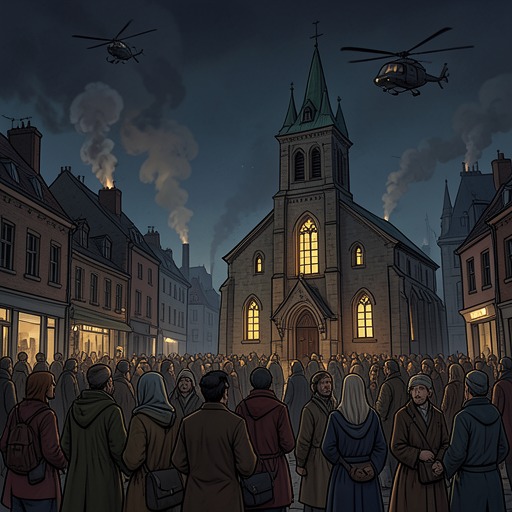
Before the attacks, Italian officials had described the terrorist threat as serious and imminent. Security preparations around Vatican City included surface-to-air missiles and snipers on nearby rooftops, 5,000 uniformed police and army personnel patrolling the surrounding streets, and hundreds of plain-clothes officers mingling with the crowds. A helicopter hovered above the area as the cardinals arrived, while protests on many conflicting social and political causes swelled into a general cacophony. The threats and the disorder formed the setting for a conclave already enclosed against outside communication, but they did not identify what would happen or where.
The attacks make the earlier warning concrete. During the conclave, explosions damage two large windows beside the Sistine Chapel’s stove flue. Broken glass covers the vestibule floor, and security personnel arrive at the door with their guns drawn. Lomeli blocks their entry, insists that nobody has been injured, and calls their intrusion a sacrilege. This brief breach brings the violence to the threshold of the election itself, before the cardinals have received a full account of the attacks beyond the Vatican.
The Attacks and Their Reported Course
The cardinals first hear that a suicide bomber and a car bomb struck the Piazza del Risorgimento, a public square about 400 metres beyond Vatican City’s walls and close to the Sistine Chapel. At least thirty people are reported killed. They also learn of a shooting during Mass at San Marco Evangelista, an attack in Munich at the Frauenkirche, and an explosion at the university in Louvain. Witnesses in the Piazza del Risorgimento report that the bomber shouted “Allahu Akbar.” At this stage, no group has claimed responsibility; the reported words and the locations of the attacks inform the cardinals’ interpretation, but do not by themselves establish who organized them.
Lomeli later presents a summary prepared by the Vatican Press Office in conjunction with the Holy See’s security service. It places the car bomb in the Piazza del Risorgimento at 11:20 in the morning, followed shortly by the detonation of a person carrying explosives as people fled. It reports that two gunmen entered San Marco Evangelista during Mass and were shot dead by nearby security forces. At 11:30, ten minutes after the first bombing, an explosion occurred in the library of the Catholic University of Louvain; an armed man also opened fire inside the Frauenkirche in Munich, where the incident became a siege.
The same briefing gives a developing toll: thirty-eight dead in the Piazza del Risorgimento, twelve at San Marco Evangelista, four at the university in Belgium, and at least two in Munich. Lomeli warns that these figures are likely to rise and that the wounded number in the hundreds. The account therefore distinguishes the early report of at least thirty deaths from a later, more detailed count of at least fifty-six, while making clear that even the later figures remain provisional.
The Conclave Confronts the News
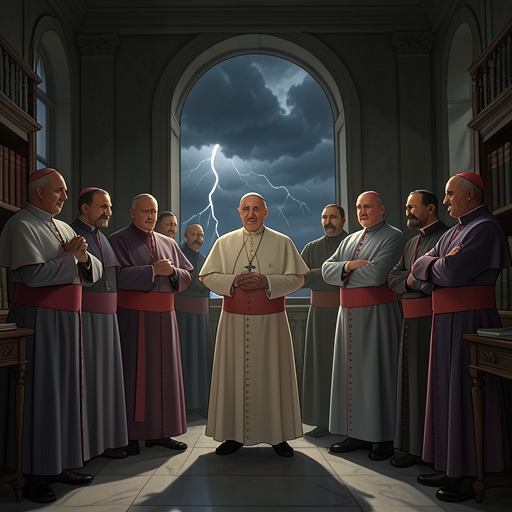
The attacks halt the conclave’s inward focus. Lomeli asks the cardinals to stand for a minute of silence for the dead and injured. Their response is also a contest over whether the news should alter the election: Goffredo Tedesco argues that the Church must not choose a Pope merely because he seems best suited to appear on the balcony and calm the crowd. The Holy Spirit, he insists, cannot be summoned to meet an immediate political need. His intervention places the electoral duty to discern a candidate beside the pressure of a public emergency.
Tedesco then turns that argument against Lomeli. He questions whether the dean is a pastor capable of healing the broken-hearted and attributes the present crisis to what he describes as doctrinal drift and relativism. He connects that charge to the presence of mosques and minarets in what he calls the homeland of the Catholic Church. Aldo Bellini cries out in protest. Tedesco answers by invoking the victims of the Piazza del Risorgimento and San Marco Evangelista, arguing that the Church bears some responsibility for tolerating Islam while Christians are attacked elsewhere. The exchange shifts from the facts of coordinated violence to a sweeping political and religious claim about collective guilt and reciprocal hostility.
Interpretation and Consequences
The attacks become both an immediate security emergency and a struggle over how the violence will be explained. The eyewitness report from the square supports the conclusion that the bomber used an Islamic invocation, while the available information at the meeting does not include a claim of responsibility. Tedesco treats the attacks as evidence for a broad conflict between Christianity and Islam and presents the Church’s tolerance as weakness. Lomeli, by contrast, warns against an emotional response: an assault in Rome is already grave, he says, but interpreting attacks in three countries during the papal election as the beginning of a religious war could lead the world to see the crisis in precisely those terms.
That distinction matters because the attacks occur as the cardinals are selecting the Church’s leader and because one of the most prominent responses urges them to treat the violence as confirmation of an existing civilizational struggle. The event does not resolve that disagreement or establish who organized the attacks. Instead, it raises the stakes of the conclave: the cardinals must continue their election amid loss of life, incomplete information, and pressure to convert fear into a definitive account of what the violence means.