George and Daisy Luttrell's marriage
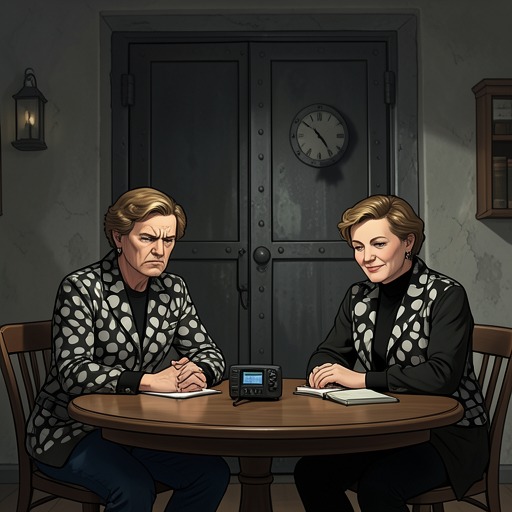
CurtainGeorge and Daisy Luttrell’s marriage is depicted through a sharp contrast between domestic friction and enduring attachment. At Styles, Daisy appears to command both the household and her husband, while George seems nervous and yielding; after Daisy is injured, however, his distress and the couple’s reunion reveal a depth of love that makes the earlier suspicions of a staged response seem grotesque.
The Marriage at Styles
George is introduced as a very tall, attenuated old man with a cadaverous face, mild blue eyes, and a habit of tugging irresolutely at his small white moustache. His vague, rather nervous manner gives him an air of uncertainty even before the marriage’s private tensions come into view. When a sharp cry of “George” rings up from the hall, he starts like a nervous horse and puts a hand to his lips. His immediate anxiety makes Daisy’s voice seem to govern the house, and his response suggests how readily her summons unsettles him.
The setting reinforces the practical pressures around the couple. Styles has become a commercial guest house, and Daisy is alert to the need to make it pay. In a scene overheard from the terrace outside the dining-room window, George opens a cupboard, takes out a bottle, and appears to be preparing to give drinks to people outside. Daisy sharply stops him: drinks must be paid for, she says, and without her business sense he would be bankrupt. She insists that she has to look after him “like a child,” while George offers only an agonized, low protest. Their exchange exposes a household in which Daisy claims responsibility for the finances and casts George as incapable of managing them.
Authority and Conflict
Daisy’s authority is not merely implied by her briskness; she states it outright. When George objects that she is going too far, she challenges his right to decide what happens in the house, asserting that she runs it. The locked door and the argument over the bottle give the exchange a concrete domestic shape: George tries to resist, but Daisy takes control of the immediate situation. To observers who hear only fragments through the open window, their marriage can look like a pattern of domination and helplessness.
That impression is complicated by the differences between the public scene and the later private one. The narrator initially hears Daisy’s voice as sharp and irritating and George’s as subdued, so the couple’s disagreements are filtered through an outsider’s partial view. The same George who seems unable to stand up to Daisy will later express unmistakable fear for her; the change in what can be seen does not erase their quarrels, but changes what those quarrels can mean.
Courtship and Shared Past
After the crisis, George recalls their beginning to Poirot. At a hunt ball, Daisy wore white tulle that seemed to float around her. George remembers being bowled over by her at once and deciding that she was the girl he would marry; he says, with evident pride, that he succeeded. His account preserves the force of youthful attraction within the marriage’s later routines and disputes.
He also remembers Daisy as pretty, saucy, and quick with a spirited reply, someone who gave as good as she got. The present-day sharpness the narrator has observed is thus linked to a quality George once cherished rather than presented as wholly new. The memory makes their relationship feel shared and continuous: the assertive wit that now fuels conflict also belongs to the woman who captivated him. George chuckles as he remembers, speaking as though revisiting the courtship is a pleasure in itself.
Injury and Recognition
When the narrator enters the sickroom, Daisy looks ill, white and frail, with her eyes closed. She opens them and calls for George in a small, breathless voice. One arm is bandaged and supported; with her free arm she reaches unsteadily toward him. George steps forward, clasps her frail hand, and calls her by name before gruffly thanking God that she is all right.
The sight transforms the narrator’s understanding. Looking up at Daisy, George has slightly misty eyes, and his expression conveys deep love and anxiety. The narrator feels ashamed of the group’s “ghoulish imaginings” about the couple and retreats quietly from the room. What had seemed capable of being a camouflaged accident can no longer be read against the force of George’s heartfelt relief; he is not simply performing concern for appearances. The episode does not settle every aspect of their domestic life, but it decisively shows that beneath the quarrels George’s attachment to Daisy is real.
Narrative Significance
The marriage is revealed in stages, and the reader’s understanding changes with the evidence. George’s nervousness, Daisy’s command of the guest house, and their argument over money initially invite a view of him as a passive husband and her as an overbearing one. George’s recollection of their courtship supplies a longer history, while Daisy’s injury brings the relationship into immediate physical focus: her unsteady reach and his clasp of her hand communicate what the overheard argument could not.
The contrast also corrects suspicion through intimacy rather than through a formal explanation. The observers first interpret the Luttrells from outside, hearing Daisy’s rebuke and George’s protests; in the sickroom they witness an unguarded exchange of fear and relief. Their marriage therefore matters not only as a portrait of a bickering couple but as a test of how partial appearances can mislead. Daisy may run the house and speak sharply, yet George’s response when she is hurt reveals the lasting tenderness that their daily conflict had concealed.