Arthur Hastings—Judith Hastings father-daughter relationship
CurtainArthur Hastings and Judith Hastings share a close but uneasy father-daughter bond: he loves her deeply and worries about the intensity she keeps to herself, while she is reserved, self-reliant, and impatient with what she regards as his old-fashioned sentiment. Their affection is real, but it seldom takes the form of easy confidence. That gap becomes painful when Hastings tries to intervene in Judith’s love for Major Allerton and discovers that concern cannot make her disclose what she considers her own secret life.
Identity and Background
Hastings describes Judith as the child he has secretly loved best, while admitting that he has never understood her. She is the youngest of his children still close to him; her brothers and elder sister have established lives elsewhere. Judith, by contrast, has pursued an education and work of her own: she earned a B.Sc. and became secretary to Dr John Franklin, who conducts research into tropical disease. Hastings’s account of her life thus conveys both his pride in her ability and the distance between her independent adult world and his paternal understanding of it.
The difficulty, as Hastings sees it, is not a lack of love but a forceful inwardness. Judith keeps her own counsel, sometimes broods in silence, and can show a fierce, nearly bitter partisanship. Her mother had reassured Hastings that this reserve was not evidence of mistrust; she understood it as a compulsion, though she too worried about the intensity of Judith’s feelings and her lack of an outlet for them. Hastings’s portrait therefore begins with affection shadowed by uncertainty: he wants to protect his daughter, but knows that he cannot easily read her.
Affection and Reserve
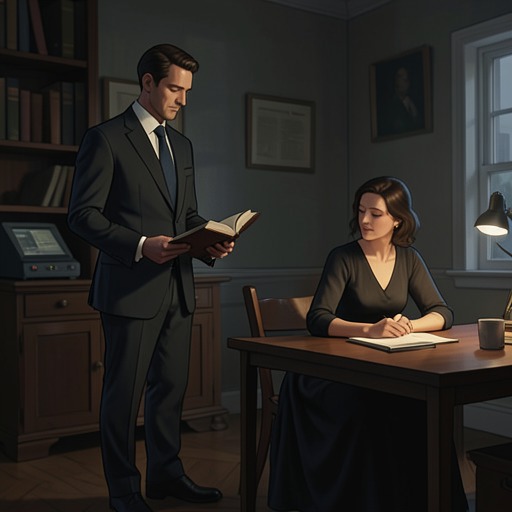
Judith’s reserve is visible even in their reunion. She does not kiss Hastings; instead, she smiles shyly and says, “Hullo, Father.” The greeting is modest, but Hastings reads the embarrassed smile as proof that she is glad to see him. The scene captures the relationship’s characteristic mismatch: Judith offers a restrained sign of feeling, and her father, conscious of how little she displays, searches that sign for reassurance.
Hastings is not wholly confident in his place as her father. Judith is often scornful and impatient of what she calls his sentimental, outworn ideas, and he admits to being a little nervous of her. His love does not remove that apprehension; rather, it sharpens his awareness that she may judge his efforts to help as intrusive or inadequate. Their bond is affectionate, but the authority and familiarity usually associated with parenthood do not guarantee him access to her inner life.
Concern and Conflict over Major Allerton
Hastings’s unease becomes active when he grows concerned about Judith’s attachment to Major Allerton. He has already wondered whether her devotion to her work and to her employer, Dr John Franklin, might be romantic, but the practical footing of their relationship had reassured him. Allerton presents a different fear. Hastings regards his attraction as cheap and hopes Judith is level-headed enough not to be taken in by him; he later recognizes that he raised the subject partly because he wanted reassurance for himself.
His attempt to question her is clumsy despite his effort to sound casual. Judith bristles, confirming the difficulty of the conversation before it can become a calm exchange of advice. Hastings’s motive is protective, but it is also bound up with his need to know what she feels. The scene exposes a limit in his paternal approach: he sees himself as trying to guard her from a poor choice, while she experiences his intervention as a challenge to her right to decide what her attachment means.
The Rose Garden Confrontation
Later, Hastings considers whether speaking to Judith will help or make matters worse. He is tempted to say nothing, but recognizes that silence would be cowardice: he is shrinking from the discomfort of confronting his daughter and is, as he acknowledges, afraid of her. Pacing through the gardens, he reaches the rose garden and finds her seated alone. Her unhappiness is so plain that, to him, the mask has fallen; her distress finally overcomes his hesitation.
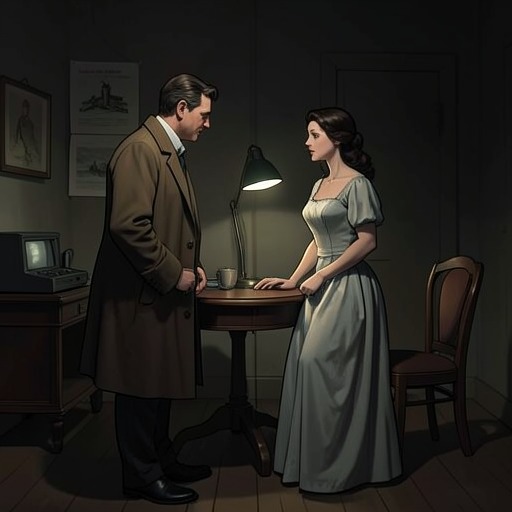
Hastings tries to tell her that he understands and believes Allerton is not worthy of her. The intervention does not comfort her. Judith answers that Allerton is worth everything in the world to her, and when Hastings persists, her smile disappears. She turns on him furiously, tells him not to interfere and never to speak to her about the matter again, and insists that it is her life and her own secret inner life. She then pushes past him and leaves him staring after her, dismayed. The physical gesture gives the conflict a decisive shape: the father who approached in concern is literally put aside when he crosses the boundary she has drawn.
What the Relationship Reveals
The relationship is marked by a recurring contrast between Hastings’s wish to understand and Judith’s determination to keep her feelings private. His love is sincere, but he cannot assume that it gives him a right to her confidence; Judith’s reserve, in turn, leaves him anxious enough to mistake intervention for care that will be welcomed. The difference is not simply between an affectionate parent and an ungrateful child. The narrative shows how tenderness can coexist with misunderstanding, and how an attempt to protect may deepen estrangement when it ignores the other person’s claim to make a life on her own terms.
The contrast between the two encounters clarifies that tension. At their reunion, a shy smile and a brief greeting are enough to reassure Hastings that Judith is glad to see him, although she offers no demonstrative embrace. In the rose garden, by contrast, her unhappiness invites his response, but not the particular judgment he delivers about Allerton. Her anger does not erase the underlying bond; it shows how little that bond can settle the question of what she is willing to share. Hastings remains deeply concerned, yet the final exchange leaves him outside the secret she insists is hers.