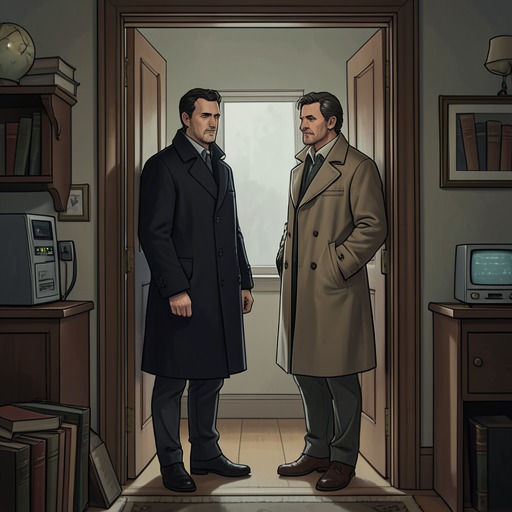
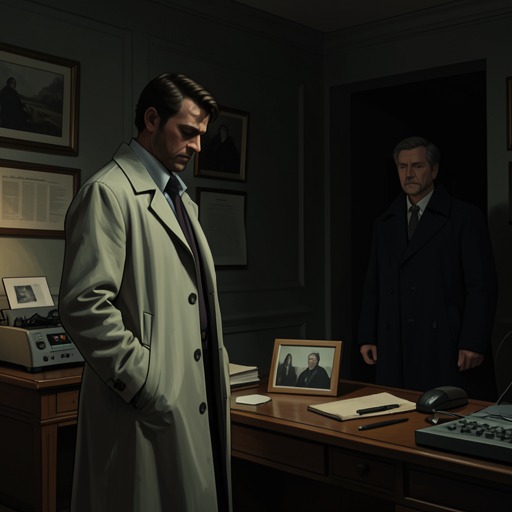
Hercule Poirot—Arthur Hastings friendship and detective partnership
CurtainThe friendship and detective partnership between Hercule Poirot and Arthur Hastings is the emotional and practical core of their return to Styles. First forged in an earlier murder investigation, it has shaped Hastings’s life and brought him to his wife; decades later, Poirot’s physical decline reverses their familiar working arrangement, making Hastings his eyes and ears while Poirot sets the investigation in motion.
Origins and enduring attachment
Hastings recalls meeting Poirot again at Styles after first encountering him in Belgium. The memory is vivid: Poirot, limping and conspicuous beneath his large moustache, approaching along the village street. Hastings describes him not merely as a former colleague but as his dearest friend, whose influence moulded his life. Their partnership in pursuing another murderer also led Hastings to meet the woman who became his wife, whom he remembers as his truest and sweetest companion.
That shared history gives the reunion its emotional force. Hastings returns to Styles as a bereaved man, his wife buried in Argentina, and measures the changes in his life against the possibility of beginning again on the day he first travelled there in 1916. Poirot is bound to that remembered turning point: their friendship connects the earlier case, Hastings’s marriage, and the present visit to a past that cannot be recovered.
Reunion at Styles
When Hastings sees Poirot again, the familiar greeting is tender rather than formal. Poirot addresses him as his friend, embraces him, and repeats the greeting; the warmth of the exchange briefly bridges the years and physical changes separating them. Hastings’s account emphasizes that Poirot’s eyes remain shrewd and twinkling, softened by emotion, even as the rest of his appearance registers his decline.
The reunion soon resumes the investigative pattern that defines their partnership. When Hastings asks why Poirot has come to Styles, Poirot points out that he had not answered earlier and now gives his purpose: he is there to hunt down a murderer. Hastings is astonished and momentarily wonders whether Poirot is rambling, an initial reaction that shows how unexpectedly the old detective’s determination emerges from his frail condition.
A partnership with reversed roles
At Styles, Poirot is crippled with arthritis and uses a wheelchair. His body has grown thin, and Hastings recognizes that the physical man has changed markedly, although he believes Poirot’s mind retains its former keenness. The practical consequences are immediate: Hastings understands that he must take a more active part than before and serve as Poirot’s eyes and ears.
Poirot’s dependence is also social and investigative. On fine days, Curtiss carries him downstairs and wheels him into the garden; in poor weather, he is taken to the drawing room. Visitors may sit and talk with him, but he can no longer choose for himself whom to draw into a private conversation. Hastings’s mobility therefore gives the partnership a new reach: he can move through the house and observe people in ways Poirot cannot.
Poirot spells out that assignment with characteristic directness. Hastings is to identify a potential victim, follow people, talk to them, and listen to conversations without being noticed. Poirot even lists spying and looking through keyholes among the tasks Hastings’s active body makes possible. Hastings objects that he will not look through keyholes, revealing a continuing difference in temperament within their cooperation: he may accept the investigative role, but not every method Poirot proposes. Poirot closes his eyes rather than prolonging the familiar dispute.
Shared cases and differing judgments
The partnership rests on more than affection; it is shaped by years of exposure to cases in which appearances, evidence, and public judgment diverge. Poirot’s notes on Leonard Etherington’s death record the circumstances of the case: Etherington died after what appeared to be food poisoning, but an autopsy identified arsenical poisoning. His wife was charged, then acquitted because the evidence did not establish guilt beyond reasonable doubt. Despite the acquittal, general opinion held her guilty, and her life became difficult as friends turned cold toward her. Two years after the trial, she died after taking an overdose of sleeping draught; the inquest returned a verdict of accidental death.
The case file illustrates the distinction between a legal verdict and a durable public suspicion, a distinction relevant to the work Hastings and Poirot undertake together. At Styles, the coroner similarly frames the question of Barbara Franklin’s death among three possibilities: accident, deliberate self-poisoning, or administration by another person. Poirot testifies that he saw her leave the laboratory with a small bottle and appear startled at seeing him. The coroner recounts her poor health and melancholy, and the belief that she imagined herself an obstacle to her husband’s career; the jury concludes that she took her own life while temporarily of unsound mind.
Hastings also encounters the persistence of suspicion after a formal finding. A local woman recalls the earlier murder at Styles, insists that the husband had been responsible, and suggests that the current case may likewise involve a husband despite the suicide verdict. Her speculation does not overturn the inquest’s conclusion, but it demonstrates how the history of Styles and the community’s suspicions continue to shape interpretations of death. Hastings’s closeness to Poirot places him between such informal judgments and the detective’s effort to investigate what happened.
The partnership under uncertainty
The bond is marked by affection, but not by simple agreement or equal capacity. Poirot’s physical helplessness makes Hastings more active in the investigation, while Poirot’s authority still gives their work direction. Hastings’s role is to observe and report; Poirot’s is to interpret and pursue the murderer. Their arrangement preserves the partnership by changing how its labor is divided.
The book’s closing uncertainty places particular weight on Hastings’s position as narrator and friend. He refuses to believe Poirot’s death was natural, but acknowledges that he does not know who killed Poirot or why. At Norton’s inquest, the verdict is suicide; the locked door, key in the dead man’s pocket, shuttered windows, and pistol in his hand make that conclusion appear complete, although the surgeon notes the unusual position of the wound. The pistol had been seen on Norton’s dressing table during his stay at Styles, and the inquest accepts a staged-looking scene as a straightforward explanation. Hastings concludes that in the duel between Poirot and X, X had won.
That ending darkens the meaning of their partnership without erasing its intimacy. Hastings’s loyalty makes him unwilling to accept an apparently natural death for Poirot, yet loyalty cannot supply the answer he lacks. The detective’s final contest is left unresolved for his friend: the man whose influence moulded Hastings’s life is gone, and Hastings can recognize the failure of the apparent explanation without discovering the truth behind it.