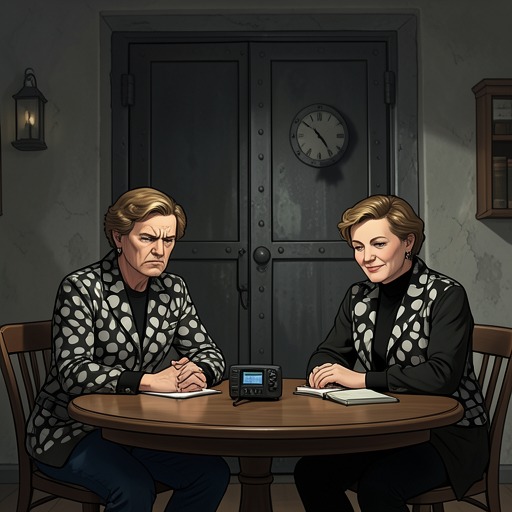
John Franklin and Judith Hastings
CurtainJohn Franklin and Judith Hastings are bound by a love that cannot be acknowledged while Franklin is married, and by the choice to make that love a marriage once his wife is no longer alive. Their relationship is one of the final revelations in Hercule Poirot’s account: the daughter Arthur Hastings believes is attached to Major Allerton is, in fact, deeply and unhappily in love with Franklin, and she is leaving for Africa with him as his wife.
Identity and Background
John Franklin is Judith Hastings’s employer, and their connection begins under circumstances that keep their feelings unspoken. Franklin is married to Barbara Franklin, while Judith works as his assistant. To Arthur, this arrangement makes Judith’s departure with Franklin seem impossible: accompanying him abroad while his wife is alive would be a different matter from working for him in England, and he expects that people would talk. His immediate impulse is to forbid it.
Poirot’s retrospective explanation recasts what Arthur had seen. Franklin’s brusque manner and his habit of never looking at Judith were not signs of indifference. Poirot identifies them as the behavior of a man deeply in love who is also determined to live by his standards. Franklin is unsentimental in speech, but, in Poirot’s account, he has a strong character and a strict code: a man remains with the wife he has chosen.
Love Under Constraint
The relationship is shaped by the difference between private feeling and conduct. Poirot says that Franklin loved Judith and that she loved him, but Franklin’s commitment to his marriage prevented him from acting on that love. His work was the great passion of his life, and his absorption in it, alongside his clear sense of his own feelings and disregard for outside pressure, made him resistant to Stephen Norton’s insinuations. Poirot presents Franklin as a man who could be emotionally involved without abandoning his principles or being manipulated into doing so.
Judith’s love, by contrast, is described as deep and unhappy. She believed Arthur had understood the truth when he found her in the rose garden; his expression of sympathy felt to her like an intrusion into a raw wound, and she responded with fury. Poirot explains that Judith could not bear pity or consolation about feelings she was trying to keep private. Her anger therefore emerges not from a lack of feeling but from the pain of being seen incorrectly—or too closely.
The Allerton Misunderstanding
When Judith discovers that Arthur thinks she cares for Major Allerton, she lets him continue to believe it. The mistaken assumption gives her cover: it protects her from Arthur’s clumsy sympathy and from further questions about Franklin. She flirts with Allerton as a desperate solace, knowing what kind of man he is; he amuses and distracts her, but Poirot stresses that she never had genuine feelings for him.
That concealment also shapes Arthur’s response to her news. When Judith says she will not be in England, he first imagines that she is going abroad with Franklin as his assistant. His objection is immediate and absolute. Judith lets him finish, then corrects the premise: she is going as Franklin’s wife. Arthur is stunned. His first faltering response is to name Allerton, showing how completely the false explanation has governed his understanding of his daughter’s affections.
Marriage and Departure
Arthur objects that Judith cannot marry Franklin so soon. Judith answers that she can: she wants to go abroad with him, and, as Arthur himself has just said, it is easier now. There is nothing for them to wait for. Her statement makes the changed circumstances decisive. The feelings had existed while marriage to Franklin was impossible; now the obstacle has gone, and Judith can state openly what she wants.
Poirot’s closing prediction gives the marriage a concrete future rather than a grand or comfortable one. Franklin and Judith will be happy together, he thinks, but poor. They will face innumerable tropical insects and strange fevers in Africa. The hardships do not contradict their happiness; Poirot frames them as compatible with their own idea of a perfect life. The couple’s departure thus ends the concealed and painful phase of their relationship with a deliberate shared choice.
Narrative Role and Significance
The late disclosure changes the meaning of earlier behavior. Franklin’s brusqueness, Judith’s anger in the rose garden, and her apparent flirtation with Allerton all looked like evidence of different motives to Arthur. Poirot’s explanation connects them into a single account: Franklin’s reserve expresses fidelity, Judith’s fury protects an unreturned or forbidden love from pity, and her flirtation provides distraction while concealing the truth. The relationship is revealed not through an early confession but through a correction of Arthur’s assumptions.
Their story also clarifies the limits of Norton’s influence. Norton saw possibilities in the Franklin household and tried Franklin first, but drew a blank: Poirot says Franklin was immune to the kind of insidious suggestion Norton used. The eventual union of Franklin and Judith is therefore not presented as the result of Norton’s manipulation. It comes into view only after Poirot explains the feelings and choices that the outward appearances had obscured.