John Franklin—Barbara Franklin marriage
CurtainThe marriage of John Franklin and Barbara Franklin is defined by a painful asymmetry: Barbara experiences illness as dependence and fears that she has become a burden, while John’s commitment to medical research gives their life together a purpose beyond her sickroom. Their exchanges and the choices made around his career suggest a marriage strained by incompatible needs, but not reducible to simple hostility. Barbara can accuse him of insensitivity and still admire his work; John’s frustrated ambition can coexist with his decision not to leave her behind.
Identity and Domestic Circumstances
Barbara is introduced as a woman of about thirty, exceptionally slender, with a fragile, almost transparent complexion and a long, gentle face. On the occasion Hastings visits, she lies propped on pillows on a day bed, wearing a delicate white-and-pale-blue negligee. The physical delicacy of this tableau establishes how illness governs her domestic circumstances: she receives visitors from a resting place while her husband and Sir William Boyd Carrington are present, drinking coffee.
Her illness also shapes the way she speaks about other people’s health. When the subject turns to someone who seems fortunate not to know ill health, Barbara says she envies that person and asks Nurse Craven for her view. She praises the nurse as extraordinarily good to her and says she is treated like a baby. The exchange conveys both the practical dependence built into Barbara’s routine and her awareness of how much that dependence asks of the people around her.
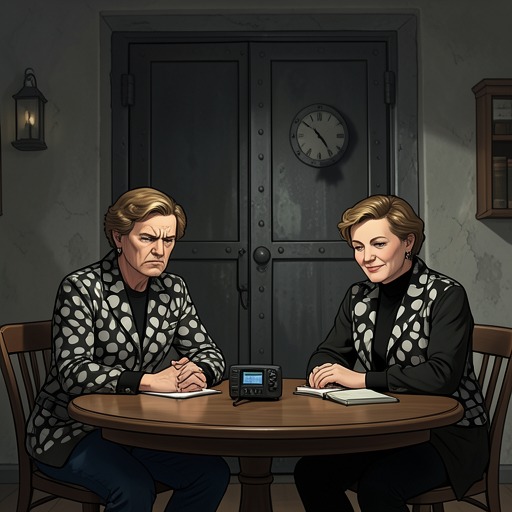
That domestic balance is not always gentle. Barbara complains that John has worked Judith too hard and calls him a slave driver, making the criticism in front of the household. John, who has been looking out of the window, whistling and jingling loose change in his pocket, starts at the question and asks what she said. The small interruption exposes a characteristic distance: Barbara directs a charge at him, while John appears not to have been attending to her.
Illness, Interpretation, and Mutual Regard
Barbara’s condition is described not only as bodily frailty but also through competing interpretations of its causes. After leaving her, Sir William tells Hastings that Barbara had been a beautiful young woman and recalls that he lost his heart to her before she married John three or four years later. He suspects the marriage has not been happy and believes that John neither understands nor appreciates her. In his view, Barbara’s sensitivity and nervous state contribute to her delicacy, which seems to him capable of easing when she is amused or interested. This is Sir William’s assessment, not an established medical explanation; his personal history with Barbara gives his account an evident emotional investment.
Barbara herself describes the marriage in the language of burden. In conversation with Hercule Poirot, she says that she feels acutely how much John must bear: she calls herself a sickly, useless wife and imagines herself as a millstone around his neck. She insists that John has not said this outright, but believes his feelings are transparent. Her account therefore distinguishes between what he has told her and what she reads in him. She understands him as too insensitive to conceal frustration, rather than as deliberately cruel.
Yet she does not present him solely as an uncaring husband. When the discussion turns to his scientific work, Barbara quietly insists that Poirot should not mistake her complaints for a lack of admiration: she thinks it tremendous that John lives for his work. The slight tremor in her voice lends weight to the declaration, even as Hastings suspects that she enjoys adopting different roles, here appearing as the loyal, worshipful wife. The scene leaves both possibilities in view: Barbara’s admiration is real enough to be voiced, while the performance of loyalty is also part of how Hastings interprets her.
Research and the Refused Journey
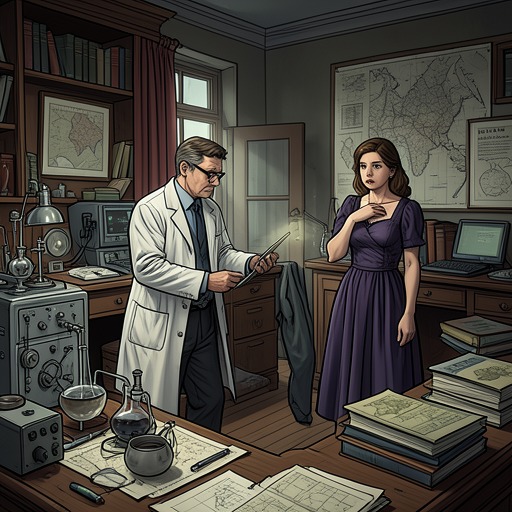
John’s vocation gives the marriage its central practical conflict. His work concerns alkaloids derived from the Calabar bean and their possible relation to Jordanitis, a rare tropical disease with fatal consequences for the few white people known to have contracted it. He explains that two similar-looking species of bean differ in their effects: a further alkaloid found in one may neutralize the action of the others. He is especially interested in the substance’s potential effect on the muscular system and says that it is unstable, although he is getting results. He believes the research needs to be pursued in Africa, at the source of the knowledge and materials he is studying.
Barbara tells Hastings that John was offered the chance to go to Africa the previous autumn and continue his research there. She says he had already done first-class work in tropical medicine and was intensely keen to continue. The appointment would not have paid well. Barbara protested because she considered herself too unwell to endure the climate and resisted being left behind, particularly when the low salary would have required her to live very economically. The refusal thus joined two different kinds of constraint: her account centres on illness and the costs of separation, while the decision also involved the financial conditions attached to John’s opportunity.
Hastings assumes that John could not leave his wife in her condition. Barbara’s response, asking whether Hastings knows much about her health, unsettles that easy conclusion without supplying a different definitive account. The marriage is seen through partial judgments: Hastings’s inference, Barbara’s self-understanding, and Sir William’s suspicion that the relationship itself has contributed to her decline. None alone resolves the tension between care, dependence, and frustrated opportunity.
A Reopened Future
Later, John tells Hastings that the chance has returned. After initially describing his work as interesting only to a handful of people, he squares his shoulders and says that he has his opportunity now: the Minister Institute has told him the post is still open, and he has got it. He is to begin in ten days, and confirms that the appointment is in Africa. His sudden animation contrasts with the earlier thwarted journey; the work that had seemed blocked by the circumstances of the marriage is again within reach.
The announcement marks a consequential change in their circumstances, but the available evidence does not show Barbara’s response or explain how the couple will manage the departure this time. It therefore does not establish that their earlier conflict has been settled. What it does make clear is how closely the marriage has been tied to John’s professional future: his research is both a source of purpose and the opportunity around which the couple’s illness, finances, and separation have come into conflict.