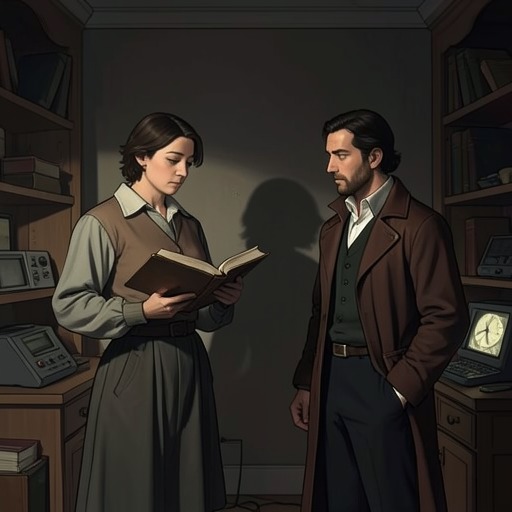
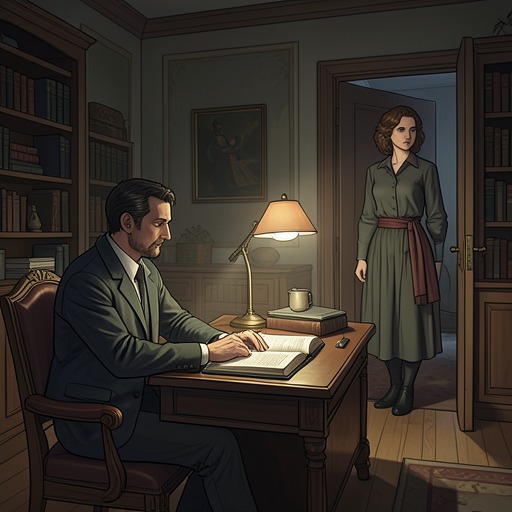
Philip and his wife
DeceptionPhilip and his wife’s relationship is tested when she reads his notebook and interprets its intimate conversations with an imagined woman as evidence of an affair. Their dispute exposes a deeper divide: she experiences the notebook as proof of his desire to escape their marriage, while he describes it as a writer’s game in which lived encounters and invention have become difficult to separate. Neither explanation restores the privacy or trust that the notebook has broken open.
Marriage Under Strain
The confrontation follows a period in which Philip’s wife has felt him withdrawing from their shared life. She says he does not speak or respond during their dinners and looks unwell; he answers that he does not sleep. She connects his trips to the studio with sexual betrayal, accusing him of going there to have an affair rather than to work. His evasive response initially gives her little reassurance, and her certainty breaks into tears.
Her suspicion is not based only on the idea that he might be inventing a woman. The notebook contains conversations that seem to her too intimate to be fabricated, as well as knowledge of English life she believes could only come from a real visitor to the studio. She links that writing to Philip’s distraction and to his lack of interest in her over the preceding months. The imagined woman becomes, in her account, a rival whose attention and words receive the energy Philip no longer gives his wife.
The argument turns particularly painful when she says he loves this woman more than he has ever loved her. Philip replies that the woman does not exist and claims that, if his wife did not exist, he could love her in the same way. His answer denies the rival’s reality but does not dispel the force of the writing: the wife has read a sustained expression of desire, and the question of whether its object is real cannot by itself undo its effect on their marriage.
The Notebook and Competing Accounts
Philip explains that the notebook combines actual conversations with material he has made up. He acknowledges having spoken with Nathan’s former lover Rosalie Nichols in the hospital and having written down part of their exchange, then invented more around it. He says that he can no longer remember where accurate reporting ends and imagined dialogue begins. Rosalie’s difficult circumstances and courage had made him want to preserve the encounter; in his account, its reality supplies the impulse for what he hopes is accurate imagining.
He also draws a boundary between his account of real relationships and the betrayals written into the notebook. He tells his wife that Ivan never accused him of sleeping with Olina and that their friendship did not end in the way the notebook depicts. He describes himself as deliberately making his fictional self implicated: merely witnessing another person’s story would not create the same dramatic heat. By compromising that self, he says, he makes the indictment more vivid. His wife, however, treats the apparent confession as part of the evidence against him, not as an explanation of a writer’s method.
Philip further argues that the English woman’s apparent knowledge has several sources. He has lived in England for a time, paid attention to English life, and learned from Rosalie; he describes the woman in the notebook as a repository for such knowledge. He says that some material came from conversations with different people, including Rosalie and a Polish woman, while most of what his wife has read is not direct record. His explanations offer a genealogy for the notebook’s details but leave its intimacy intact, which is precisely what his wife finds hardest to accept.
Desire, Invention, and Marriage
The couple disagree not only over whether an affair occurred but over what counts as betrayal. Philip admits that he imagines love affairs and that, while sitting in the bedroom as his wife sleeps, he sometimes makes up conversations with imagined women. He concedes that this may constitute a kind of perverse betrayal, especially because he writes the fantasies down. At the same time, he presents writing as a mitigating circumstance and describes the notebook as mourning for a life he led before marriage. He says he now lives as a married man but wants to allow himself some longing for former ways of life.
His wife gives the notebook a more direct marital meaning. Whether or not its woman exists, she argues, the love and desire expressed in it do exist; to her, the work amounts to an attempt to escape their marriage. Philip counters that the wish to escape can be an ingredient of marriage and says he was trying to trace the logic, or illogic, of that impulse rather than wound her. The exchange leaves their interpretations in collision: for him, the notebook examines contradiction; for her, it records a desire directed elsewhere and makes her exclusion legible.
Writing, Exposure, and the Unresolved Dispute
The disagreement extends to the difference between Philip’s novel and his notebook. His wife points out that the English woman in manuscript chapters is not simply the real model she believes the notebook reveals. Philip insists that the novel’s central character is Nathan Zuckerman, whereas the notebook is not a Zuckerman novel but a record of his own persona at play. He describes the notebook as an impersonation of himself, even suggesting that it can be understood as falsification surrounding a real self or as a mixture of both. This shifting account complicates rather than settles the question of what the writing discloses about him.
His wife also raises the prospect of publication and the exposure it would entail, suggesting that he might remove his own name and substitute Nathan’s. Philip rejects that solution: the novel belongs to Nathan Zuckerman, he says, but the notebook belongs to him. The distinction matters to their conflict because it refuses to make the notebook safely fictional by transferring it to his established fictional character. His wife’s concern about humiliation meets his insistence that the work is play, impersonation, and a writer’s practice.
Philip’s defense culminates in his claim that a novelist cannot live by discretion and must not yield to shame, even if shame is unavoidable. That principle does not answer his wife’s question about the injury caused by the notebook, nor does it restore the privacy she lost when she read it. Their argument remains unresolved in the available exchange: she sees the writing as a measure of her husband’s desire to leave her, while he sees her reading as a paranoid misinterpretation of a creative process. The marriage becomes the place where those incompatible claims are tested, because the material he calls fiction is also made from real conversations, real attachments, and a self he refuses to separate cleanly from his inventions.