Cultural Revolution
DecodedThe Cultural Revolution becomes, in Master Rong’s recollection, a political campaign that invades a family’s private grief and turns suspicion into punishment. In 1966, an old romantic attachment was recast as evidence of disloyalty: a public accusation led to a denunciation, physical abuse, and imprisonment, while the family’s absent son, Rong Jinzhen, remained unreachable behind the secrecy of his work. The account reaches its sharpest turn when a secret appeal is followed by the arrival of men who demand to take Rong Yinyi away, without resolving in the passage what happens next.
Background: Absence and Suspicion
Before the persecution, the family had already been living with Rong Jinzhen’s prolonged absence. His letters arrived through Box No. 36, an address his relatives could not trace to a known work unit. The first took twelve days to reach them despite having been written three days after he left; later letters came by an unusual route, without an ordinary sending-office postmark. During the Cultural Revolution, the slogan printed on the envelopes changed from a line in Chairman Mao’s calligraphy to a popular song lyric, while the unexplained postal arrangements remained. The correspondence offered contact, but not a way to locate him or understand the secret work that kept him away. The family’s uncertainty had deepened after Rong Jinzhen failed to return for a funeral. A stranger came in his place with a large wreath and spoke evasively about what he could discuss. His relatives knew Rong Jinzhen as principled and imagined that, if he could attend, he would have found a way; his absence therefore seemed ominous. Master Rong came to suspect that he might be dead, and the later letters did little to dispel the fear. When her mother decided that Rong Jinzhen should be called home because he was her son, the family sent a telegram asking him to return. That unresolved hope formed the private background to the public crisis that followed.
From Accusation to Persecution
The pressure began with a big-character poster accusing Master Rong of still loving a former boyfriend. The attack did not stop at her private feelings. Her unmarried life was presented as proof that she was waiting for him, and the accusation was extended into claims that she loved the KMT and was both a KMT prostitute and a spy. The allegations were stated as facts, collapsing a personal history into political culpability. On the afternoon the poster appeared, several dozen students attempted to surround the house. They shouted but did not force their way inside; Master Rong thought her father’s reputation might have helped prevent a worse assault. The chancellor arrived at a timely moment and persuaded them to leave. Because the students had not yet dragged her away, she initially believed the incident might be over. A little over a month later, they returned in much greater numbers. Hundreds of people came, and important university figures, including the chancellor, were under arrest. The crowd burst into the house, seized Master Rong, and dragged her out. They put a dunce’s cap on her bearing the accusation against her and thrust her among those designated for public struggle. The campaign had moved from denunciation to organized punishment: she was to be paraded as an example before the populace. After the parade, Master Rong was imprisoned in a women’s lavatory with a chemistry professor accused of immorality and bourgeois corruption. By day the women were taken out and beaten; at night they were returned to their confinement and made to write self-criticisms. Later, half of each woman’s head was shaved in a yin-yang pattern, making their humiliation visible on their own bodies. The attack also reached Master Rong’s mother. When she saw her daughter being struggled against, she was so horrified that she fainted on the spot.
The Appeal to Rong Jinzhen
Master Rong did not know whether her mother was alive or dead in hospital, and believed she herself was close to death. That evening she wrote a one-line secret message to Rong Jinzhen, asking him to come back if he was still alive and rescue her. She signed it using her mother’s name. The next day, a student who pitied her helped send the telegram. Her expectations remained bleak. She thought the likeliest outcome was that no answer would come; the next likeliest was that a stranger would arrive, as one had after her father’s death. She could not imagine that Rong Jinzhen would be able to come in person, still less that he could arrive quickly. The appeal thus reveals both the extremity of her danger and the limits imposed by his absence: even at the moment she called on him, she could not know whether he was alive, where he was, or whether his secret organization would permit him to act.
The Struggle Session and Its Interruption
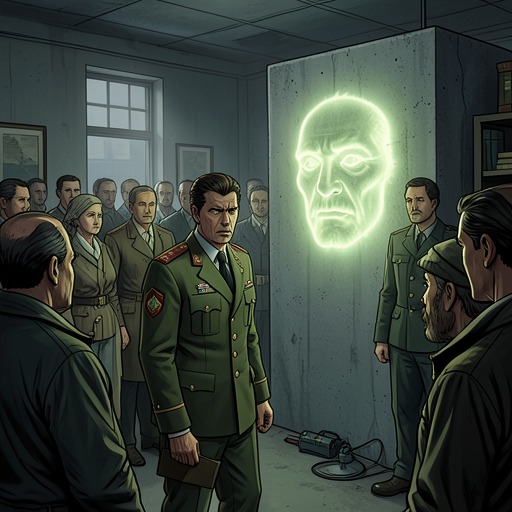
The account then presents the public struggle session in detail. Master Rong and her colleague stood on the steps outside the chemistry department’s main building, wearing tall dunce’s caps and heavy placards. Red flags and posters framed the scene. About two hundred students and professors sat on mats before them, while selected speakers took turns exposing the women’s supposed wrongdoing and questioning them. The proceedings began at ten in the morning; lunch was brought to the site, and the two accused women were ordered to recite sayings of Chairman Mao. By four in the afternoon, neither could remain standing, and both were kneeling. A jeep with military number plates then drove up and drew the crowd’s attention. Three men got out: two tall men flanking a shorter one. They walked directly into the struggle session. When Red Guards on duty tried to stop them and asked who they were, the short man answered that they had come to take Rong Yinyi away. The passage ends at this demand. It does not describe the departure or establish the immediate consequences, leaving the intervention as a stark interruption rather than a fully narrated rescue.
Significance in the Narrative
The episode sets political spectacle against private uncertainty. The accusations are public and emphatic, but the family’s knowledge of Rong Jinzhen is fragmented: delayed letters, an untraceable address, a proxy at a funeral, and no reliable way to learn whether he is alive. Master Rong’s appeal makes that gap acute, while the arrival of the jeep brings the hidden organization’s power into the open without making its workings transparent. The changing envelope slogan also marks how the political environment entered even the family’s narrow channel of communication. The letters continued to arrive, but the familiar oddities of their route remained, and later the family received shorter messages at longer intervals. In this account, secrecy is not an abstract condition: it shapes who can attend a funeral, who can answer a plea, and what a family can safely know. The struggle session turns Master Rong into a public target; the men’s arrival, ending with their demand for Rong Yinyi, introduces a counterforce whose purpose is clear but whose outcome is withheld.