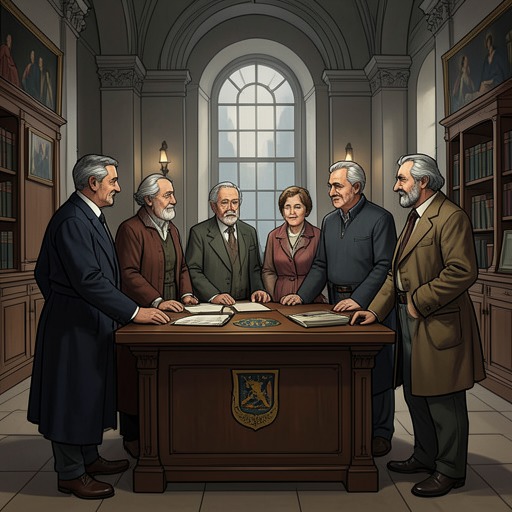
Jinzhen Wins Stanford Funding but Cannot Go to the United States Because of Kidney Failure
DecodedRong Jinzhen’s opportunity to study at Stanford University was won through Jan Liseiwicz’s advocacy and then overtaken by illness. Liseiwicz persuaded the university to offer his gifted student a fully funded PhD place and travel money, but Jinzhen became gravely ill just as he was preparing to leave. Kidney failure turned the planned journey into a long struggle for survival, consuming the money intended to take him abroad and determining that he would spend his life in China.
Recognition and the offer
Jan Liseiwicz’s recommendation followed his examination of Jinzhen on questions from the Putnam Mathematical Competition. He judged him the finest student the university had produced and believed he could become the finest student at Harvard, MIT, Princeton, Stanford University, or another leading institution. For Liseiwicz, recommending study abroad was not a general compliment but a practical response to Jinzhen’s extraordinary mathematical ability: he urged Young Lillie to give his student the opportunity to continue his education overseas.
The obstacle initially appeared to be money. Young Lillie explained that the family could not afford even Jinzhen’s passage. Liseiwicz proposed that they pay for just one semester, expecting that Jinzhen would win a scholarship before the second began. The distinction did not resolve the problem: there was no money for the fare. Liseiwicz left disappointed and uncertain whether this explanation was true. He suspected that Young Lillie might simply be unwilling to release Jinzhen for study abroad, partly because he found it hard to believe that the Rongs could be poor.
The family’s circumstances and Liseiwicz’s persistence
Young Lillie’s refusal was not a pretext. The remnants of the family’s property in Tongzhen had been seized during Land Reform, and the Rongs retained only a few dilapidated buildings in their old mansion. Their last commercial property in C City had also been given to the People’s Government at a public welcome for the new mayor. Young Lillie accepted the public presentation because the recipients believed it could encourage other prominent families to support the new government; the account presents the gift as an act of patriotic commitment, not an attempt to curry favor.
The family’s resources had been depleted over time: inherited property had been given away, spent, ruined, or divided. Young Lillie’s savings had gone toward saving his daughter’s life, his salary had not kept pace with rising costs, and other sources of income had disappeared. He supported Jinzhen’s education abroad, but could not pay for it. Liseiwicz did not yet know the extent of this poverty, which made his suspicion particularly painful in retrospect.
A few months later, Liseiwicz found a way around the financial barrier. Dr. Gábor Szegő, head of Stanford University’s mathematics department, accepted Jinzhen as a scholarship student and sent a $110 money order for travel expenses. The offer resulted from Liseiwicz’s sustained lobbying: a 3,000-word letter to Szegő had helped turn his recommendation into a funded PhD place and a passage to the United States. When he brought the news to Young Lillie, he was delighted by the older man’s happiness. The offer also made Liseiwicz’s purpose clear: he was working to advance Jinzhen’s future, not to keep him in China for his own benefit.
Illness overturns the plan
Jinzhen became seriously ill during the summer before his intended departure, and the diagnosis was renal failure. His family was told that he would die, or at best live for another six months. His condition involved severe oedema: although his weight continued to fall, his body swelled dramatically. The account describes a young man who had always been slim becoming visibly altered by the disease, while death remained a constant prospect.
Jinzhen survived, but only after spending nearly two years in hospital. Salt was prohibited because it was dangerous to him, and his scholarship’s travel money was redirected to medical expenses. The funded place, the diploma, and the student life that had seemed within reach receded as the family faced the immediate demands of his illness. Liseiwicz’s efforts had secured the opportunity, but the illness made it impossible for Jinzhen to use it.
Recovery, care, and what remained
When Jan Liseiwicz left China, Jinzhen was still in hospital, though he appeared to be out of immediate danger. Because the medical bills were mounting, the hospital agreed to transfer him home to recover. The doctor told the family that his condition was stable but that full recovery would require more than a year of special treatment and careful attention to prevent a relapse. The family’s task therefore continued beyond the crisis that had prevented his departure.
His sensitivity to salt made ordinary cooking part of that treatment. The doctor’s instructions began with quantities measured in micrograms and allowed gradual increases. Without a sufficiently accurate scale, the family first had to rely on careful judgment. Later, Jinzhen’s caregiver took prepared dishes to the hospital so that doctors could assess their suitability, having recorded the amount of salt in each. At home she counted the grains individually and portioned them into his meals five times a day. This painstaking care made recovery a daily practice, while the Stanford money that might have carried Jinzhen abroad had instead helped keep him alive.
The thwarted journey marks a decisive turn in Jinzhen’s life: his mathematical ability had been recognized internationally, yet his future was shaped by bodily illness, scarce family resources, and the labor of care. The narrative later places him in China, working with Young Lillie on research and publishing papers; it also records that Jinzhen wrote a thesis independently, with Young Lillie recommending references and writing its introduction. These later achievements do not restore the education or life abroad that illness removed. They show instead that the lost passage to Stanford did not extinguish his intellectual work, even as the chance to pursue it there vanished.