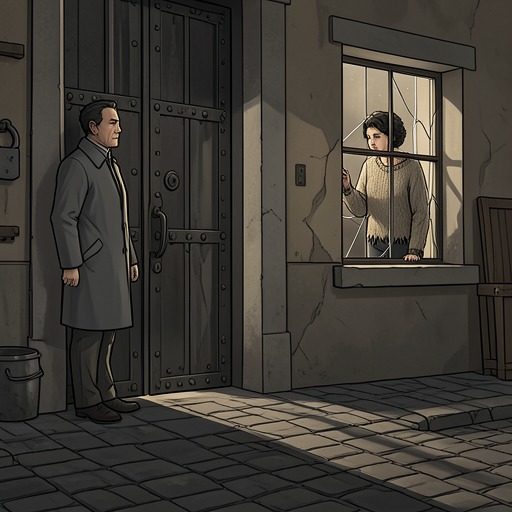
Jinzhen Rescues Aunt Rong
DecodedRong Jinzhen’s rescue of Master Rong reverses a public condemnation at the moment it seems most dangerous: after ten years away, he appears at a university struggle session, identifies himself as her brother, and secures her release. The episode moves from Master Rong’s fear that no help will come to a public display of authority that protects her family well beyond that day.
Background and Appeal
Master Rong was being persecuted during the Cultural Revolution. She and a woman professor from the chemistry department had been accused of political and ideological offenses; they were publicly paraded, confined in a women’s lavatory, taken out for beatings during the day, and made to write self-criticisms at night. Her humiliation also reached her mother, who fainted after seeing her being struggled against. When Master Rong later learned that her mother was in hospital, she did not know whether she was alive or dead, while she herself feared she might die.
In that danger, Master Rong sent a secret telegram to Zhendi, asking him to return and rescue her if he was still alive. She signed it in her mother’s name. A student who pitied her helped send it the following day. Master Rong expected no reply; the next possibility she could imagine was that a stranger might arrive, as had happened after her father’s death. She could not anticipate that Zhendi would come himself, or that he would arrive so quickly. The rescue therefore begins in uncertainty: she has asked for help without knowing whether the person she is addressing can hear her.
The Struggle Session
The session outside the chemistry department had been carefully organized. About two hundred students and professors sat on mats before the building while selected speakers took turns exposing and interrogating Master Rong and her colleague. The proceedings began at ten in the morning and continued through a lunch brought to the site. The two women were ordered to recite Chairman Mao’s sayings; by four in the afternoon they could no longer stand and were kneeling on the ground.
A military-plated jeep then arrived with three men. Two tall companions flanked a shorter man, who walked directly into the gathering and announced that they had come to take Rong Yinyi away. When a Red Guard challenged him, he refused to be deterred and insisted that she was leaving with him. The clash turned the session against the rescuers: the crowd surged forward and began punching the short man, while his two companions fought to shield him. They invoked their work for Chairman Mao and urged the crowd to stand back. One companion fired a single shot into the air, halting the assault long enough to display credentials bearing a red letterhead and a large state seal.
The armed man claimed that they had been sent on a mission by Chairman Mao and warned of consequences for anyone who obstructed them. He then invited the people in charge to discuss the matter. Two representatives spoke with him privately and returned having accepted his account. The gathering sat down again. One of the Red Guard leaders even shook the short man’s hand and introduced him as a Hero of the Revolution, though the applause was scattered and unenthusiastic. Concern about renewed trouble kept the short man from crossing back to the group; instead, the armed escort sent him away in the jeep and stayed behind.
Recognition and Release
As the jeep departed, the man leaned out and called to Master Rong as his sister, telling her not to be afraid and promising to find someone to save her. Only then did she recognize Zhendi as Rong Jinzhen. He had been gone for ten years, had grown much thinner, and wore thick, old-fashioned spectacles. Master Rong later recalled that she had not believed it was him until he called her sister; even afterward, the reunion seemed so improbable that she sometimes wondered whether it had been a dream.
Another military-plated jeep arrived while Rong Jinzhen’s car was still there. Two men in People’s Liberation Army uniforms spoke privately with the man who had fired the shot, then introduced the third arrival: Marshal Yang, the head of the university’s Red Guards. After a quiet conference beside the cars, Marshal Yang returned to the crowd and led it in revolutionary slogans. He went up the steps, removed Master Rong’s dunce’s cap and placard, and publicly declared her a revolutionary comrade and the sister of a national hero. He then took off his own Red Guard armband and tied it onto her arm. The crowd joined the slogans. Whatever their motives—respect, protection, or an effort to redirect attention—their repeated cries marked the end of Master Rong’s treatment as a counter-revolutionary.
Official Protection and Aftermath
Three days after Rong Jinzhen left, a representative of his work unit delivered an official document from the PLA Military Region headquarters and the Provincial Revolutionary Committee. It recognized him as a Hero of the Revolution, with recognition from the Central Politburo, the State Council, and the Central Military Commission. The document extended that status to his family: no work unit, Communist Party member, or private individual could enter their house without permission, and no one could question their revolutionary credentials. A handwritten warning from the local Military Region commander said that anyone who disobeyed would be treated and punished as a counter-revolutionary.
For Master Rong’s family, the document made the rescue more than a temporary reprieve. They treasured it, and she said it prevented further trouble. It enabled her brother to return to N University from Shanghai and later helped him obtain permission to go abroad, where he could continue his superconductivity research. She also emphasized how unusual it was to secure permission to leave the country at that time. The family did not know what task Rong Jinzhen had completed to gain such influence. A later departmental rumor linked him to China’s nuclear weapons program, but the published list of scientists from its first and second generations did not include his name; Master Rong left the claim unresolved. The story’s consequences are therefore both concrete and partly concealed: his intervention changed the family’s daily security, while the source of the authority behind it remained unknown.