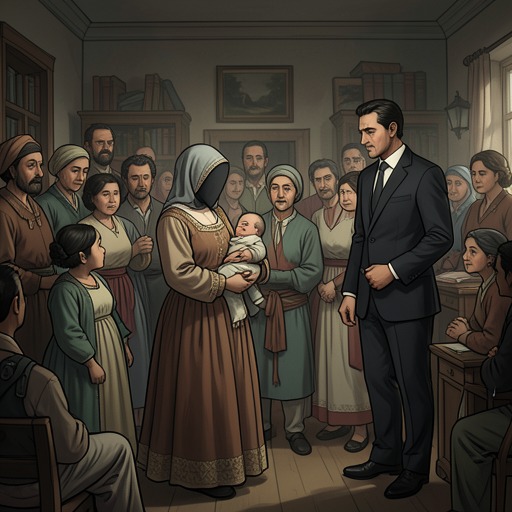
Mysterious Woman Dies After Giving Birth to Jinzhen
DecodedMysterious Woman Dies After Giving Birth to Jinzhen is the decisive beginning of Rong Jinzhen’s life: his birth ends with his mother’s death and turns a contested claim of kinship into a family crisis. The child is accepted into the Rong household only after his resemblance to the Killer makes his parentage unmistakable; a different resemblance, to his grandmother, prevents him from being abandoned. Birth, disclosure, and survival are bound together from the outset.
The Claim and the Journey to the Rongs
The unnamed woman arrived from outside the province after the Killer’s death and asked to see the head of the Lin family. She identified her pregnancy as the Killer’s, but the family, accustomed to his many relationships, distrusted her claim and expelled her. The woman herself did not welcome the prospect of carrying the pregnancy to term. After the expulsion she sat by the road in distress, and a bystander directed her to N University, where she might appeal to the Killer’s other family connections.
At the university she sought out Mr Lillie, whose sympathy for people who had suffered injustice led him to take her in. The account later gives the explanation Rong Xiaolai offered for sheltering her: she was a devout Buddhist, had grown up in a nunnery, and was unmarried; after praying at the Buddhist statue on Putuo Mountain the previous year, she had discovered that she was pregnant. Rong Xiaolai asked his wife whether she believed the story, then made belief secondary to the practical question of whether she would shelter the woman. The woman was taken to the Rong family’s old home town, Tongzhen, and eventually lived with the Rongs.
The Birth and the Mother’s Death
The birth took place a few months after the woman joined the Rong household. It recalled the earlier ordeal in which Rong Youying had suffered terribly while giving birth to the Killer, making the repetition feel less like an isolated misfortune than the return of a family history. The woman was much younger than Rong Youying had been, but her labor was prolonged and severe. Midwives came and went, and the household understood that both mother and child were in danger.
The child was born, but the woman suffered a haemorrhage and died. Those present regarded the successful delivery as a miracle, while recognizing that her survival would have required a second miracle. She did not survive. The narration also attaches the death to the estate’s neglected garden: two old plum trees, thought to be dead, flowered that winter. Residents connected the unexpected bloom to the childbirth, making the landscape bear a local, uncanny memory of the event. By the time the blossoms appeared in January, the woman was already dead; the account says that people imagined her soul as a hungry ghost haunting a desolate hillside.
Parentage Exposed and the Child Spared
When the midwife cleaned the newborn, the household was shocked by how closely he resembled the Killer. The resemblance extended beyond his thick dark hair and large head to the shape of the Mongolian spot above his buttocks. The child’s body appeared to settle the question that the woman’s account had left disputed: he was the Killer’s son. Her pilgrimage story, presented as the explanation for an unmarried pregnancy, could no longer conceal the child’s connection to the family.
That disclosure changed the meaning of the Rong family’s shelter. Rong Xiaolai’s earlier account had made the woman’s religious devotion the grounds for compassion; after the birth, the baby was regarded instead as the illegitimate child of a murderer, imposed on relatives already burdened by the Killer’s conduct. The woman’s death left him without her protection, and the family seriously considered getting rid of him. What kept him alive was not recognition of him as a family member, but a resemblance to his grandmother, the sainted Miss Lillie. That likeness gave the Rong household a reason to spare him and raise him in the Rong Family Mansion.
Naming, Belonging, and the Event’s Aftermath
Survival did not mean immediate belonging. The Rongs did not recognize the infant as one of their own, and people who spoke about him commonly called him the Grim Reaper. The old servant couple assigned to care for him found the name frightening and tried unsuccessfully to replace it with an ordinary baby name. Their discomfort eventually led them to ask Mr Auslander, already a long-standing member of the household, to choose a name that might take hold among their neighbors. Thus the birth’s first aftermath was another struggle over identity: the child had entered the family’s home, but had not yet been given a secure place within its language or lineage.
The event also precedes the later account of Rong Jinzhen’s acceptance into a different family setting. After the death of a daughter, Rong Xiaolai’s wife urged him to bring the boy home, reasoning that the bereaved household had lost one child while this boy needed a family. The resulting bond did not erase the circumstances of his birth, but it offered a form of kinship beyond the reluctant shelter that followed his mother’s death. The episode establishes a recurring distinction in Rong Jinzhen’s story: biological resemblance can expose an origin, yet care and a decision to receive him determine whether that origin becomes a home.