At the opening of the chapter
The Southward Flight
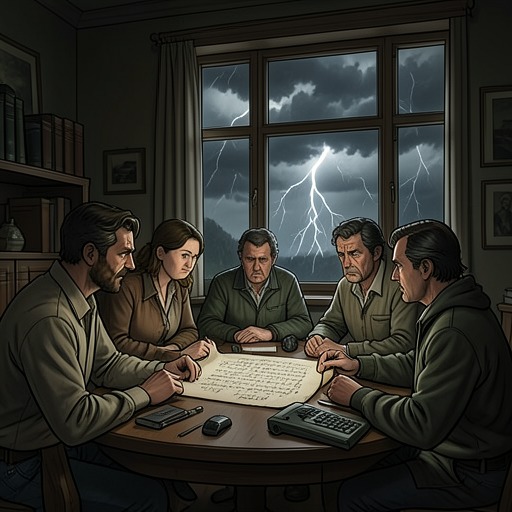
After learning that [Elder Xu](entity:character-recall-character-354fdfe43f63) had died, [Qiao Feng](entity:character-recall-character-574cafa84444) and A'Zhu headed south in disguise. They hoped to reach the people who knew the identity of the concealed “[Leading Big Brother](entity:expression-recall-expression-leading-big-brothe-e0dafcf809f7)” before the unknown killer could strike again. To pass unnoticed, they altered Qiao Feng’s imposing appearance and traveled quietly, accepting the danger that their pursuer seemed to stay ahead of them.
During the journey south
News of Elder Xu
At a small noodle shop, [Qiao Feng](entity:character-recall-character-574cafa84444) overheard two [Beggar Society](entity:organization-recall-organization-beggar-society-25b665a53abd) members say that [Elder Xu](entity:character-recall-character-354fdfe43f63) had died horribly and that the Society planned to gather for his memorial in [Weihui](entity:location-recall-location-weihui-76a90fe2d4ba). Their words confirmed that the people who might know the old secret were being eliminated, and Qiao Feng and A'Zhu immediately changed course for the memorial.
On arrival in Weihui
A Disgraced Society
[Qiao Feng](entity:character-recall-character-574cafa84444) saw [Beggar Society](entity:organization-recall-organization-beggar-society-25b665a53abd) members crowding the streets, behaving with little of the discipline that had once defined the organization. The deterioration pained him despite his expulsion, since he had devoted years to building the Society. He and A'Zhu went to [Elder Xu](entity:character-recall-character-354fdfe43f63)’s memorial hall, where fresh blood on the tablet marked the Society’s determination to avenge him.
That day in Weihui
The Secret Meeting
[Qiao Feng](entity:character-recall-character-574cafa84444) followed [Zhao Qiansun](entity:character-recall-character-83ff1cec8405) out of the city and overheard him meeting [Granny Tan](entity:character-recall-character-e289c6ad3d2c) in a boat. Their conversation and song revealed an old emotional attachment, but Qiao Feng interrupted and subdued them before they could explain why they had come together. He demanded the identity of the “[Leading Big Brother](entity:expression-recall-expression-leading-big-brothe-e0dafcf809f7),” offering secrecy in exchange, but both refused to betray the man.
Soon after the interrogation
Three Bodies in the Boat
[Qiao Feng](entity:character-recall-character-574cafa84444) went to [Grandpa Tan](entity:character-recall-character-793075a1c7d0) with [Granny Tan](entity:character-recall-character-e289c6ad3d2c)’s hairpin and brought him to the boat, expecting to expose the meeting and force an answer. Instead, they found Granny Tan and [Zhao Qiansun](entity:character-recall-character-83ff1cec8405) dead from powerful palm blows; Grandpa Tan, convinced Qiao Feng was responsible, took his own life. Qiao Feng realized a hidden adversary had killed them and left no trace.
The following night
The Shan Family Fire
[Qiao Feng](entity:character-recall-character-574cafa84444) and A'Zhu hurried to [Tai'an](entity:location-recall-location-tai-an-69a1da620f6e), only to find the Shan family manor burning. The entire household had perished, apparently so the arsonist could destroy letters that [Shan Zheng](entity:character-recall-character-468fd7622ac1) had said were evidence of the “[Leading Big Brother](entity:expression-recall-expression-leading-big-brothe-e0dafcf809f7)’s” identity. The villagers blamed Qiao Feng, while he recognized that his unseen enemy was again erasing witnesses and evidence.
After the Shan family’s destruction
The Turn Toward Tiantai
A'Zhu persuaded [Qiao Feng](entity:character-recall-character-574cafa84444) not to rush blindly after the killer. They chose instead to seek [Zhiguang](entity:character-recall-character-45cae45f111d) on [Mount Tiantai](entity:location-recall-location-mount-tiantai-4cc9b1a291a8), one of the few remaining people tied to the [Yanmen Pass](entity:location-recall-location-yanmen-pass-9957b9917d90) affair. Qiao Feng hoped to question the monk, but feared that the enemy might reach him first; he slowed their journey in the hope of preventing another death.
At Zhiguan Temple
A Name on the Cliff
[Zhiguang](entity:character-recall-character-45cae45f111d) welcomed [Qiao Feng](entity:character-recall-character-574cafa84444) and revealed that his birth surname was Xiao: his father had left a message at [Yanmen Pass](entity:location-recall-location-yanmen-pass-9957b9917d90) identifying himself as [Xiao Yuanshan](entity:character-recall-character-1b3e8c8ae4bd). He gave Qiao Feng a cloth rubbing of that final inscription, which described the mistaken attack that had killed Xiao Yuanshan’s wife and his vow, made to a Han master, never to kill Han people.
During the same visit
Xiao Feng’s New Name
The revelation transformed [Qiao Feng](entity:character-recall-character-574cafa84444)’s understanding of his origins: he was Khitan, and his father’s name was [Xiao Yuanshan](entity:character-recall-character-1b3e8c8ae4bd). He began calling himself Xiao Feng, while A'Zhu accepted the new name without treating Khitan identity as inferior. The change sharpened his conflict between the people among whom he had grown up and the ancestry now exposed to him.
Before leaving Zhiguan Temple
Zhiguang’s Final Teaching
When [Qiao Feng](entity:character-recall-character-574cafa84444) pressed for the “[Leading Big Brother](entity:expression-recall-expression-leading-big-brothe-e0dafcf809f7)’s” identity, [Zhiguang](entity:character-recall-character-45cae45f111d) wrote that distinctions between Han and Khitan, kindness and enmity, honor and disgrace were ultimately dust. He then died in meditation before Qiao Feng could obtain the answer. Qiao Feng suspected that his enemy had frightened Zhiguang into suicide, but A'Zhu urged him to consider a life beyond vengeance and jianghu.
On the road from Mount Tiantai
A Promise Beyond the Pass
A'Zhu confessed that she wanted to live with Xiao Feng beyond [Yanmen Pass](entity:location-recall-location-yanmen-pass-9957b9917d90), herding cattle and sheep rather than returning to the violence of the Central Plains. He accepted her devotion and, moved by the prospect of no longer being alone, promised that they would go north together after asking [Madam Ma](entity:character-recall-character-53f1b9b6079d) one final question. Their hope gave the journey a tenderness that sharply contrasted with the deaths and accusations behind them.
On the journey to Xinyang
The Disguise as Bai Shijing
To question [Madam Ma](entity:character-recall-character-53f1b9b6079d) without provoking her hostility, A'Zhu disguised herself as [Bai Shijing](entity:character-recall-character-11b92d92cf22), with Xiao Feng posing as her attendant. She planned to use the trust Madam Ma might place in a senior [Beggar Society](entity:organization-recall-organization-beggar-society-25b665a53abd) figure and to draw her into speaking about the murder of [Ma Dayuan](entity:character-recall-character-5817033489a0). Xiao Feng disliked the deception but accepted that A'Zhu’s skill might uncover what direct questioning could not.
At Madam Ma’s home in Xinyang
The Clue of the Mid-Autumn Meeting
A'Zhu told [Madam Ma](entity:character-recall-character-53f1b9b6079d) that [Zhao Qiansun](entity:character-recall-character-83ff1cec8405) had linked [Ma Dayuan](entity:character-recall-character-5817033489a0)’s murderer to a gathering at the “[Leading Big Brother](entity:expression-recall-expression-leading-big-brothe-e0dafcf809f7)’s” residence on the Mid-Autumn Festival. Madam Ma’s sudden panic confirmed that the story had touched a dangerous truth. She eventually disclosed that the leader was Duan Zhengchun of the [House of Duan](entity:organization-recall-organization-house-of-duan-aa3874340964), the South-Stabilizing Prince of [Dali](entity:organization-recall-organization-dali-8f6b9e5f8b06).
Immediately after the interrogation
The False Trail to Dali
[Madam Ma](entity:character-recall-character-53f1b9b6079d) described Duan Zhengchun’s high status, his connection to the old [Yanmen Pass](entity:location-recall-location-yanmen-pass-9957b9917d90) expedition, and the strategic importance of [Dali](entity:organization-recall-organization-dali-8f6b9e5f8b06)’s alliance with the Song. Xiao Feng believed he had finally found the man behind his parents’ deaths and prepared to seek revenge, while A'Zhu quietly worried about the danger of facing the powerful [House of Duan](entity:organization-recall-organization-house-of-duan-aa3874340964). Neither yet understood that the identification was a deliberate misdirection.
On the journey north from Xinyang
A Strange Encounter at the Lake
[Xiao Feng and A'Zhu](entity:relation-recall-relation-439572efee53) followed a wounded guard’s directions to [Little Mirror Lake](entity:location-recall-location-little-mirror-lake-e12019ce8a1a), where they encountered Duan Zhengchun and his companions under attack by [Duan Yanqing](entity:character-recall-character-cd660fc0ea10) and the other great evils. The purple-clad A'Zi, whom Xiao Feng had not yet recognized as A'Zhu’s sister, caused trouble with poisonous weapons and a strange silk net. The confrontation drew together the [Dali](entity:organization-recall-organization-dali-8f6b9e5f8b06) party, the enemies pursuing them, and Xiao Feng’s own unresolved revenge.
During the confrontation at Little Mirror Lake
Duan Yanqing’s Challenge
Duan Xianqing challenged Duan Zhengchun with the legitimate sword techniques and finger techniques of the Duan clan of [Dali](entity:organization-recall-organization-dali-8f6b9e5f8b06), aiming to seize the throne through a seemingly justified victory. He had stronger internal energy and gradually suppressed Duan Zhengchun; Chu Wanyi fought bravely
At the climax of the duel
Xiao Feng Saves Duan Zhengchun
As [Duan Yanqing](entity:character-recall-character-cd660fc0ea10) prepared a killing blow, Xiao Feng intervened and pulled Duan Zhengchun from danger. He then drove off the South Sea Divine Alligator and prevented the fight from turning into a wider slaughter. The rescue was not forgiveness: Xiao Feng still intended to confront Duan Zhengchun himself, but wanted his own vengeance rather than a stranger’s hand to determine the outcome.
After the battle at Little Mirror Lake
A’Zi’s Parentage Revealed
[Duan Zhengchun and Ruan Xingzhu](entity:relation-recall-relation-4b12e057bf5c) recognized A'Zi as their daughter through her identifying lock and shoulder mark. Hidden nearby, A'Zhu learned that she too was their child, abandoned with her sister when their parents separated. She also understood that the man Xiao Feng intended to kill was her father, but concealed the discovery while she considered how to spare Xiao Feng from a choice between vengeance and the woman he loved.
That night at the blue stone bridge
The Appointment on the Bridge
A'Zhu disguised herself as Xiao Feng, canceled the meeting with Duan Zhengchun, then disguised herself as Duan Zhengchun and went to face Xiao Feng in his place. She hoped that by taking the fatal blow herself, she could keep Xiao Feng from killing her father and from drawing the [Dali](entity:organization-recall-organization-dali-8f6b9e5f8b06) court into a cycle of revenge. Xiao Feng, believing he was striking Duan Zhengchun, delivered a full-force palm.
The same night
A’Zhu’s Death
The lightning revealed that the figure Xiao Feng had struck was A'Zhu. As she died, she explained that Duan Zhengchun was her father and that she had acted to save Xiao Feng from the consequences of killing him. She asked Xiao Feng to care for A'Zi, leaving him with the unbearable knowledge that his vengeance had killed the person who had given him a reason to live beyond it.
The next day at the bamboo house
The False Accusation Unravels
Grief-stricken, Xiao Feng returned to the empty bamboo residence and prepared to bury A'Zhu beside himself. A calligraphic scroll by Duan Zhengchun made him question the handwriting on the old letter to [Wang Jiantong](entity:character-recall-character-5826de92ef64): the letter and the scroll did not appear to be written by the same person. [Ruan Xingzhu and A'Zi](entity:relation-recall-relation-ba0cae272d56) returned, confirming that the scroll was Duan Zhengchun’s and giving Xiao Feng reason to doubt [Madam Ma](entity:character-recall-character-53f1b9b6079d)’s identification.
Soon after the scroll’s discovery
The Assassins at the House
[Qin Hongmian and Mu Wanqing](entity:relation-recall-relation-07d81087856c) arrived intending to kill [Ruan Xingzhu](entity:character-recall-character-973ef96ef5b7), but Xiao Feng subdued them without leaving A'Zhu’s side. When Ruan Xingzhu and [Qin Hongmian](entity:character-recall-character-664d93aaec19) recognized one another and reconciled over their shared history with Duan Zhengchun, the immediate threat passed. Xiao Feng unblocked them, promised to help A'Zi if needed, and left with the suspicion that the case against Duan Zhengchun had been engineered.
After the reconciliation
A’Zhu’s Burial
Xiao Feng buried A'Zhu in the bamboo grove and wrote simple markers for both of them, unable to bring himself to scatter earth over her face until the final moment. Her promise to herd cattle and sheep beyond [Yanmen Pass](entity:location-recall-location-yanmen-pass-9957b9917d90) had become impossible. He then set out to find Duan Zhengchun, not to carry out the revenge he had once planned, but to determine why A'Zhu had died for a false accusation.
Several days later, in the snow
Madam Ma and Duan Zhengchun
Following A'Zi’s trail, Xiao Feng found Duan Zhengchun secretly visiting [Madam Ma](entity:character-recall-character-53f1b9b6079d) in the Ma residence. Madam Ma appeared to be his former lover, yet her tenderness concealed an attempt to poison him with Ten Fragrance Bewitching Powder and bind him. The scene made Xiao Feng suspect that her earlier claim identifying Duan Zhengchun as the “[Leading Big Brother](entity:expression-recall-expression-leading-big-brothe-e0dafcf809f7)” had been part of a larger scheme.
During the confrontation at the Ma residence
Bai Shijing’s Arrival
[Bai Shijing](entity:character-recall-character-11b92d92cf22) entered and tried to kill the poisoned Duan Zhengchun, revealing his intimate connection with [Madam Ma](entity:character-recall-character-53f1b9b6079d). A mysterious figure appeared in the dark, used the [Throat-Lock Capturing Technique](entity:concept-recall-concept-2a8d13d8316f), and frightened Bai Shijing into confessing that Madam Ma had urged [Ma Dayuan](entity:character-recall-character-5817033489a0) to expose [Qiao Feng](entity:character-recall-character-574cafa84444)’s birth secret. The unknown figure strangled Bai Shijing and departed before Xiao Feng could identify him.
After the mysterious figure left
Madam Ma’s Confession
Xiao Feng returned to find [Madam Ma](entity:character-recall-character-53f1b9b6079d) mutilated and paralyzed by A'Zi’s punishment, but still alive. Under questioning, she admitted that she had hated Xiao Feng ever since he ignored her at a public gathering. She had read the hidden letter, coerced [Bai Shijing](entity:character-recall-character-11b92d92cf22) into killing [Ma Dayuan](entity:character-recall-character-5817033489a0), and recruited Quan Guanqing to help overthrow Xiao Feng; she had also arranged the accusations that led to his expulsion.
At the end of Madam Ma’s confession
The Letter’s Writer Remains Unknown
[Madam Ma](entity:character-recall-character-53f1b9b6079d) confirmed that the letter to [Wang Jiantong](entity:character-recall-character-5826de92ef64) had been the instrument of her revenge, but she alone besides its writer knew the “[Leading Big Brother](entity:expression-recall-expression-leading-big-brothe-e0dafcf809f7)’s” identity. She demanded that Xiao Feng hold and admire her before she would reveal it. When A'Zi interrupted and showed Madam Ma her disfigured reflection, Madam Ma died without disclosing the name, leaving Xiao Feng’s central mystery unresolved.
Immediately after Madam Ma’s death
Xiao Feng Leaves the Central Plains
Xiao Feng burned the Ma residence and headed north, unable to remain among the people who now regarded him as a villain and unable to uncover the name he sought. A'Zi followed, partly because she had nowhere safe to return and partly because A'Zhu had entrusted her to him. Xiao Feng resisted her company, but his grief and promise to A'Zhu gradually bound him to the responsibility.
During the northward journey
The Poisoned Wine Shop
At a roadside shop, A'Zi used poison to punish a bartender who had mocked her, then challenged a Xingxiu disciple with a poisoned bowl of wine. Xiao Feng defeated the disciple without killing him, but the man discharged his poison by murdering the bartender. The episode deepened Xiao Feng’s revulsion at A'Zi’s cruelty while showing how little she feared consequences for other people.
During the same journey
The Divine Cauldron Dispute
Several Xingxiu disciples tried to retrieve the [Divine Wood King Cauldron](entity:object-recall-object-divine-wood-king-cauld-a08b774a6cf4), which A'Zi had stolen from her sect. Xiao Feng protected her and learned that the cauldron was tied to the sect’s Great Energy-Dissolving Skill, but A'Zi had secretly kept it rather than truly handing it over. Her evasions brought the pair into conflict with the sect’s violent hierarchy and its rule that rank depended on combat.
That night in the mountains
A’Zi’s Challenge to Zhaixingzi
[Zhaixingzi](entity:character-recall-character-709de77ef818) captured A'Zi and demanded the stolen cauldron, then forced her to fight for her life under Xingxiu rules. Xiao Feng secretly supplied her with internal energy, enabling her to turn the sect’s green fire against Zhaixingzi. A'Zi won the title of senior disciple and killed him, then left the sect’s followers behind, treating the new rank as a useful disguise rather than a commitment.
Soon after the Xingxiu encounter
The Second Ambush
As Xiao Feng continued north, A'Zi admitted that she had attacked him earlier with a poisoned needle because she wanted to immobilize him and keep him from abandoning her. Her confession did not erase the harm she had caused, but it exposed the insecurity beneath her cruelty. Xiao Feng continued to judge her against A'Zhu’s dying request and allowed her to travel with him under strict rules against harming others.
A few days later, in the snow
A’Zi’s Poisoned Needle
A'Zi feigned death and suddenly spat a poisoned needle at Xiao Feng. He deflected it with a massive palm strike, but the force struck her so hard that she stopped breathing. Horrified that he had apparently killed A'Zhu’s sister as well, Xiao Feng spent hours channeling his internal energy into her until she revived, leaving her gravely injured and dependent on his care.
The following days
The Changbai Mountain Search
Xiao Feng carried A'Zi through winter, seeking ginseng and refusing to give up even when physicians pronounced her dead. He used his own energy to sustain her breathing and fed her rare remedies wherever he could obtain them. His care was driven not by affection for A'Zi alone but by the promise he had made to A'Zhu, a duty that became the organizing force of his life after her death.
During the winter in the northern wilderness
The Tiger Hunt
Lost in deep snow while searching for ginseng, Xiao Feng heard tigers and pursued them to find food. He killed one barehanded and helped the Jurchen hunter Wanyan Aguda bring down the other. In the wilderness, the feat won him a place among Aguda’s people and offered a brief reprieve from the suspicion and hostility he had encountered in the Central Plains.
Soon after the tiger hunt
A Guest Among the Jurchen
Aguda brought Xiao Feng and the injured A'Zi to the camp of his father, Helibu, where Xiao Feng was welcomed despite being Khitan. A Han trader served as interpreter, and the Jurchen valued Xiao Feng’s strength, courage, and extraordinary capacity for wine. Xiao Feng learned their language, hunted with Aguda, and stayed among them while A'Zi slowly recovered.
During the spring hunting season
The Khitan and Jurchen Clash
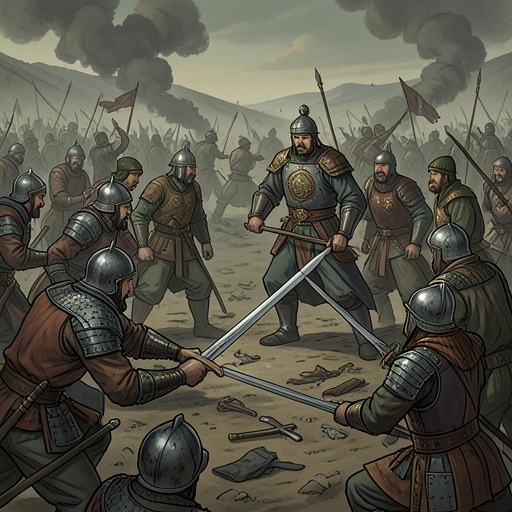
A Khitan force attacked the Jurchen hunting party, killing several of Aguda’s people. Xiao Feng initially tried not to harm his own ethnic group, but when the attack continued he seized the Khitan commander and compelled the force to withdraw. The encounter forced him to act across the boundary of his ancestry and his adopted friendships, while revealing how easily border violence turned communities into enemies.
After the clash
The Sworn Brotherhood
The captured commander identified himself as [Yelu Ji](entity:character-recall-character-d17403fa6b6e), a Khitan noble. Xiao Feng released him rather than accept ransom or treat him as an enemy, and the two became sworn brothers. Xiao Feng revealed his Khitan identity and wolf tattoo, while Yelu Ji invited him to share the wealth and authority of the Liao court; Xiao Feng preferred his simpler life among the Jurchen.
Several months later
The Emperor’s Gift
[Yelu Ji](entity:character-recall-character-d17403fa6b6e) sent an enormous gift of money, livestock, and goods to Xiao Feng, who accepted the gesture only to redistribute the wealth among the Jurchen tribe. The shared bounty strengthened his standing among Aguda’s people and reflected their communal ownership customs. A'Zi’s condition improved slowly through ginseng and animal remedies, though she remained physically weak.
Later that year
The Hunt at the Grassland
As A'Zi regained enough strength to travel, she persuaded Xiao Feng to explore westward across the grasslands. They came upon a large Khitan hunting assembly, where organized cavalry drove deer into an encirclement. The spectacle led Xiao Feng to recognize the commander among the troops and brought him face to face with the sworn brother whose true rank he had never known.
At the Khitan hunting camp
Yelu Hongji Revealed
[Yelu Ji](entity:character-recall-character-d17403fa6b6e) greeted Xiao Feng as an honored guest, and the soldiers’ cries of “Long live the king” revealed that he was Emperor Yelu Hongji. The two renewed their brotherhood despite the gulf between emperor and former wanderer. During the ensuing feast, Xiao Feng’s drinking and reputation impressed the court, while A'Zi’s quick flattery helped lighten the formal atmosphere.
During the return journey to the capital
The Southern Chancellery Rebellion
A military signal announced a rebellion in the capital: Yelu NieLugu had seized the palace and taken the imperial family and officials hostage. His father, Yelu ZhongYuan, was the emperor’s powerful uncle and had once stood next in line to the throne. Hongji’s army was outnumbered, and the rebels used the emperor’s relatives and soldiers’ families to undermine loyalty.
During the rebellion’s first major confrontation
The Family Hostages
The rebels captured the families of Hongji’s soldiers and threatened to execute them unless the troops surrendered. Hundreds of soldiers broke ranks to reach their loved ones, and the imperial force’s formation collapsed. Hongji chose retreat rather than order his men to fight through the civilians, while Xiao Feng remained beside him as the army withdrew toward the mountains.
The next morning
The Northern Chancellery Charge
With the rebel army closing in, the [Northern Chancellery](entity:organization-recall-organization-11a7e8b4c2ec) commissioner led three thousand soldiers in a desperate charge to buy Hongji time. They broke into the enemy’s formation but were killed, and their commander died after fighting to the end. Their sacrifice showed the cost of loyalty under the rebellion and left Hongji with little hope of recovering the throne.
At the height of the mountain battle
Xiao Feng’s Intervention
When Hongji prepared to surrender or die, Xiao Feng devised a way to disrupt the rebel leadership. He shot the Prince of Chu and then captured Yelu ZhongYuan, forcing the rebel troops to lay down their weapons after promising them amnesty in Hongji’s name. His bold action ended the fighting before the armies could destroy one another.
After the rebellion was suppressed
A New Imperial Office
Hongji restored order, spared most of the rebels, and appointed Xiao Feng Prince of Chu and Lord of the [Southern Chancellery](entity:organization-recall-organization-a758e4ed3e23). Xiao Feng accepted only after realizing that an outright refusal could destabilize the settlement. Though he had once wanted to avoid office, he now held authority over the very army that might be sent to conquer the Central Plains he still regarded as home.
After taking office
The Captives Released
While hunting near the Liao frontier, Xiao Feng encountered soldiers returning from a raid with hundreds of Song civilians as captives. He questioned the raiders, recognized the brutality of the practice, and ordered the captives freed rather than used as targets or sold. The decision confronted him with the cycle of reciprocal border raids and the human cost concealed by ethnic labels.
During the same hunt
You Tanzhi’s Lime Attack
Among the captives, You Tanzhi recognized Xiao Feng as the man he blamed for his father and uncle’s deaths. He tried to blind Xiao Feng with a concealed bag of quicklime, but Xiao Feng deflected it and disarmed him. Despite A'Zi’s wish to punish or kill the young man, Xiao Feng released him, acknowledging that the deaths at [Juxian Manor](entity:location-recall-location-juxian-manor-be7d2aa589ad) had not been deliberate.
After Xiao Feng released You Tanzhi
A’Zi’s Human Kite
A'Zi secretly ordered her attendants to recapture You Tanzhi and play with him as a human kite, flinging him into the air until he was badly injured. Her cruelty was paired with an emerging fixation: she wanted to keep him near because his stubbornness and obvious fascination entertained her. You Tanzhi, in turn, became captivated by her beauty even while suffering her abuse.
Several days after the capture
The Iron Mask
To conceal You Tanzhi from Xiao Feng, A'Zi had attendants take a mold of his face and forge an iron mask onto his head. She told him the disguise was meant to protect him from Xiao Feng, making him believe that his captivity was a rescue. She renamed him Iron Clown and kept him under her control, alternating apparent favors with threats and humiliation.
Soon after the mask was fitted
The Lion’s Trial
A'Zi tested You Tanzhi’s obedience by ordering him to put his masked head into a lion’s cage. When the lion could not crush the iron, You Tanzhi seized its keeper and pushed him into the cage; the lion killed the man. A'Zi praised the result as entertainment, while You Tanzhi interpreted her attention as a form of favor and begged to remain in her service.
After You Tanzhi became her servant
The Venomous Practice
A'Zi used the [Divine Wood King Cauldron](entity:object-recall-object-divine-wood-king-cauld-a08b774a6cf4) to attract venomous creatures and feed them blood before making them bite You Tanzhi. She absorbed the resulting poisonous blood to train her palm, treating his survival as incidental. You Tanzhi’s hidden copy of the Yijin Jing revealed diagrams when wet with his tears and saliva, and he instinctively followed its strange postures to neutralize the poison.
Several months into A'Zi’s training
The Frost Silkworm Hunt
When ordinary venomous creatures no longer satisfied her, A'Zi and You Tanzhi traveled farther from the city to seek a rare creature. They found a white python and a crystal silkworm that killed it and fed on its venom. A'Zi pursued the silkworm, but it escaped into a stream; You Tanzhi continued searching after she abandoned him and eventually found its scorched trail near a temple.
That evening near MinZhong Temple
The Monk and the Silkworm
You Tanzhi discovered that the silkworm belonged to [HuiJing](entity:character-recall-character-huijing-b5a3160fc331), a Shaolin monk who had confined it within a medicinal circle. He stole it by luring it into a wine gourd and carried it back to A'Zi. She kept the creature in a jar, fed it other poisonous animals, and prepared to use its extraordinary cold and venom in her training.
Ten days after the silkworm was captured
The Silkworm’s Bite
A'Zi ordered You Tanzhi to let the frost silkworm suck his blood, believing he would die and the poison would empower her palm. He used the diagrams from the Yijin Jing to circulate the cold energy through his body, unwittingly turning the creature’s venom into a source of strength. A'Zi absorbed the silkworm’s fluids, assumed You Tanzhi was dead, and had him discarded in a stream.
After several days in the stream
The Frozen Awakening
The water around You Tanzhi froze into a shell, preserving him rather than killing him. When the ice melted, he woke and understood that A'Zi had used him and would likely kill him if he returned. He began practicing the Yijin Jing diagrams more deliberately, though he still believed a silkworm spirit—not the manual—was responsible for the strange energy within him.
Several months after his recovery
The Wolf’s Death
While living alone in the wild, You Tanzhi killed a charging wolf with a reflexive palm. He was astonished by the force of the blow and credited it to the silkworm’s spirit, unaware that the Yijin Jing and absorbed frost poison had transformed his internal power. His once-feeble body was becoming a dangerous weapon, even as his motives remained shaped by revenge and obsession.
About a year after A'Zhu’s death
The Beggar Clan Gathering
You Tanzhi overheard [Beggar Society](entity:organization-recall-organization-beggar-society-25b665a53abd) members discussing [Qiao Feng](entity:character-recall-character-574cafa84444)’s disappearance and the search for a new chief. He learned that Quan Guanqing was again being considered for leadership and followed the group to a gathering of the [Hall of Great Wisdom](entity:organization-recall-organization-1250a2f7b3e7). The chance to locate Xiao Feng revived his old grievance, while the mention of the former chief tied his private vengeance to the Society’s unsettled political struggle.
At the Hall of Great Wisdom gathering
Duan Yu’s Message
Duan Yu arrived with a letter from his father, Duan Zhengchun, stating that [Bai Shijing](entity:character-recall-character-11b92d92cf22) and [Madam Ma](entity:character-recall-character-53f1b9b6079d) had not been killed by [Qiao Feng](entity:character-recall-character-574cafa84444) and that [Ma Dayuan](entity:character-recall-character-5817033489a0)’s death had another cause. Quan Guanqing accepted the letter but deferred its reading until the Society’s general assembly. The message supplied independent confirmation that Xiao Feng had been framed, but the crucial identity behind the old letter remained unsolved.
After Duan Yu’s visit
The Chess Invitation
Two mute messengers invited Duan Yu and Quan Guanqing to a chess gathering at [Lei Gu Mountain](entity:location-recall-location-218907e1aa7e), hosted by [Su XingHe](entity:character-recall-character-su-xinghe-b72229999e54). Duan Yu accepted, still preoccupied with [Wang YuYan](entity:character-recall-character-wang-yuyan-30bdce89c73e) and hoping the journey might bring him closer to her. Quan Guanqing declined, while the invitation drew the story toward the hidden conflict between Su XingHe and the Xingxiu Sect.
That night
The Poisoned Messengers
Two messengers of Su Xinghe were found dead after delivering the invitation, obviously killed by poison related to Ding Chongchou's disciples. Subsequently, a disciple of the Star Host sect appeared at the gathering of the Thieves' Society, demanding the poison to give to the master
The following morning
Ding Chunqiu’s Valley Attack
Ting Chongchun led a group of disciples to attack the with poison whistles and hidden poisons. Quan Guanqing's giant python array initially restrained Ting Chongchun and his disciples, but the head of the Star Host Sect applied poison, turning the situation
During the valley battle
You Tanzhi Saves the Xingxiu Sect
You Tanzi hid nearby, set fire to drive away the giant python and rescued Ding Chongchou and his disciples. The people of the Xingxu Sect praised Ding Chongchou instead of the one who saved them; however, Ding Chongchou noticed that You Tanzi
A few days after the valley battle
The Search for HuiJing
Ting Chongchun learned that Huijing once obtained a ice snake, so he set out to find him and believed that there might be other ice snakes in the [Kunlun Mountains](entity:location-recall-location-2b0a905e8b1e). The members of the Xingxu sect met and the other retainers of Mo Dun
At the roadside pavilion
The Pavilion Clash
A stormy wave attempted to remove the iron mask from You Tanzi's face, but it had already fused with his face. You Tanzi struck the stormy wave with a hand force infected with cold poison, causing him severe injuries; Xuan Tong also suffered from the same cold poison. Ding
After the pavilion encounter
Xue MuHua’s Staged Death
Xuan Nan and the retainers of the Mo Cong family delivered a poisoned companion to Xue Mu Hua's residence, but they found a funeral notice and a suspicious servant who claimed Xue Mu Hua had died. A coffin filled with stones and poison confirmed that Xue Mu Hua had
During the confrontation at Xue MuHua’s residence
XuanTong’s Enlightenment
While Baoyu and Hekei were fighting, the learned Goudu tried to persuade Xuan Tong using the teachings of Confucianism and Buddhism. Xuan Tong suddenly understood the principle of non-attachment, put down his weapon, and sat in meditation. He peacefully passed away
In the underground refuge
The Eight Friends’ History
Hsueh Mu Hua explained that he and the other seven were disciples of Su Xinghe. Su Xinghe was once forced by his younger brother Ding Chunqiu to be silent. Ding Chunqiu betrayed his master, injured his master, and after surpassing his master in
That night in the refuge
The Cave Is Breached
Ding Chongchou found the underground hideout, but couldn't decipher the mechanisms. Instead, he began to attack all the entrances. The Eight Friends realized the cave wouldn't last long, so they decided to join forces to fight. Xuan Nan and the retainers of the Mengdong
As the refuge was breached
The Eight Friends’ Defiance
Ting Chongchun threatened Su Xinghe with poison fire and murder, forcing Xue Mu Hua to rescue Hui Jing. Xue Mu Hua agreed to save Hui Jing to prevent his master from becoming Ting Chongchun's target, even though he knew Ting Ch