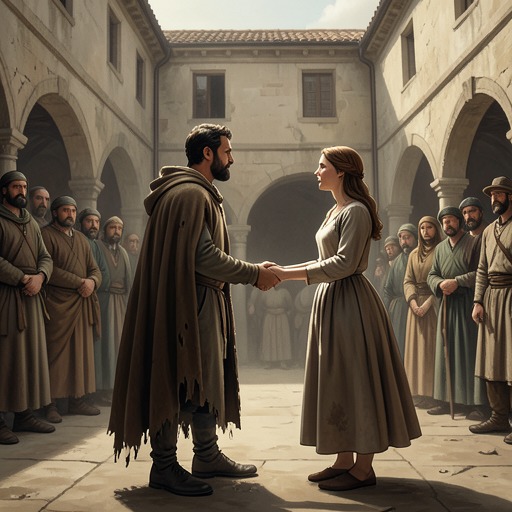
Abindarráez is captured by Rodrigo de Narváez and allowed to return temporarily
DianaAbindarráez’s capture by Rodrigo de Narváez is the turning point that interrupts his journey to Jarifa and tests what a victorious captor owes to a defeated opponent. In the embedded tale Felismena recounts at Felicia’s house, a night patrol becomes a fierce contest of arms; then the prisoner’s explanation transforms the encounter into an act of mercy. Narváez releases Abindarráez on his word, allowing love to proceed without dissolving the obligation of honor.
Background and the journey to Coín
Felismena introduces Rodrigo de Narváez as a celebrated captain whose distinction rests on both warfare and generosity. After the infante Don Fernando’s conquest of Antequera, Narváez received responsibility for its defense and for the fortress at Álora. He remained there with fifty selected gentlemen in royal service. The patrol that meets Abindarráez is a small expedition from this garrison, undertaken to see whether their Moorish neighbors have left the roads unguarded.
Abindarráez is traveling from Cártama toward Coín, a short journey made weighty by the purpose of his visit. Jarifa has sent for him while her father is away in Granada, and Abindarráez expects to see her and marry her. Their relationship already carries the force of a commitment: Jarifa has pledged herself to him, while the separation caused by her father’s transfer from Cártama has left the lovers waiting for an opportunity to reunite. On the road, however, Abindarráez’s thoughts are so occupied by love that his song and sighs betray the sorrow beneath his anticipation.
The night encounter and capture
Narváez rides out with nine companions, keeping some men behind to guard Álora. At a fork in the road, the patrol divides into two parties, with a horn as the signal for assistance. One group hears a man singing and withdraws among trees to watch him pass. The song marks Abindarráez not as an ordinary traveler but as a lover in distress; the patrol, however, sees an opportunity to seize a valuable captive and attacks.
Abindarráez meets the five assailants with his lance. He fights hard enough to put three on the ground and force the other two to face him, despite a wound in his thigh. When he loses his lance, he appears to flee; then, leaning down from his horse, he retrieves the weapon from beside one of the fallen men and turns back to the fight. A horn brings Narváez to the scene before the two remaining attackers can be overcome. The episode establishes Abindarráez’s courage through action: wounded and outnumbered, he continues to resist rather than surrender at the first disadvantage.
Narváez then challenges him directly. He admires the Moor’s skill and sees honor in defeating an opponent of such evident ability. Their combat continues until Abindarráez, already exhausted and hurt, gives Narváez a strong lance-thrust over his shield. Narváez strikes his arm in return, closes with him, and pulls him from the saddle. The capture is decided by physical force, but the narration distinguishes defeat from cowardice: Abindarráez has fought boldly, and his horse and wounds have helped bring him down.
The captive’s explanation and Narváez’s decision
Rather than treating his prisoner’s melancholy as weakness, Narváez asks why a man who has shown such courage sighs so deeply. He promises friendship if Abindarráez will tell him the cause. The question changes the encounter’s direction. Abindarráez explains that his grief is not simply the pain of his wounds or the shame of capture: he is the young Abindarráez, of Granada’s Abencerraje family, and the misfortunes of that house have shaped his own sense of ill fortune.
He then tells Narváez what the interrupted journey meant. Jarifa had called him to Coín, and he was traveling in hope of seeing her and becoming her husband. The prospect had made him joyful; capture, he fears, will cost him the chance at precisely the moment it has come within reach. His distress gives the military victory a second meaning. Narváez has not merely taken an enemy combatant; he has unknowingly stopped a lover on the way to a long-awaited reunion. Abindarráez’s disclosure also makes clear that the depth of his sorrow cannot be measured by his injuries alone.
Narváez responds by offering a conditional release. If Abindarráez promises to return to Álora and become his prisoner again within three days, the captain will let him continue to Coín. Abindarráez accepts the condition and pledges himself as a knight. Narváez calls his companions back, takes responsibility for the prisoner’s return, and confirms the agreement by asking for Abindarráez’s word. The arrangement does not erase the capture: it places the captive’s liberty in the keeping of his own promise.
Before Abindarráez departs, Narváez gives him a horse because his own mount has been hurt in the fight. Abindarráez is also fatigued and losing blood, so the release is an act of practical assistance as well as clemency. He rides urgently toward Coín, while Narváez and his men return to Álora speaking of his valor and bearing.
Reunion, return, and significance
At Coín, Abindarráez reaches the fortress and enters by a concealed door after checking that the surrounding ground is quiet. Jarifa’s attendant lets him in, and the lovers reunite. Jarifa tells him that she has summoned him in order to make him her husband; their private commitment becomes marriage. The immediate consequence of Narváez’s decision, then, is not escape from obligation but the fulfillment of the purpose that had brought Abindarráez onto the road.
The larger story brings the promise back into view: Abindarráez returns to Narváez, and Jarifa comes with him. Narváez’s permission has enabled the couple’s reunion without turning his word into an empty formality. The capture thus establishes a bond between adversaries that depends on trust as much as force. Narváez’s victory is real, but his generosity gives the defeated man room to act honorably; Abindarráez’s return, in turn, answers mercy with fidelity. Set within Felismena’s tale, the episode places bravery, love, parole, and compassion in the same chain of consequences, showing how an act of clemency can redirect a military encounter toward mutual respect.