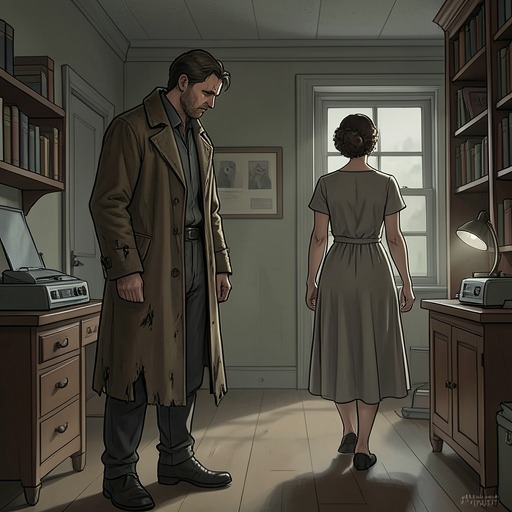
Danteo and Duarda’s final break
DianaDanteo and Duarda’s final break turns on the difference between a promise and an action: he returns to court a woman he once pledged to marry, but she refuses him because he married Andresa instead. Duarda recounts how she trusted him, refused to elope, and then watched him marry another; his wife’s recent death does not undo that breach. Her answer is not simply a rejection of his present suit but a declaration that the choice he made released her from their former bond.
The encounter beside the Mondego
Duarda’s story unfolds in Lusitania, where Felismena overhears her speaking with Armia beside the Mondego River. Armia urges her to pity Danteo, who loves her and suffers for her, and to remember the services he once performed. Duarda refuses to be persuaded by those reminders: she says he promised to marry her and then married someone else. Now that Andresa has died, he has returned to ask for Duarda’s hand, but Duarda sees no reason to accept the man who once abandoned their understanding.
The delay matters to Duarda. Andresa has been dead for less than a month, yet Danteo is already renewing his courtship. Armia treats his return as evidence that he belongs with Duarda after all, even suggesting that Andresa’s death has restored him to her. Duarda answers that she belongs to herself. Armia’s confidence in the lovers’ original bond meets Duarda’s insistence that a past attachment cannot overrule the choices made since.
The promise and the marriage
Armia offers a defense of Danteo’s earlier marriage. She recalls that before he married, Danteo told Duarda that his father wanted him to marry and asked what he should do. Duarda replied that she had neither the age nor the power to grant him permission, and that he could follow his own will and his father’s wishes, as she would follow hers. Armia presents this exchange as a kind of release: Danteo, she argues, could reasonably understand Duarda’s answer as permission to proceed.
Duarda rejects that account by setting it beside an earlier conversation. The day before Danteo asked about his father’s wishes, he had urged her to marry him secretly, without their parents’ consent. She refused—not because she did not love him, but because she believed their promise sufficient and thought it wrong to risk a secret marriage when waiting might allow their parents’ anger to pass. She had told him she was his and could never belong to another. For Duarda, that assurance makes his later conduct all the more decisive: he asked for leave to marry, and within three days he had done so. The sequence, rather than Armia’s interpretation of a single reply, defines the injury.
Declarations weighed against deeds
When Danteo arrives, he speaks to Duarda in Portuguese and offers practical service as well as renewed devotion. He asks only that his company not trouble her or his verses weary her; he offers to take her goats to the river, watch the flock, and spare her labor. His proposal makes love legible as care and work. But Duarda answers by recalling the care she once gave him: no other shepherd in the fields around the Mondego had received from her even a word that might encourage complaint, and she tended his sheep with greater solicitude than her own.
She acknowledges that her devotion made Danteo confident, then names what followed: he married Andresa. In the aftermath, she says, she wished for vengeance on both of them, and endured what others knew of her suffering. She does not present that earlier wish as a reason to resume their relationship. Instead, she distinguishes the feeling she once gave him from the freedom she has since reclaimed. His present offers cannot make the earlier marriage disappear, and his words cannot substitute for the fidelity he failed to show.
Felismena, who has listened to the exchange, supports Duarda’s distinction between speech and conduct. She reflects that finely arranged words and songs can make claims of love persuasive without proving that love is true. This response gives the encounter a wider emphasis: Danteo’s poetry and service may express present desire, but Duarda judges him by the choice he made when their promised future was at stake. The scene does not establish that his feelings are false; it shows that, for Duarda, feeling alone cannot repair the breach.
Refusal and interruption
Duarda ends the dispute by refusing to spend more time on it and asserting that, since a person who belongs to one cannot belong to another, she now belongs to herself and cannot belong to Danteo. Her position closes off the future Armia imagines. The relationship is not restored by Danteo’s bereavement, his renewed devotion, or the memory of their earlier intimacy; Duarda treats her regained independence as the consequence of his marriage to Andresa.
The conversation is cut short when the shepherds hear the sound of combat nearby. Felismena and the others hurry toward the commotion, where a lone knight is being attacked by three opponents, and Felismena intervenes. The abrupt shift leaves Danteo and Duarda’s refusal as the scene’s last word on their relationship: the narrative moves on without showing a reconciliation, and Duarda’s decision stands as an explicit break rather than an invitation to further persuasion.