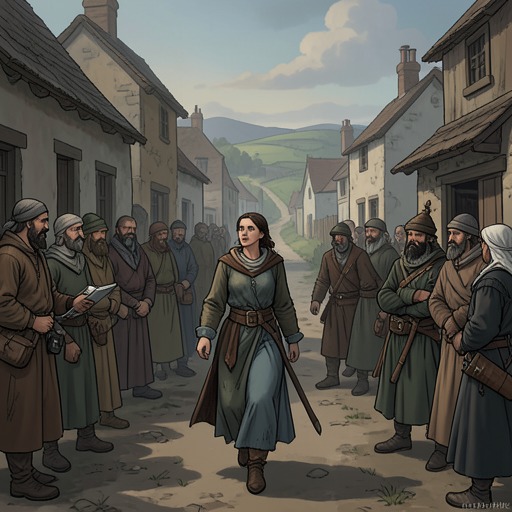
The Romantic Entanglement of Selvagia, Alanio, Ismenia, and Montano
DianaThe Romantic Entanglement of Selvagia, Alanio, Ismenia, and Montano is a chain of mistaken identity, redirected affection, and unreturned love, told by Selvagia as the history of her own misfortune. Ismenia’s disguise first draws Selvagia toward the wrong person; the real Alanio then loves Selvagia, while Ismenia tries to recover him by turning to Montano. As each affection shifts, the four shepherds become bound in a pattern no one can fully control, and Selvagia’s tale ends not in romantic union but in exile from her home and a generous wish for the man who has forgotten her.
A Deception at the Festival
Selvagia places the beginning of her story in Lusitania, in a fertile pastoral province between two great rivers. She lives in a village by the Douro, near a magnificent temple of Minerva visited by shepherds and shepherdesses at an annual festival. The celebration has distinct customs: shepherdesses and nymphs arrive to keep vigil in the temple, while shepherds may enter only to pay their respects and must then leave until the next day’s ceremonies. The separation gives Ismenia an opportunity to remain among the women without the shepherds present.
At the temple, Ismenia approaches Selvagia disguised as a shepherdess’s male companion and claims to be Alanio, from a village three miles away. Selvagia believes her. They speak through the night, exchange embraces and promises, and part at dawn with tears and sighs. Selvagia remembers Ismenia’s apparent laughter as she leaves, but at the time explains it away as a mistake of her own eyes. She returns home carrying the supposed Alanio’s words and the conviction that she has fallen in love.
The truth is that Ismenia has a cousin named Alanio, whom she loves deeply and who resembles her so closely that, apart from their sex, the two might be taken for one another. When Selvagia asks her supposed suitor’s name, Ismenia instinctively gives the name already foremost in her heart. Later, leaving the temple, Ismenia meets the real Alanio and tells him what happened, laughing as she describes how Selvagia has been deceived and believes herself to love a man. Alanio draws out the details. Eight days later, he comes to Selvagia’s village and meets her by a nearby spring. She takes him for the same person who had spoken to her in the temple; their conversation confirms her love, and Alanio, too, seems to become attached to her.
Affection Changes Direction
Selvagia and Alanio continue their relationship in secret, but Ismenia discovers it. She recognizes that her deception has helped bring about the very result she fears: Alanio has turned toward Selvagia and away from her. Selvagia, for her part, does not stop loving him once she learns the truth; she says that knowing who he really is only strengthens her attachment. Ismenia writes to her, seeking to undo the deception and urging her to give Alanio up. Selvagia’s reply acknowledges Ismenia’s pain but refuses to abandon her own love, while also recognizing that Ismenia has, in effect, given her the person she treasures most.
Ismenia then tries to make Alanio jealous by pretending to return the affection of Montano, a shepherd who has long courted her and whom Alanio dislikes. The plan works in an unexpected way. Montano responds with joy and devoted service, and Ismenia’s initially feigned attachment becomes genuine: she comes to love Montano and to wish to avoid Alanio. Alanio, meanwhile, is distressed to see Ismenia favor his rival. He begins courting her again and visits Selvagia less openly and less often. His feelings for Selvagia lose ground as his jealousy and renewed attention to Ismenia take hold; Selvagia remains constant, but the relationship she thought secure fades through his withdrawal.
The pattern becomes still more intricate when circumstances bring Montano near Selvagia’s village. Montano’s father visits on business concerning pasture lands with Selvagia’s father, and Montano himself has begun to cool toward Ismenia, whether from the abundance of her favors or from jealousy of Alanio’s attentions. When he sees Selvagia bringing her sheep to the fold, his affection turns toward her. The four now desire in a chain: Selvagia loves Alanio, Alanio loves Ismenia, Ismenia loves Montano, and Montano loves Selvagia. Their movements through the countryside mirror that sequence, as each follows the person who does not return their love.
The Four in the Valley Wood
The shifting attachments converge in a wood between the two villages. Ismenia has gone to visit shepherdesses nearby; Alanio follows her and finds her beside a stream, combing her golden hair. Selvagia hears that Alanio is going to the valley wood and takes goats with her as an excuse to follow. She finds him weeping over Ismenia, who laughs at his tears and sighs. Selvagia confronts Ismenia about the original deception, but Ismenia answers with enough composure and argument to reverse the accusation: Selvagia, she points out, has not only gained Alanio but also drawn Montano away from her.
Montano arrives after hearing from Solisa, a shepherdess who is a friend of Selvagia. The episode brings the four people whose desires have been repeatedly displaced into one place, making their incompatible attachments visible at once. Their story is not a simple contest between a faithful lover and a fickle one: Selvagia persists, Ismenia’s feelings genuinely change, and Alanio’s return to Ismenia comes at the cost of his earlier attachment to Selvagia. The sequence of pursuits exposes how quickly a lover’s apparent security can become another person’s abandonment.
Songs, Marriages, and Selvagia’s Departure
The shepherds give voice to their changing loyalties through song. Alanio sings while fixed on Ismenia, and Selvagia watches the man she loves appear lost to someone else. She bears the scene in silence at first, in part because she is not the only one suffering: Ismenia, now looking toward Montano, also begins to sing. Later Montano sings an old song about loving someone who loves another. Selvagia’s own song expresses her willingness to keep loving even if she must die forgotten. Her constancy is presented not as a path to reward but as the condition that makes the other characters’ changes so painful.
After Selvagia finishes, the shepherds weep, especially Ismenia. The group returns to its villages because remaining outside at such a suspicious hour would violate their sense of propriety. The next day, without telling Selvagia why, her father removes her from their village and takes her to the home of her aunt Albania. Selvagia has been displaced from the place where the entanglement unfolded, and she does not know the reason for her removal. She later learns that Montano has married Ismenia and that Alanio intends to marry Silvia, another of Ismenia’s sisters. Though Selvagia has lost Alanio, she hopes he will be happy with his future wife, because her love for him still leads her to wish him every joy.
Narrative Significance
Selvagia tells this history in retrospect, presenting the romantic confusion as an experience that has given her the right to speak about love’s injuries. The episode’s structure turns on repeated reversals: a false Alanio introduces Selvagia to desire; the real Alanio seems to confirm it; Ismenia’s feint toward Montano becomes sincere; and Alanio’s attempt to recover Ismenia abandons Selvagia. The eventual marriages settle two of the shifting attachments, but they do not repair Selvagia’s loss. Her departure and her final goodwill toward Alanio leave the story with an unresolved contrast between emotional constancy and romantic outcome: steadfast love may survive, even when it brings neither possession nor return.