L’origine du tableau de chasse
DingoL’origine du tableau de chasse is the narrator’s mock explanation of how the hunter’s display of game began: aboard a ship, Dingo kills livestock and caged birds, then arranges the bodies by species and size. The narrator first sees the scene as costly damage, but recasts it as a major sociological discovery, complete with a triumphant report to his club. The episode’s comedy depends on the collision between an animal’s practical behavior and the grand human theories built around it; its accompanying lament for the threatened dingo gives the joke a serious undertone about human mastery over other species.
The Claim and Its Setting
The explanation comes through a letter from Sir Edward Herpett, who presents Dingo as an unusual and increasingly rare animal. His account makes a show of scientific classification: dingoes, he says, were once considered dogs, but respectable naturalists now treat them as an autonomous intermediate species between dogs and wolves. He invokes disputes among scholars and the authority of a congress, then declares the classification settled by an imposing list of disciplines. The learned apparatus is deliberately excessive, preparing the reader for a story in which an ordinary animal act will be elevated into a discovery about human culture.
Herpett’s letter also casts Dingo as a fashionable gift. He predicts that the animal will become a prized accessory among London gentlemen, and says that Edward VII intends to replace a human attendant with his own dingo. This blend of status, scientific prestige, and affection for a supposedly magnificent animal makes the shipboard episode more than an isolated anecdote: Herpett is both promoting Dingo and presenting himself as an authority on its nature.
The Shipboard Tableau
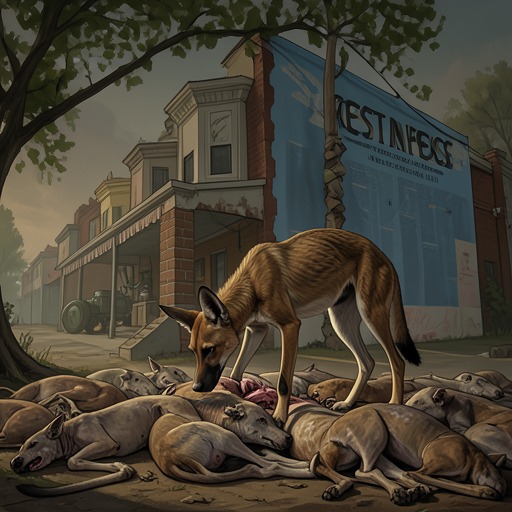
During the return voyage, Dingo escapes the Malay boy entrusted with watching her at night and reaches the ship’s rear deck, where the poultry cages and sheep pen are located. By about three in the morning, she has killed the animals there. When discovered, she is finishing a methodical arrangement of the dead animals on the deck, grouping them by species and placing them in rows ordered by size, as hunters do with game after a day’s hunt.
The display is not limited to the poultry and sheep. Dingo has also strangled numerous unusual birds kept in sturdy wicker cages for London Zoo. Among them is a rare bird of prey, whose peculiar features Herpett describes at length. The administration of the ship charges him 455 pounds in compensation. The passengers, however, are entertained by the episode and by Herpett’s continuing accounts of dingo habits and scientific history. The scene thus joins a precise financial consequence to a spectacle that becomes social amusement—and, in the narrator’s later telling, evidence for a theory.
A Comic Scientific Discovery
Herpett’s first response is anger and regret: he had allowed Dingo to roam freely on deck because she was gentle and popular with the passengers, and the captain points out that a muzzle might have prevented the destruction. Herpett counters that it is uncertain whether Dingo would have accepted such a restraint. His response then reverses. Instead of regretting the loss, he becomes immensely proud, reasoning that the animal’s arrangement of her kills reveals the origin of the tableau de chasse.
The claim deliberately echoes the grand scale of scientific discovery. Herpett compares himself with Herbert Spencer, who was said to have traced cultural forms to practices among the Fijians, and declares that his own observation is an even greater sociological achievement. At a stop in New York, he sends his club a triumphant telegram announcing that he has beaten Spencer’s record. The compensation bill, once a painful cost of Dingo’s actions, becomes in his account a small price for scientific glory. His closing suggestion that scholars are jealous completes the parody: the discovery’s authority rests not on examination or proof, but on the discoverer’s boastful interpretation of a startling scene.
Wildness, Utility, and Extinction
The episode’s humor depends on a reversal of human and animal roles. Dingo’s orderly arrangement resembles a human hunting ritual, but the apparent resemblance does not establish that she shares its cultural meaning. Herpett turns observed behavior into a story about civilization’s origins, just as his elaborate taxonomic claims turn an animal into an object of classification and fashionable display. The account invites readers to notice the distance between what was observed—the arrangement of the kills—and the expansive theory imposed upon it.
That tension resonates with the narrator’s later recognition that trying to impose human habits and concepts on Dingo misunderstands the animal’s distinct nature. The narrator comes to respect Dingo’s resistance to being made into something between a dog and a human being. In the shipboard story, Herpett’s interpretation is affectionate and absurd rather than a neutral scientific account, but it nonetheless illustrates how readily people make animal behavior serve human ideas. The tableau is at once evidence of Dingo’s practical activity and a screen for human speculation.
Herpett’s letter also places the anecdote against the decline of dingoes in Australia. He says that the species has disappeared from Tasmania and is diminishing on the Australian mainland as settlers destroy forests and wage an exterminatory war against dingoes. He fears that surviving animals will be confined to acclimatization gardens, where their distinctive traits will weaken until they become like domestic dogs. His counterfactual is pointed: had dingoes been destroyed before his arrival in Australia, he suggests, science might have lost the supposed discovery of the tableau de chasse. The comic self-importance of that claim sits beside a genuine warning that human destruction can erase animals and the possibilities for understanding their lives.
Narrative Function
L’origine du tableau de chasse is not offered as a verified account of the historical origin of hunting displays. It is a story within Herpett’s letter, retold and framed by the narrator, whose escalating claims expose the instability of supposedly authoritative explanations. The pattern is characteristic of the episode’s satire: an animal acts, a human witnesses the act, and scientific and social prestige gather around an interpretation that exceeds the evidence.
The same contrast appears elsewhere in the novel when Dingo’s preferences resist the narrator’s efforts to teach him human ideals, or when the narrator reflects that dogs understand human speech more readily than humans understand animal communication. Read alongside those reflections, the tableau episode does not simply make Dingo a comic imitator of human hunters. It shows how the human observer converts an animal’s behavior into a mirror of human custom, while leaving open the more difficult question of what that behavior means within the animal’s own life.