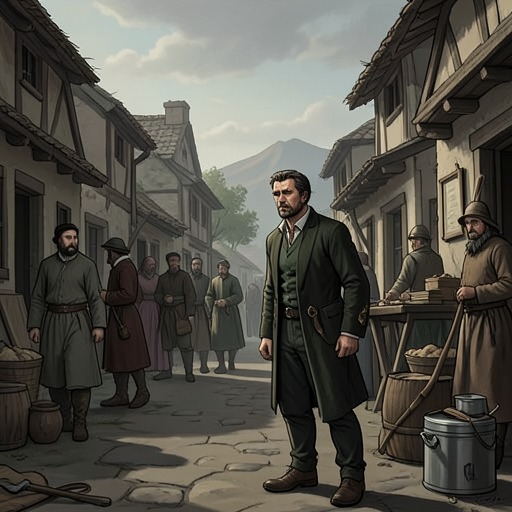
« Avant toute chose, il faut des pauvres et des riches »
DingoThe saying “« Avant toute chose, il faut des pauvres et des riches »” is Pierre Piscot’s inherited defense of social hierarchy, voiced as though the existence of rich and poor were an unquestionable necessity. Repeated by Mme Piscot amid the pressures of raising a large family, it becomes more than a political slogan: it expresses how deprivation can be accepted as the natural order even by those bearing its costs.
Origin and Use
Pierre Piscot repeats the position of his late father in political conversations at Jaulin’s. He has no hope for the promises of social revolution; instead, he insists that society must contain both rich and poor. The narrator presents the belief as a family inheritance, passed down despite the suggestion that it brought Piscot’s father little benefit.
Piscot’s alarm at the prospect of a society without either rich or poor makes the saying practical as well as ideological. He wonders what place he himself would have in such a world. The maxim thus protects a familiar social arrangement not by explaining how it serves the poor, but by making its disappearance seem incomprehensible.
The Saying in the Piscot Household
Mme Piscot repeats the same formula in her own moments of distress. The household has eight children, and caring for them keeps her at home rather than allowing her to take productive work outside it. The narrator describes a life in which she rarely complains, apparently unable to imagine that it could be otherwise; when hardship presses, she falls back on the words Piscot uses.
The family’s material circumstances give the refrain its force. Pierre Piscot earns three francs on working days, but earns nothing on Sundays and spends much of the week’s wages on drink. Occasional assistance brings clothing, firewood, vegetables, or, from time to time, leftover meat. The narrator calculates that ten people must manage food, clothes, tools, repairs, and drinking on the daily wage in a small rural community where goods are expensive and practical transport is lacking.
Meaning and Narrative Function
The saying’s repetition links political conservatism to everyday resignation. Piscot treats a class-divided society as indispensable, while Mme Piscot uses the same claim to voice distress without imagining an alternative. In the narrator’s account, the phrase exposes how an inherited doctrine can pass from political talk into the household and help make severe inequality appear inevitable.