La jaunisse mortelle de Dingo
DingoLa jaunisse mortelle de Dingo is the final illness and death of Dingo, whose fierce, energetic life gives way to a prolonged bodily collapse. The episode brings the narrator’s practical care into close contact with the limits of veterinary medicine, and makes Dingo’s trust in those caring for him a defining feature of his last days.
Diagnosis and Decline
While confined to stillness in the bedroom, Dingo falls ill. Yellow and brown marks soon appear across his eyes, the mucous membranes of his mouth, and his eyelids; he vomits blood. The veterinarian identifies the disease as jaundice and gives almost no hope of recovery, saying that only one dog in a thousand survives and that he has never saved one. In his experience, dogs die by the eleventh day.
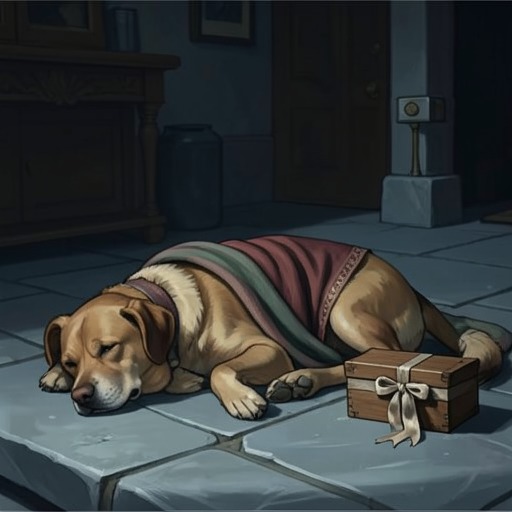
The diagnosis makes Dingo’s altered body starkly visible. The narrator recalls the dog who once bounded toward him affectionately and the supple predator who sank his teeth into living sheep and chickens; now Dingo lies on a rug, his head tilted under its own weight. His body has wasted to a skeleton, his once-firm muscles drawn tight over prominent bones. The tawny plume of his tail has lost its fullness, while his head seems disproportionately large above his diminished frame. At night, under the weak lamp, he resembles a discarded cardboard animal or poor child’s toy. The contrast is not simply between strength and weakness: it is between the active animal known through motion and the fragile body that illness has made impossible to overlook.
Care, Trust, and Death
Despite the severity of his illness, Dingo submits completely to the care he is given. He offers his paws, head, and every part of his body without hesitation. During washing or when medicine is administered, his watchful, docile eyes turn away, as though he cannot bear to look at the danger and is trying all the more completely to obey. Afterward, he looks toward the narrator with a gentle, sorrowful gratitude, weakly wags his tail, and returns to his bed in a zigzagging walk, his weakened body pulling him first one way, then the other. His dependence is not expressed in words but in this repeated sequence of surrender, recognition, and effortful retreat.
The narrator keeps Dingo alive through sustained care until the seventeenth day, six days beyond the veterinarian’s expected limit. That night, while his wife sleeps, the narrator sits half-reclined beside her bed and Dingo rests on a mattress at his feet. Dingo’s breathing is short and labored; fever makes him tremble. Still hoping because the eleventh day has passed, the narrator gently washes his throat, mouth, and lips, where long yellow strings of saliva have gathered. The washing seems briefly to ease him. Then, with a last effort, Dingo stands and stretches his two limp paws toward the narrator’s chest like arms. He rises against him, falls heavily, and dies with his head on the narrator’s knees.
Grief and the Body
Dingo’s death leaves the narrator awake until morning, grieving in the dim light of the bedside lamp. His thoughts return to the blackened fir box from which he had once lifted Dingo as a tiny, comical puppy; the memory of that beginning makes the dog’s diminished body more than the end of an illness. The narrator weeps silently for a long time, while his wife, asleep in the adjoining bed, does not wake.
The scene widens into a reflection on why animal death can seem more immediately final than human death. Human beings, the narrator observes, are schooled by inheritance and education to believe in the soul’s immortality, and so resist what a human corpse presents; people may accept more readily that a dead dog is simply gone. Yet this apparent difference does not lessen his attachment to Dingo. Not wanting his wife to see the corpse, he carries it into his own room, then returns to find her still sleeping the attentive sleep of the ill. Her continued immobility makes the loss newly precarious: beside Dingo’s death, the narrator is left facing uncertainty about how many days his wife will remain in bed.
An Unresolved Vigil
Dingo’s survival beyond the veterinarian’s eleventh-day estimate changes the measure of his final illness, but not its outcome: care prolongs his life to the seventeenth day without making recovery possible. The ending therefore refuses the comfort of treating devotion as a cure. Its last uncertainty belongs not to Dingo, whose death is definite, but to the narrator’s wife, still ill and motionless as he returns from carrying the body away. The vigil ends with grief and care still bound together, and with no assurance about how long the next vigil will last.