La sédentarité forcée de Dingo à Paris
DingoLa sédentarité forcée de Dingo à Paris is a period of confinement imposed after the narrator begins watching Dingo closely and limiting him to brief, supervised walks. The arrangement is meant to contain the danger of his uncontrolled attacks, but it leaves him withdrawn and inactive. His deterioration also prompts the narrator to question whether Dingo alone is responsible for the trouble: apartment life has denied him the space and activity suited to his nature.
Background and Restrictions
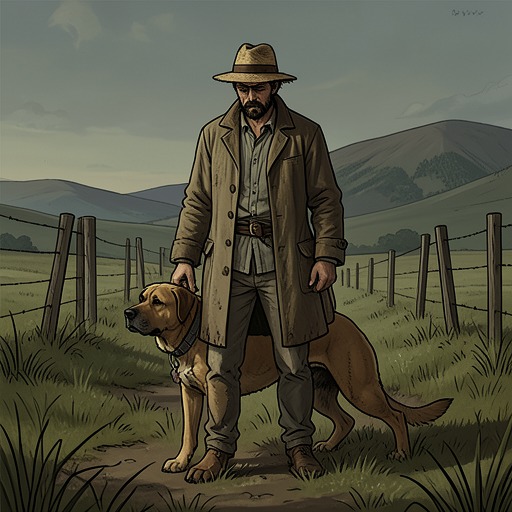
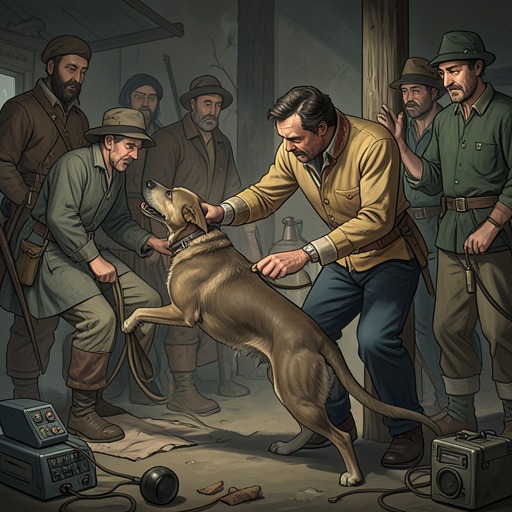
Dingo’s confinement follows a history of forceful hunting behavior. At Ponteilles, he would watch sheep pass the narrator’s gate and struggle to contain his agitation, displaying an intensity that contrasted with his quiet observation of people in the street. In another episode, he killed one hundred hens in a farmyard. These incidents make the narrator’s decision to keep him under close supervision understandable, even as the restrictions become severe.
The narrator keeps Dingo at home and permits only short, hygienic outings, accompanying him without taking his eyes off him and often using a leash. The arrangement narrows Dingo’s world to the apartment and the controlled walks beyond it. The narrator’s vigilance is practical, but it also makes the confinement a daily condition rather than a temporary interruption: Dingo cannot range freely or pursue the adventures that had previously occupied him.
Life Inside the Apartment
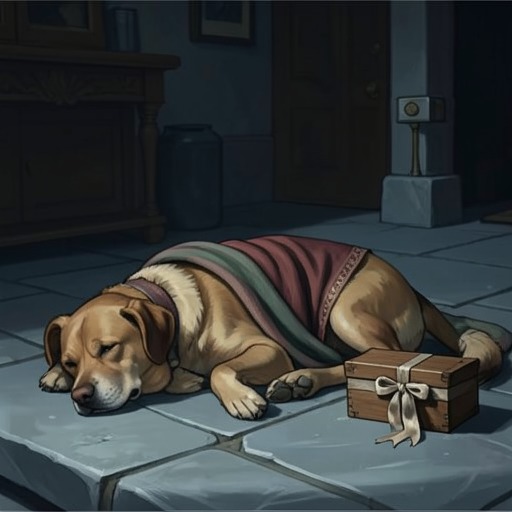
At first, Dingo inspects the rooms and tries to use the narrow entrance hall as a place to play. He soon seems to understand that there is too little room for such activity and settles into the stillness expected of an apartment dog. His apparent acceptance is marked by humiliation and distaste; rather than adapting cheerfully, he increasingly lies down and stays there, as though sleep were the only remaining pleasure.
The change is physical as well as behavioral. Dingo loses his appetite, leaves the food offered to him, and does not rouse even when presented with raw meat. The narrator describes a dog who has not simply become calm but has lost interest in movement and ordinary rewards. This decline gives the restrictions a cost: the same watchfulness intended to keep Dingo from harming others also confines the animal until he seems to have relinquished most of his former activity.
Miche and the Domestic Routine
The indoor routine brings Dingo closer to Miche, who accepts apartment life more readily. At Ponteilles she had ranged through the countryside, hunted birds, and searched fields for small animals; in Paris she sleeps on rugs and does not venture onto the landing. Her adaptation makes the contrast between the two animals plain. The same domestic setting that suits Miche leaves Dingo dispirited.
Miche tries to draw him into play each day before lunch. She approaches, gives him a light tap with her paw, moves away, and repeats the invitation until he agrees to follow her through the entrance hall and open rooms. Dingo plays only weakly and with distraction. At times he stops, turns his head, and appears to attend to a space beyond the apartment walls, where he could use his body freely. When he refuses to join in, Miche examines him by moving around him and then settles on a chair. Her repeated attempts make their companionship visible, but they do not restore his energy or resolve the mismatch between Dingo and his surroundings.
Hunting Instinct and Human Responsibility
The confinement does not remove Dingo’s hunting impulses; it redirects them toward what is available indoors. Each day he goes to the cupboard where the furs are stored, whining, scratching at the floor, and biting the door’s wooden mouldings. When the door is left open, he enters and tears apart a sable stole, then attacks other furs, including an otter coat. He carries the items into the salon, turning the domestic room into the scene of a destructive bout of play. The episode shows how an animal’s predatory response can be triggered by objects that humans keep as luxury goods, even when those objects are no longer living prey.
Afterward, the narrator reconsiders the blame assigned to Dingo. At Ponteilles, he had already wondered whether Dingo’s attacks were partly provoked by the villagers’ conduct; in Paris, he sees the dog’s responsibility as more limited still. The first act of violence had been defensive, while the destruction of the furs followed from hunting instincts stirred by animal pelts kept behind a cupboard door. The narrator concludes that human choices, including his own, helped create the conditions for Dingo’s behavior. He acknowledges that he had neglected Dingo in Paris, leaving him at home while attending to friends and the demands of city life.
Return to Open Country
When Dingo again becomes listless in Paris, the narrator fears that he may become ill and rents a rustic house at Veneux-Nadon, near the Forêt de Fontainebleau. The garden opens directly onto the forest, without a fence or barrier between them. There Dingo promptly becomes active, cheerful, and more affectionate. The change marks a sharp contrast with the apartment: in a place where he can run and breathe freely, he appears to recover the happiness that confinement had drained from him.
Dingo spends most of his time in the forest and is seen far from the house, ranging across the surrounding territory. The narrator does not know exactly how he lives during these excursions, but the freedom of the woodland stands as the practical answer to the failure of Parisian confinement. La sédentarité forcée de Dingo à Paris therefore concerns not only the restrictions placed on a dangerous dog, but also the conflict between those restrictions and the needs of an animal whose activity depends on open space.