L’instinct de chasse et de prédation de Dingo
DingoL’instinct de chasse et de prédation de Dingo is the force that repeatedly sets Dingo’s wild, bodily apprehension of the world against human efforts to classify, discipline, or contain him. Its effects range from his intense responses to passing flocks and his exhaustion of local game to attacks on animals encountered in houses and city streets. The narrative presents the instinct as destructive, but also as inseparable from Dingo’s energy and well-being: confinement and inactivity diminish him, while access to open woodland restores his liveliness.
Identity and Early Description
Dingo arrives already associated with disputes about what kind of animal he is. In Sir Edward Herpett’s account, the animals resemble dogs and foxes, recall wolves in their ferocity, and are nevertheless declared to be neither dogs nor wolves, but dingos. The elaborate taxonomy is delivered with mock scientific confidence: successive authorities and systems of classification are invoked as if naming the animal could settle what it is. Yet the traits emphasized in the same account—carnivorous ferocity and a distinctive physical power—also anticipate the behavior that will define Dingo in practice.
Sir Edward Herpett’s other promise is that dingos will become fashionable among London gentlemen, an image of the animal as an elegant possession. The plot repeatedly tests that genteel framing against Dingo’s actual conduct. He cannot be reduced to a decorative pet: his attention fixes on animals, and his response to prey is energetic and physical. The contrast between social prestige and predatory action makes the classification of Dingo a running joke, but also gives the instinct a central role in the book’s conflict between wildness and domestication.
The Village and the Hunting Impulse
At the gate of the narrator’s enclosure in Ponteilles, Dingo watches the movement of the street: tired horses, cattle, and, above all, passing flocks of sheep. Their orderly progress under the shepherd and his dogs excites him. Behind the bars, he becomes restless, sniffs the strong smell of the flock, and makes leaps against the barrier; the narrator describes his gaze as burning. The scene makes the instinct visible before a hunt begins: Dingo is physically contained, but his attention and agitation are already directed toward the animals passing beyond his reach.
The village’s dogs gather near the same gate and square. Among this varied population, the most prominent are les Bas-Rouges, strong and healthy animals with black coats marked in fire color. Their presence turns the meeting place into a noisy setting where dogs sometimes fight; the narrator notes that some wounded animals have had to be put down. This local canine life places Dingo among other working, guarding, and hunting dogs, while making clear that his own response to animals exceeds ordinary village routines.
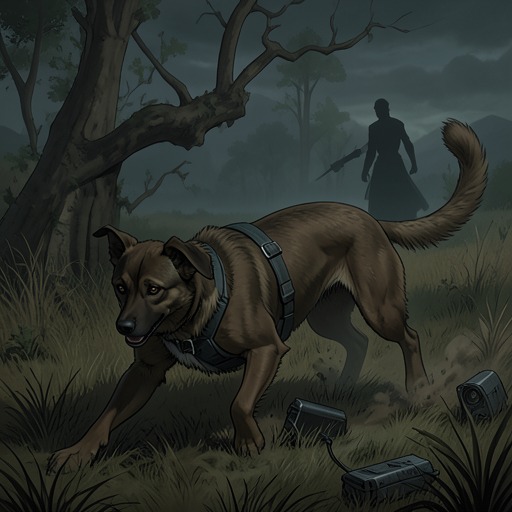
That difference becomes apparent in the account of the game around Ponteilles. Pierre Piscot explains that Dingo repeatedly rushes a covey of partridges, causing it to move to another patch of stubble, then pursues it again before it can settle. After this repeated flight, the exhausted birds become easy prey. Piscot recalls that local hunters used to know and count six coveys on the communal land, including one of twenty-two birds; now, he says, there are none left. The decline is not attributed to a single sudden attack but to repeated pursuit that removes the game from the countryside.
Dingo also catches hares by running them down. Piscot describes this as another source of the local game’s disappearance, and the narrator’s response is dismay: the consequences of Dingo’s hunting have left the country with little game. His prowess is acknowledged even by those alarmed by its effects. In the account of the missing partridges and hares, the dog’s skill and the village’s loss are two sides of the same fact.
From Instinct to Attacks
The instinct is not confined to the open countryside. In a poultry yard, one episode leaves one hundred chickens dead and arranged in rows beneath a damaged shed. The overturned feeders, displaced nesting boxes, and broken fittings show the extent of the disturbance. The account’s focus on the number and orderly arrangement of the dead birds makes the scene both a record of loss and an unsettling display of Dingo’s capacity for destruction. It also confirms that doors and ordinary barriers cannot be relied on to keep him away from vulnerable animals.
Dingo’s hostility toward military men is another expression of his direct, physical manner of acting, although the narrative says its cause is learned only later. He is not presented as a political theorist or as a participant in organized agitation. Instead, he attacks soldiers he encounters, with especially forceful reactions to those whose uniforms are most elaborate. The narrator initially finds this behavior puzzling and briefly entertains supernatural explanations; the passage makes clear, however, that the cause is not supernatural. This episode broadens the pattern of instinctive attack beyond ordinary prey, while preserving a distinction between Dingo’s actions and an articulated human ideology.
City, Fur, and the Costs of Confinement
In Paris, Dingo’s predatory habits acquire a new target in the narrator’s collection of furs. He has repeatedly gone to the closed wardrobe, sniffing at its door, scratching the floor, and biting the woodwork. When the wardrobe is accidentally left open, he enters cautiously and attacks the stored pelts, including a sable stole and an otter coat. He treats them as though they were animals, carries them into the rooms, and defends his spoils when the narrator enters. Miche watches from a chair as the destruction spreads through the salon.
The narrator’s response turns the episode into more than a report of damage. At first he is furious about the ruined furs, but then questions whether Dingo alone should bear blame. In Ponteilles, the narrator had considered the villagers’ conduct alongside Dingo’s violence; in Paris, he recalls that the dog’s first violent act was in self-defense and sees the furs as the products of animals confined for human luxury. He also acknowledges his own role: he has left Dingo idle at home while pursuing the obligations of Parisian life. The episode thus connects predation to a conflict over human ownership of animal bodies, without making Dingo’s destruction harmless or erasing its consequences.
The narrator takes Dingo on a journey in the hope that travel will distract him from animals. Instead, Dingo’s sense of smell repeatedly leads him to them. The narrator does not enumerate every incident, but recalls several: two pheasants in a Nuremberg alley, a gazelle in a Frankfurt shop, a kangaroo at a restaurant in Altona, parrots in Dresden, ospreys in Düsseldorf, and a boar in Munich. In Cologne, Dingo enters an aviary and kills its flamingos; other rare birds escape and strike the enclosure’s wires. At Lucerne, a railway inspector nearly suffers a fatal attack when he tries to force Dingo into the dog compartment, and the narrator intervenes. The incidents vary in setting and kind of animal, but together establish how readily the drive follows him across urban spaces and human attempts at control.
Habitat, Meaning, and Limits
Paris also reveals the cost to Dingo of a life without room to move. With crowds, congested streets, and too little open space, he becomes sad and inactive, sleeps for much of the day, and walks reluctantly when made to go out. In spring, the narrator rents a rustic house at Veneux-Nadon, beside the Forêt de Fontainebleau. The garden opens onto the forest without a fence or barrier. Dingo becomes cheerful and active almost at once, and lives largely in the woods, ranging far from the house through the surrounding territory. The contrast links his vitality to access to a habitat in which movement and animal encounters remain possible.
The forest does not simply turn the hunting impulse into an uncomplicated ideal. In a remembered walk, the narrator has seen a group of deer feeding peacefully before a hunt. Later, hearing the hunt at a distance, he thinks of the animals as vulnerable creatures fleeing dogs, horns, and pursuing riders. That contrast shifts attention from the spectacle of the chase to the pursued animals and to the narrator’s grief at the possibility that one of the deer he admired is in danger. Dingo’s own predation and human hunting are not identical, but both belong to a world in which animals become quarry.
The narrative therefore holds several judgments together. Dingo’s hunts devastate local game, kill domestic and captive animals, and cause serious danger to people who try to restrain him. At the same time, his energy diminishes in restrictive surroundings and returns in the forest, while the narrator recognizes how human confinement and luxury shape the encounters he condemns. The instinct remains neither an abstract symbol nor a simple excuse: it is a persistent pattern of behavior whose consequences change with its setting, and a test of the human boundary between animal nature and civilized ownership.