Le manque d’eau à Ponteilles
DingoLe manque d’eau à Ponteilles is the village’s enduring lack of reliable, clean water and a measure of its administrative inertia. Ponteilles depends on contaminated wells and foul ponds that dry up in the first days of summer; although the narrator tries to arrange a water supply at no cost to the commune, the mayor’s delay outlasts the minister willing to help. The unresolved shortage also underlies a comic local institution: Joseph Velu’s honorary command of a fire brigade that has neither a pump nor water.
The Shortage and Its Public Meaning
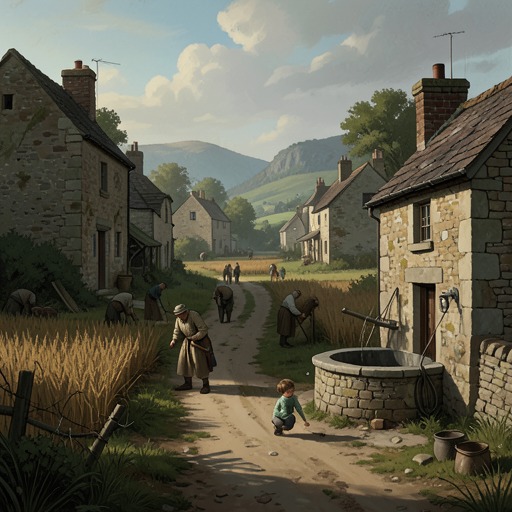
The narrator recalls that Ponteilles had no water in any dependable public sense. Its sources were wells described as polluted and ponds described as fetid, and the ponds dried as soon as summer began. The condition was not presented as a new emergency but as an established feature of village life. When the narrator called it a deplorable and shameful state of affairs, the mayor answered that the villagers had never had water and had nevertheless managed to live. He also invoked the commune’s lack of money, treating the expense of improvement as sufficient reason to leave the existing conditions in place.
That response sets bare endurance against the possibility of public provision. The narrator regards the absence of water as an administrative failure that ought to be remedied; the mayor treats its long duration as evidence that remedy is unnecessary. His appeal to poverty closes the question before the proposed work can be assessed. The shortage therefore persists not simply as a physical lack, but as a matter repeatedly acknowledged and left unresolved.
The Water Project and Its Failure
The narrator offered to assist and believed he could arrange for the project to cost the commune nothing. He took the proposal to a minister who was his friend. The minister agreed in principle, but required the mayor to have an estimate prepared first, so that the commitment would be based on the project’s cost. The narrator returned to the mayor with this answer, expecting the estimate to put the plan in motion.
It never arrived. For a year, whenever the narrator met the mayor, he asked after the estimate and urged him to hurry, warning that ministers did not remain in office forever. The mayor said that the matter was being considered, but did not produce the document. The minister eventually fell from office, and after that the village water project was never discussed again. A possible route from political goodwill to practical provision thus stopped at a preliminary administrative task: without the estimate, the minister could not determine what he was undertaking, and without action from the mayor, the opportunity expired.
The mayor later recast the narrator’s offer as a threat. He claimed that the narrator had wanted to draw him and the commune into a bad affair and that he had been clever enough to avoid it. This explanation reverses the apparent roles: the person who had tried to secure assistance becomes, in the mayor’s account, a would-be schemer, while the official who let the estimate lapse presents his inaction as prudence. The shortage remains untouched, but the mayor’s version shields that failure from responsibility.
Velu and the Unbuilt Infrastructure
The absence of water also gives an absurd edge to Joseph Velu’s public standing. A former army brigadier who continued to wear military dress after leaving the service, Velu held numerous village roles and was captain of the firefighters. Yet his captaincy was honorary: the municipality had never found money in its budget to buy a pump or bring water to the commune. The narrator links this lack to the village’s water question, which came up at municipal council meetings without being settled.
Velu repeatedly gave the proposed water supply a grand, official-sounding name and spoke as though he were its forceful advocate. Repetition alone made him an orator on the subject and lent him a measure of prestige. But the contrast is sharp: the language of civic action circulates in council, while the practical means of firefighting and a reliable water supply remain absent. Velu’s honorary title makes the deficiency visible through comedy, without suggesting that the underlying need is imaginary.
Isolation and the Wider Pattern
Other details of village life place the water shortage within a broader pattern of weak infrastructure, though they do not explain its cause. Jaulin describes buying fuel through several intermediaries, from a local connection onward through a chain of relatives and acquaintances to the factory. He says the transport cost weighs heavily because the village has no railway. The narrator also recounts that Vincent Péqueux’s horse-drawn service links Ponteilles to the station at Cortoise, ten kilometres away, twice each day; frequent stops mean that Vincent often misses the train and sometimes loses the mail or parcels entrusted to him.
When a new railway line from Amiens was proposed through Ponteilles, the municipality and the population protested, partly because they feared that Vincent’s carriage service and horses would be displaced. The narrator interprets the opposition as a convergence of solidarity with Vincent, attachment to old habits, and instinctive hostility to novelty. That episode is not the cause of the water project’s failure, but it gives the shortage a revealing setting: the village is accustomed to arranging necessities through limited, fragile systems, while resistance to change can preserve familiar arrangements even when they are inconvenient. Against that background, the abandoned estimate is more than a missing piece of paperwork. It is the point at which a possible improvement to everyday life disappears into the same inertia that leaves the water question perpetually on the council’s agenda.