Addiction stigma and family shame
DopesickStigma surrounding addiction and its treatment operated as more than a judgment about drug use: it isolated families, complicated efforts to seek care, and encouraged communities to mistake silence for safety. In the account of the opioid crisis around Roanoke, Virginia, shame appears at the bedside, in family support meetings, at public hearings, and even within recovery groups. The movement from hiding to speaking out becomes a measure of how families tried to keep people alive when medical and criminal-justice systems often failed to work together.
How Shame Kept the Crisis Private
The book’s reporting began in 2012, as heroin reached the suburbs of Roanoke, where the reporter had spent two decades covering marginalized families for the Roanoke Times. At first, many families were too ashamed to speak on the record. Five years later, as the book was being completed, nearly everyone agreed to be identified, apart from people who feared consequences for their jobs or safety. That change did not mean the stigma had disappeared; it showed how disclosure could become possible as families recognized their experiences in one another’s.
For Robin Roth, shame took the form of an imagined mark she carried through the city. In 2012, before social-media groups connected parents across the state, she felt branded with a giant “F” for parenting failure. She suffered in silence and anger, much of it directed at Spencer Mumpower, whom she held responsible for the death of her only child, Scott Roth. At Spencer’s federal sentencing, she brought Scott’s framed portrait to the witness stand and asked Spencer whether he would visit her when she was old and lonely, eat dinner with her, mow her lawn, or wish her a happy birthday. Each question returned to the absence that the courtroom could not repair. Meanwhile, Ginger Mumpower found some relief in knowing that prison would at least make it less likely her son would die of an overdose. The mothers’ different positions around the same sentence reveal how grief and blame could coexist with the wish that a child survive.
The silence was not confined to one family or one town. Parents along the routes supplying heroin struggled to identify whom to blame, but mostly remained shut down by grief and shame. A friend of the reporter, overwhelmed by concern for her thirty-four-year-old addicted daughter, asked through tears, “Just tell me one thing, what can your book do to help me keep my daughter alive?” The question joined private desperation to a wider institutional failure: the legal and medical structures meant to address the epidemic were disconnected, sometimes at odds, and capable of producing unintended consequences. Families were left to navigate the gaps while fearing the judgment attached to naming the problem.
The Family Secret and the Limits of Denial
Laura Hadden tried to confront stigma by explaining addiction as a condition that altered a person’s capacity for choice. At a community meeting in Woodstock, she described how the brain’s natural opioids were suppressed by a flood of synthetic ones, tolerance increased, and a person could crave larger quantities simply to avoid becoming violently ill. To make withdrawal and craving imaginable, she asked parents to picture going without food for three days, then being left alone with a plate of tempting food they were forbidden to eat. She connected that drive to young people traveling to Baltimore, bringing heroin home, and selling it in their communities.
The explanation met resistance. Hadden recalled that about ten people attended and no one asked her a question; she called the response a joke. Her lesson about the brain and local drug sales could not overcome the audience’s reluctance to believe heroin might reach their own children. The contrast is central to the book’s account of stigma: information could make addiction more intelligible, but it could not by itself make a community willing to recognize the problem as present in its own homes.
Drenna Banks’s experience shows how shame could outlast parents’ efforts to control their children’s behavior. She had monitored Colton Banks’s Adderall after discovering that he was abusing it, grounded him after finding marijuana, and sent him to a twenty-eight-day rehabilitation program when he progressed to pills. After his death, she recalled the embarrassment of believing she was doing the right things as a parent while drugs took over his life, in a subject “nobody talks about because it’s this dark, hidden secret.” At Colton’s funeral, she departed from her prepared remarks and urged mourners not to hide. She said that she knew of at least three other boys she was meant to help. The funeral became both a public expression of grief and a direct attempt to interrupt the secrecy that had surrounded addiction.
From Isolation to Mutual Support
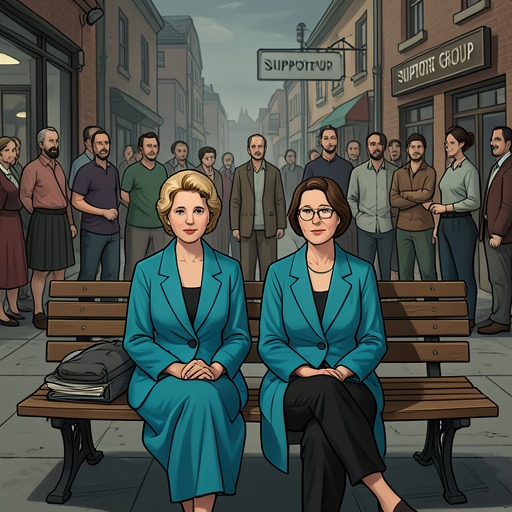
Jamie Waldrop and Drenna Banks had initially isolated themselves, each facing a crisis that was difficult to discuss with friends. Their sons had been friends and used drugs together; Jamie did not understand the depth of her sons’ addiction until she found them unconscious in separate incidents at home. The Families Anonymous meeting where the mothers met offered recognition rather than a demand that either explain away what was happening. Jamie described avoiding other friends because she did not know what to say when they asked how her children were doing. Discovering another family in a similar nightmare helped make disclosure a source of connection rather than only exposure.
That connection led to practical support. While Christopher Waldrop was in his first residential-treatment stay, he learned that Colton had died of an overdose. Though Christopher was away at rehabilitation and could not attend the funeral, Jamie sat beside one of his high-school friends. She and other local mothers were preparing to make their families’ experiences public, deciding that survival had to take precedence over shame. Jamie pledged to help the friend find a treatment bed when he was ready. In this account, speaking out mattered not as a general declaration but as a route to a concrete next step: helping someone reach treatment at the moment he was willing.
The support networks the families lacked in 2012 were not simply convenient sources of information. At that time, Facebook groups had not yet connected suffering parents across the state to share rehabilitation advice, coping strategies, and material help. Families Anonymous meetings, funerals, and individual acts of outreach became places where parents could recognize the crisis in one another’s lives. The book presents that recognition as a counter to isolation, while showing that it did not erase grief, conflict, or the difficulty of finding effective care.
Stigma Inside Treatment and Public Institutions
Shame and judgment also affected people seeking recovery. During the two years the reporter followed Tess Henry, she attended twelve-step meetings but felt stigmatized for taking buprenorphine. Some participants saw medication-assisted treatment as not being clean, or as merely replacing one opioid with another. Although Narcotics Anonymous officially accepted medication-assisted treatment, experienced members asked to sponsor or mentor Tess declined. A relative said the rejection must have felt like daggers. The incident reveals a divide between formal acceptance and the conduct a person encountered in the room: a treatment option could be recognized in policy while its users remained socially excluded.
Stigma also shaped public responses to prevention. Janine Underwood spoke to her local school board and county officials about her son’s story and sought support for the county risk-prevention council, which was running on small federal grants and little else. She had pulled strings to place her children in the Hidden Valley school zone because she thought its affluence offered a safer setting. Instead, shame and inaction flourished there; calls to the Hope Initiative about heroin users came almost daily from Hidden Valley and nearby Cave Spring, and police data showed the problem was worse in those communities than in less affluent parts of the county. After Janine spoke, the room fell silent. The school board declined to support the program, and the county provided its usual $2,000.
Janine’s account and the families’ experiences at meetings point to a recurring consequence: stigma narrows the space in which help can be requested or offered. It can keep parents from telling friends, communities from acknowledging that addiction is local, and recovery groups from fully welcoming people receiving medication. The book does not present disclosure as a cure for these failures. Rather, it shows families trying to make the crisis visible, build support where institutions left gaps, and treat the survival of people with addiction as more urgent than the preservation of appearances.