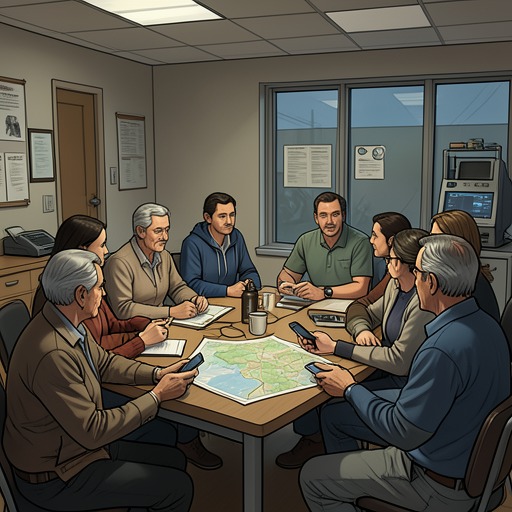
Economic distress in Appalachia
DopesickEconomic distress in Appalachia is the book’s account of how disappearing work, growing disability, and weakened public supports reshaped communities and helped create conditions in which the opioid crisis could spread. Its central argument is structural: economic dislocation did not by itself produce addiction, but it intensified vulnerability while pharmaceutical promotion increased opioid availability and policy decisions restricted routes to care.
Industrial Loss and Material Insecurity
The decline of work appears across the book as a slow transformation of rural life rather than a single economic shock. In rural counties affected by globalization, automation, and the decline of coal, unemployment, food insecurity, crime, and disability claims rose together. In Martinsville, Virginia, and Henry County in Virginia, unemployment exceeded 20 percent, food-stamp claims more than tripled, and disability rates increased by 60.4 percent. These figures describe a regional contraction in the resources people could use to sustain themselves, not simply a decline in the number of factory jobs.
The damage was visible in the changing landscape and in the uses to which people put what remained. In Galax, two major employers, Hanesbrands clothing and Webb Furniture, closed, while other plants continued to downsize. Furniture and sewing work had been moving to lower-wage countries, and workers displaced from those industries often had few equivalent opportunities nearby. The book also describes federal retraining as an inadequate response: only a third of eligible workers entered Trade Adjustment Assistance training, and many who gained credentials subsequently earned less than they had in factory work, if they found employment at all. The effects of industrial change therefore extended beyond lost wages to diminished prospects for recovery and stability.
The widening rural–urban divide supplies a national dimension to the regional story. Economic activity became more concentrated in cities, where wages were one-third higher than in rural areas; the gap was 50 percent wider than it had been in the 1970s. The 2007–2009 recession further widened the divide. This context matters because the book’s account does not treat Appalachia as an isolated exception: rural communities faced a broader reorganization of work and investment, while possessing fewer alternative employers and fewer resources with which to absorb the loss.
Disability, Pain, and Opioid Supply
Economic insecurity intersected with disability and pain in ways that made pharmaceutical supply consequential. The book links workforce decline to rising disability, then sets that development alongside the expansion of painkiller promotion. In rural Virginia towns including Lebanon and St. Charles, Purdue representatives targeted communities with high rates of dislocated workers and work-related disability claims. They used prescribing data to identify physicians who already wrote prescriptions for competing painkillers, and directed more visits to doctors judged most likely to prescribe OxyContin. The company’s sales incentives further aligned promotion with volume: representatives could receive annual bonuses of $70,000, with larger bonuses tied to doctors’ higher-milligram prescriptions.
The change in prescribing practice was notable. Five years earlier, cancer specialists had been the leading prescribers of long-acting opioids; by 2000, family doctors had become the largest single group prescribing OxyContin. Purdue promoted the drug for noncancer pain, including back pain, osteoarthritis, and injuries. The book places this marketing in communities already facing job loss and disability, showing how economic need and commercial supply developed alongside one another. Shannon Monnat’s analysis gives the relationship a broader formulation: the collapse of work and the rise in disability formed part of the conditions in which an expanding supply of opioids could become especially damaging. The account does not reduce the crisis to a simple chain of cause and effect; it emphasizes the convergence of structural distress, medical practice, and drug availability.
Unequal Exposure and Unequal Punishment
The book also examines how race shaped both access to prescription opioids and exposure to criminal punishment. In Roanoke, heroin had long been understood as an inner-city drug associated with a small, largely African American group of users and dealers, and it remained relatively invisible to much of the public. The later opioid crisis became more closely associated with white users, but this difference was not evidence of a simple racial distinction in susceptibility. The book cites 2014 findings that physicians prescribed painkillers to people of color at lower rates because they were less trusted not to misuse them. By 2014, overdose deaths among young white people were three times their 2002 rate, while the death rate for people of color had remained relatively unchanged.
That apparent protection through under-prescribing coexisted with disproportionate punishment. The book contrasts responses to white opioid users who dealt or committed property crimes to avoid withdrawal with the treatment of people such as Ronnie Jones, who was imprisoned for heroin distribution. Three-quarters of federal drug offenders were Black or Hispanic, and people of color constituted 57 percent of state-imprisoned drug offenders. The contrast reveals how an addiction crisis could be framed as a public-health problem for one population and a criminal-justice problem for another. Economic marginalization and drug policy thus operated unevenly: communities could face both fewer legitimate work opportunities and more severe consequences for drug-related activity.
Treatment, Insurance, and Public Priorities
Virginia’s limited health-care safety net compounded the problem. The state legislature repeatedly rejected Medicaid expansion after the Affordable Care Act, forgoing $6.6 million a day in federal funds and coverage for 400,000 low-income Virginians. In states that expanded Medicaid, the program became a major means of paying for treatment, counseling, and addiction medication; it also covered 1.3 million people with addiction who were not poor enough for Medicaid under earlier rules but could not afford private insurance. The difference was not abstract for rural families. A 54-year-old teacher in St. Paul, Virginia, had been without insurance for decades, while her husband, a former Walmart worker disabled by strokes, relied on Medicare. She patched together free coverage through Remote Area Medical events and visits to the Health Wagon’s mobile unit, and delayed seeing her family doctor because she paid cash for care.
Chris Perkins, Roanoke’s police chief, argued for redirecting resources from incarceration toward treatment. In his proposed arrangement, savings from diverting people with addiction from jail would help pay for care. He pointed to Virginia’s billion-dollar corrections system and the contrast between that expenditure and the small sums required for inpatient treatment; two hundred of the city jail’s eight hundred beds were typically empty. He also observed that people often left jail with more drug contacts than they had had on arrival. His criticism connected treatment scarcity to a political preference for maintaining incarceration budgets, even when jail capacity went unused.
Other approaches described in the book joined treatment to practical support. Winchester’s drug court was designed to connect offenders with treatment, including Medication-assisted treatment, as well as free housing and taxi vouchers to help them reach work. Bryan Stevenson described a broader model in which diversion from prosecution could be paired with housing, case management, employment services, and harm reduction. These proposals treated a return to legitimate work as part of reducing drug dealing and supporting reentry, rather than as a separate concern to address after treatment.
Rebuilding Community as a Health Intervention
The book’s account ultimately makes community capacity part of the public-health question. Nancy D. Campbell, a historian of the Narcotics Farm, emphasized that recovery requires alternative sources of reward: work, recreation, and sustaining relationships. Moving away from the place where addiction began might help some people, but relocation alone could not replace those resources, especially when opioids were widely accessible and local communities continued to lose jobs and services. The argument shifts attention from individual willpower to the conditions that make a life beyond drug use possible.
The Health Wagon offers a concrete example of both local care and its limits. Founded in 1980 by a Catholic nun who first provided care from a red Volkswagen Beetle, the organization later served uninsured residents through mobile clinics. Yet its staff could not substitute for comprehensive insurance or a stronger regional safety net. School closures, shrinking employment, reliance on food banks, and the lack of affordable care formed part of the same landscape. Economic distress in Appalachia is therefore significant not merely as background to the opioid epidemic but as a continuing condition that shapes exposure, treatment access, and the prospects of rebuilding. The book’s emphasis is on the interaction: drug supply can ignite harm, but durable recovery also depends on work, health care, and community resources.