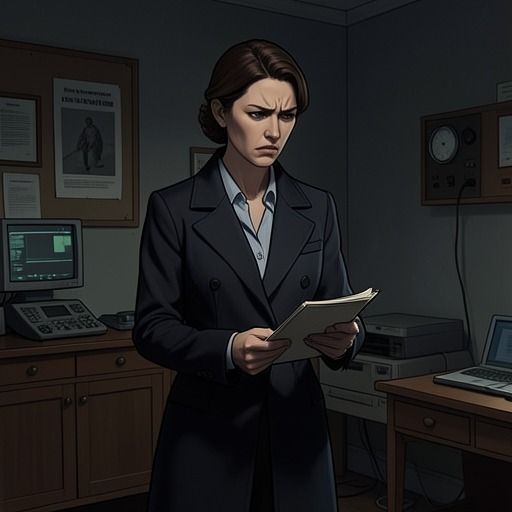
Charlie Dunlop
EileenCharlie Dunlop is Eileen Dunlop’s father, a retired X-ville police officer whose alcoholism and persecutory delusions turn their home into a place of fear and neglect. Eileen remembers him as contemptuous and emotionally withholding, yet also records moments that resist a simple portrait of him as only cruel: he may have removed the keys from her car while she was unconscious, possibly preventing her death. That uncertain act gives their estranged, dependent relationship its unresolved edge.
Identity and Background
Charlie is described as a physically imposing-looking but not especially large man, with broad shoulders, long legs, and thinning gray hair. His face seemed older than his actual age, and Eileen recalls his skeptical expression and perpetual disapproval. His hands shook, and he repeatedly rubbed his chin. He regretted never growing a full beard, a small example of what Eileen saw as his mixture of vanity, regret, and illogic. She compared his sensitivity and anger to those of the boys at Moorehead, where she worked, while making clear that the comparison did not excuse his treatment of her.
Before his retirement, Charlie served as a police officer at the county precinct. The local force was small, and its work was often undemanding. He was respected by people who knew him on the beat and acquired the nickname Father Dunlop, associated with his cold blue eyes and moralizing manner. He had also served as a marine and retained a strong attachment to his police uniform. While on the force, he often slept in uniform with his gun, imagining himself prepared for a call to confront a criminal, although the heroic encounters he anticipated did not come. Eileen’s judgment of his pride is sharp: she remembers him treating his badge as proof of exceptional virtue, despite the limited demands of his work.
His drinking changed markedly after Eileen’s mother became ill and died. What Eileen had once considered ordinary beer drinking and occasional whiskey became drinking at home, at night, in the morning, and eventually on the job. He took time off, wandered the streets, and fell asleep on neighbors’ porches. At O’Hara’s he became unwelcome after pulling a gun on the owner. Later, he totaled a squad car and accidentally fired his gun in a police locker room. These incidents mark a decline that affected both his employment and his standing in town.
Delusions and Decline
Charlie’s persecutory beliefs give his later life an imagined drama of surveillance and danger. He described shadowy figures as hoodlums who watched and taunted him, hiding around houses and appearing too quickly for him to see clearly. He interpreted their presence as part of a conspiracy involving the mob and believed the police were protecting him because of work he had done against it. He also suspected that the figures had entered his own house, perhaps living inside its walls. Eileen rejected the claims, noting that his actual police work in X-ville had been slight, but his beliefs shaped his daily fears and explanations.
After retirement, the police chief took away Charlie’s driver’s license. He had driven the wrong way on a freeway and later left his car in a public cemetery. His difficulties did not end with driving. He went outside during blackouts, knocked on neighbors’ doors under the pretense of investigations, drew his gun on shadows, and sometimes lay in the road or gutter. Other episodes included falling asleep on a lawn, disturbing property, urinating in a playground sandbox, shouting at cars, and throwing rocks at dogs. Police repeatedly returned him home, sometimes with an apologetic air, while also blaming Eileen for failing to control him. Their responses deepened her resentment: the officers appeared to accommodate his delusions rather than confront the danger or offer her meaningful support.
A particularly serious incident arose when neighbors and a school principal reported that Charlie had been sitting at a window and pointing his gun toward children walking home from school. An officer told Eileen that Charlie had agreed to put his property in her care on the condition that she not use it against him. The immediate conversation concerned the gun, which Eileen assumed was unloaded, though she knew Charlie continued to clean it. The transfer put responsibility for a potentially dangerous object into the hands of a daughter already managing his unpredictable behavior.
Life with Eileen
After Eileen’s mother died, the family home remained crowded with her belongings and became dusty and neglected. Charlie slept in an armchair in the kitchen; Eileen withdrew to the attic, which was quieter than the bedroom beside her mother’s. The house’s unused rooms and deteriorating furnishings reflect the stagnation of their shared life. Charlie was afraid of darkness and often lit the stove and oven while drinking, despite claiming to be cold and wearing little. In one scene central to Eileen’s recollection, he sat on the stairs with sherry and a cigar butt and greeted her with sarcasm. She describes hating him while remaining dutiful because they were the two people left in the house.
His cruelty was not limited to broad insults. Eileen recalls his contempt for her appearance and a pattern, when she was younger, of commenting on and assessing her physical development. Her mother sometimes objected, including once saying that Eileen was too old for Charlie to touch. Eileen later connected these experiences with her anger at being measured or judged, while carefully distinguishing them from more severe violations suffered by other girls. In adulthood, she also recognized that she had been foolish about men, but the account does not reduce that history to a single cause.
Charlie could insult Eileen with an accuracy she found painful. He called her a hanger-on and urged her to get a life, even as his own judgment was impaired by alcohol and delusion. Eileen understood that his accusations were confused, but understanding did not make them harmless. She became his practical caretaker: after he disappeared on a six-day drinking binge and she collected him from a hospital two counties away, she locked his shoes in the car trunk to limit his ability to leave. She wore the car key around her neck. The measure was a form of control imposed by necessity, but it also made her body carry a reminder of the responsibility she could not set aside.
Contradiction and Narrative Significance
Charlie’s relationship with Eileen is defined by the gap between his failures as a father and the possibility that he once acted to protect her. After a night of heavy drinking, Eileen woke in her car parked in snow, with the keys missing and the trunk open. She later found Charlie asleep inside the house, with shoes on his feet. She inferred that he might have come out and removed the keys while she was unconscious. Because the car windows had been closed, she wondered whether he had prevented her from dying of carbon monoxide poisoning. The evidence does not establish what he intended: he may instead have wanted the keys to retrieve his shoes. Eileen chooses to believe that a paternal instinct briefly overcame his illness and selfishness, preferring that interpretation to luck, while acknowledging its uncertainty.
That possibility does not erase the years of neglect, fear, and insult. Nor does Eileen present Charlie’s decline as a complete explanation for his earlier cruelty. She imagines that his own parents may have beaten him, because this is the only route to forgiveness she has found, but she describes that explanation as imperfect. Even the wedding ring he continued to wear after Eileen’s mother died proves little: to Eileen it suggests he may have loved her mother to some degree, while leaving open her deeper suspicion that he was incapable of real love.
The account’s tension rests in such unresolved qualifications. Charlie is a former officer who once wore a badge as a sign of moral authority, then became a source of danger and disorder whom other officers quietly returned to his daughter. He is the man who demeaned Eileen and the possible agent of a small, life-preserving intervention whose motive cannot be known. By keeping that intervention uncertain, the narrative shows how Eileen’s care for him persists not as uncomplicated affection or forgiveness, but as a story she deliberately chooses to tell about what might have happened.