Leonard “Lee” Polk
EileenLeonard “Lee” Polk is a fourteen-year-old held at Moorehead, where Eileen Dunlop encounters him first as a silent boy in confinement and then as a name in an inmate file marked for patricide. The fragments that form his characterization set an institutional label against Eileen’s uncertain, sometimes self-serving effort to imagine the person behind it. He remains largely unknown, but that very distance is central to his significance: Moorehead keeps records about him while restricting the ordinary contact that might make him more than a case.
Identity and Arrival
Polk arrives at Moorehead a few weeks before Eileen sees him in the institution’s isolated confinement area. At intake, he is silent and withdrawn. Eileen remembers his stiff posture and his build: thin, broad-shouldered, and older-looking than his actual age. Newly inked letters mark the knuckles of his right hand, though she cannot make them out. His presentation gives her no clear account of who he is; instead, she reads a mixture of youth and apparent toughness into his bearing.
Eileen later learns that Polk is only fourteen. His age is significant in the setting of Moorehead, where the boys held there range from children to older teenagers. The institution keeps inmates until their sentences expire or they turn eighteen, and Eileen recalls having encountered a boy as young as nine and a half. Polk is therefore one of many minors processed through a system that holds their files, records their offenses, and regulates their daily lives, but the evidence does not provide a fuller account of his family, earlier life, or sentence.
Confinement at Moorehead
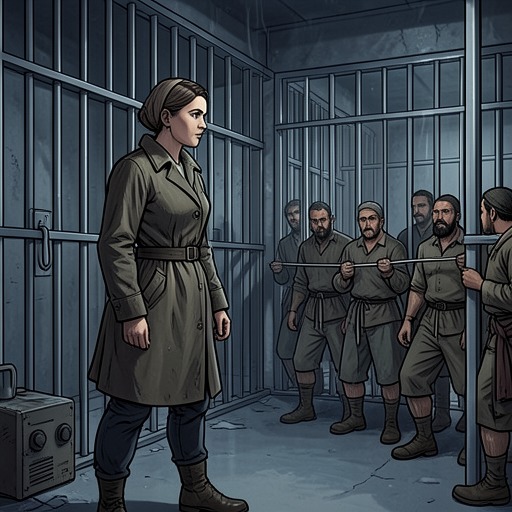
When Eileen finds him, Polk has spent several weeks in a room referred to as the cave. The space had originally been a meat locker; its former stainless-steel door has been replaced by a heavy iron door with a small window and a padlock. Through that window, Eileen sees him sitting on a cot and staring at the wall. The details make the confinement concrete without giving access to what he thinks or feels about it.
Moorehead’s wider regime helps establish the conditions around Polk’s isolation. Boys there are forbidden from many ordinary childhood activities and gestures: they may not dance, sing, speak loudly, listen to music, or lie down without permission. Eileen says she did not speak to the boys, though she read their files and knew their recorded histories. Her account separates administrative knowledge from personal acquaintance: Polk can be identified, watched, and classified, while remaining a stranger to the employee who observes him.
Eileen’s Observation and Interpretation
Eileen watches Polk through the small window. His light eyes, olive skin, and brown hair are among the features she notices; she also describes a thoughtful, sad expression and a posture that seems to her both boyish and imposing. She sees him look upward, shift his head, yawn, and eventually lie down on the cot. These are limited, ordinary actions, but the scene becomes unusually important to Eileen because she is watching without speaking to him and cannot know whether he is aware of her presence.
Her response is not a reliable account of Polk’s interior life. Eileen imagines what his circumstances might have been and interprets his appearance through assumptions she later calls naive. She speculates about the lives of young male prostitutes, but the scene does not establish that this was Polk’s history. Nor does it show that he sees her: Eileen explicitly remains unsure whether he ever noticed her, or knew her name. The gap between her attention and his unknowable perspective prevents the encounter from becoming a mutual relationship.
Eileen’s recollection also discloses something about her own way of looking. She admits that she was affected by Polk, while recognizing that her attention did not amount to understanding him. Her account moves between a wish to read sadness and vulnerability in his face and an awareness that she was projecting her own ideas onto a boy she had never spoken with. Polk consequently appears both as an individual whom Eileen notices and as a screen for her incomplete interpretations.
The File and the Limits of the Record
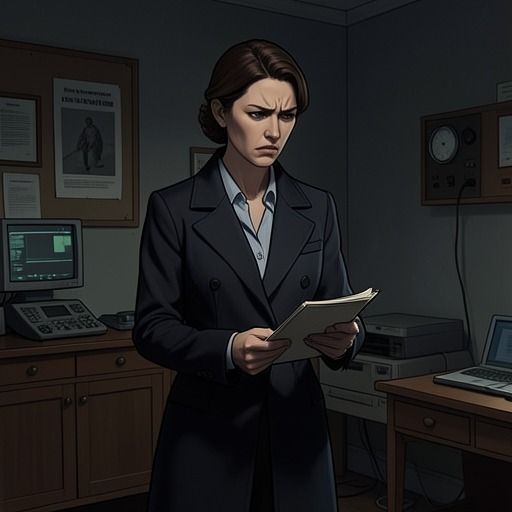
After a dismissive remark about Polk from an office worker, Eileen finds his file among the records she maintains. A newspaper clipping attached to the brief report states that he killed his father while the man was asleep. The file identifies the offense as patricide and contains numerous notes by Dr. Frye, mostly dates, times, and technical writing Eileen cannot understand. The official materials provide the central fact that shapes the reader’s knowledge of Polk, but they do not explain the circumstances behind the killing or disclose his account of it.
Rebecca Saint John asks to see the folder, and Eileen hands it to her. That transfer makes Polk’s file a point of connection between the two women as well as a record of the institution’s knowledge. It does not, in the supplied account, resolve the unanswered questions about Polk himself. His characterization remains deliberately narrow: a boy secluded at Moorehead, a person whose age and demeanor complicate the harshness of his label, and an inmate whose recorded crime is more fully documented than his experience.