Randy
EileenRandy, a daytime guard at Moorehead, becomes the first object of Eileen Dunlop’s sustained romantic fixation. His importance lies less in what he does than in the distance between his ordinary work and the elaborate hopes Eileen builds around him: she watches, imagines, and waits to be noticed, until Rebecca Saint John’s arrival redirects her desire.
Identity and First Impressions
Eileen sees Randy at the hallway post connecting her office to the rest of Moorehead. He wears the facility’s gray uniform and keeps his keys at his belt; to her, his youthful looks and composed manner seem to hint at a hidden sadness. She watches him read comics and remembers small habits, including the way he moves a toothpick in his mouth. Her attention turns routine details into signs of a personality she believes she might someday understand, though she knows she is not the kind of woman he would usually choose.
Randy’s past further sharpens Eileen’s interest. She reads his employee file and learns that he had been a Moorehead inmate as a teenager and had adolescent offenses listed there, including sexual misconduct and breaking and entering. The discovery does not diminish her attraction; she says it makes him more appealing to her. She speculates about his past and imagines him as capable of force, while acknowledging that her ideas about him are conjecture rather than knowledge.
Unrequited Attention and Fantasy
Eileen’s interest in Randy grows through observation rather than reciprocal conversation. During visiting hours, her duties bring her near him: she summons boys for visits, assists with security checks, and sees him stationed by the visitation room. While patting down mothers, she sometimes imagines that she is touching Randy instead, even as she recognizes that he barely notices her. His presence makes the prison’s visitation routine a source of anticipation, but the closeness remains entirely one-sided.
Away from work, Eileen tries to turn that distance into a possible courtship. She drives past Randy’s apartment in a neighboring town, staying low in the Dodge car to see whether he is home, and wonders what he is doing and whether she ever crosses his mind. When she encounters him on Main Street in X-ville, she raises a gloved hand and prepares to speak, but he walks past without acknowledging her. The encounters leave her hurt, yet she continues to imagine that he might eventually see and love her.
Her daydreams give Randy a role he has never chosen: she imagines him waiting after her shift and offering to accompany her to her car. In one version, she refuses his help, slips on the ice, and accepts his arm; in another, the imagined encounter turns into a forceful seduction. These contrasting fantasies expose the gap between Eileen’s wish for a romantic gesture and her awareness that desire may involve danger. They reveal her imagined scenarios, not Randy’s intentions or actions.
Eileen also tries to interpret Randy’s gestures and habits as though understanding his body language might help her please him. She knows he has had sexual relationships with women, but cannot picture him in the act; instead, she imagines him afterward, relaxed and laughing with an unseen woman. That contrast between idealization and acknowledged uncertainty makes her attachment less a relationship than a private story built around fragments of observation. She regards even a glance from him as enough to quicken her pulse for hours, while admitting that she is not the sort of woman she believes he would choose.
At Moorehead and the Displacement of Desire
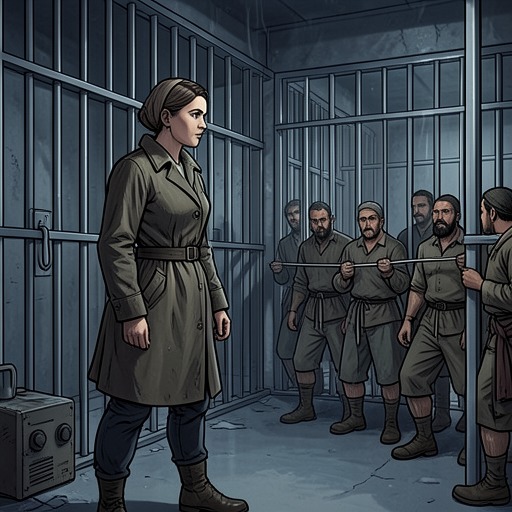
Randy’s place in Eileen’s working life was practical as well as imagined. During visiting hours, he stood guard at the visitation-room door while Eileen summoned the boys and handled the visitors. The institution’s restrictions made even a small kindness subject to enforcement: when a twelve-year-old boy who had burned down his family’s house began to cry, his mother tried to pass him a handkerchief. Randy moved quickly to block the exchange, explaining that visitors could not give the boys anything. Eileen repeated the rule’s official security rationale, although she understood that it was not really about protecting children from handkerchiefs. In this scene, Randy is not the romantic figure of her private fantasies but an employee helping maintain Moorehead’s harsh order.
The encounter also shows how Eileen’s attraction shapes her perception of ordinary work. Her tasks included patting down women visitors because Moorehead had no female guards. She performed the checks nervously, imagining Randy in place of the women she touched, while recognizing that he barely noticed her. The contrast is stark: she experiences the proximity as charged, but Randy’s attention remains on his post and its rules. His brief intervention with the boy and his mother offers no sign of private feeling toward Eileen.
Rebecca Saint John’s arrival abruptly changes the focus of Eileen’s longing. As Eileen watches Randy near the visitation-room doorway, she realizes that she is no longer in love with him. The shift comes while her attention is absorbed by Rebecca, whose manner and appearance awaken Eileen’s envy and shame. Randy, once magnified by hours of watching, suddenly seems ordinary to her. The change is not prompted by a rejection or confrontation; it happens inwardly, as though the attachment that had sustained Eileen has lost its force when a new object of desire appears.
That reversal does not erase Randy from Eileen’s emotional history. Later, she tries to look toward him as she had before, but the old fascination has gone: his familiar features and gestures no longer seem extraordinary. At the same time, she regrets not having told him that she loved him while the feeling was alive. Her final recollection restores a tenderness the present-tense attraction cannot recover. Randy’s significance therefore rests on both sides of Eileen’s changing attention: he is the first person around whom she constructs an elaborate private hope, and the first whose spell breaks when Rebecca enters her life.
Fantasy, Composure, and Narrative Limits
Eileen’s image of Randy sometimes expands beyond a possible romance into a fantasy of escape. She imagines him appearing at her attic window, stones in hand, with a motorcycle waiting outside, as if he could carry her away from the town itself. The scale of this imagined rescue contrasts with the sparse reality of their contact: Randy does not approach her, and their exchanges offer no evidence that he shares her feelings. The fantasy reveals what Eileen invests in him—not knowledge of his character, but the hope that someone might choose her and take her elsewhere.
That hope takes shape behind the composed face Eileen deliberately wears at Moorehead. She models it on plaster death masks and uses it to conceal how deeply the institution’s misery affects her. Her outward restraint and inward fixation thus coexist: while she carries out her duties and watches Randy from her desk, the private story she builds around him gives her attention a focus that the workplace itself does not provide. Eileen’s retrospective account makes the limits of that story visible. She distinguishes what she observes from what she supposes about Randy, yet repeatedly turns small details into imagined signs of intimacy. Randy matters in the narrative chiefly through this gap between the guard she can see and the imagined rescuer she creates.