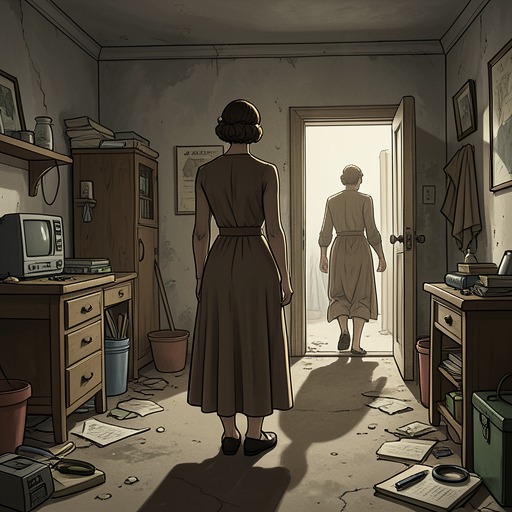
Dr. Frye
EileenDr. Frye is Moorehead’s long-serving psychiatrist, an elderly institutional figure whose authority is associated with sedatives and the supervision of family visits. In Eileen’s recollection, his retirement matters less as a personal loss than as a glimpse of the prison’s routine and of her own unnoticed place within it.
Position at Moorehead
Dr. Frye had been in charge of dispensing sedatives to the boys for decades. Eileen estimates that he was in his eighties when he retired. His work also brought him to the family-visitation area, where he observed visits from the open doorway and intervened to direct boys’ posture, answers, and apologies. The small instructions made him a visible agent of the institution’s regulation of children, while the boys’ circumstances remained largely contained in the files Eileen maintained.
Eileen describes Moorehead as restricting ordinary childhood behavior, and she regarded many of its inmates as decent boys living under difficult conditions. Dr. Frye’s presence at visits places him within that controlled environment, though the account does not describe him challenging its rules or the treatment of the boys. His role is presented through the procedures he oversees and the authority he exercises in the room.
Relationship with Eileen
Eileen administered family visits as part of her daily work. Dr. Frye sometimes watched her carry out that duty, but he never greeted her or asked how she was. She recalls feeling like furniture rather than a person. His failure to acknowledge her is not described as a direct conflict; its force lies in its repetition, reinforcing the invisibility she experienced among the prison’s staff and visitors.
The contrast between his attention to the boys’ conduct and his silence toward Eileen sharpens that sense of exclusion. He could direct a child to sit straight or answer a question, yet Eileen, who organized the visits, remained outside even the simplest exchange of courtesy. The recollection does not establish what he thought of her or whether he noticed her distress.
Retirement and Eileen’s response
On the day Dr. Frye retired, Moorehead held a party. Eileen signed the farewell card in precise, schoolgirl handwriting, bending her wrist in a gesture she remembers as sarcastic. The card showed a cowboy riding into the sunset; she reduced her message to a curt farewell. The carefully managed formality of the gesture suited a workplace where she concealed her feelings behind a composed expression.
After lunch, staff were invited to the cafeteria for cake and coffee. Eileen declined to join them and remained at her desk, staring at the clock. She recalls that she may have left a can of tuna uneaten in her locker. Her refusal to participate indicates no grief at Dr. Frye’s departure; it also shows how thoroughly detached she felt from the workplace rituals around him.
Narrative significance
Dr. Frye is characterized through a narrow set of institutional routines rather than through private history or an independent personal arc. His decades of prescribing sedatives, observations of family visits, and retirement establish the longevity of Moorehead’s regime. At the same time, Eileen’s account makes his lack of recognition personally consequential: the psychiatrist who watched over the visits never once addressed the employee responsible for administering them.
Eileen imagines that she might have confessed the intolerability of her life on Dr. Frye’s couch, but she does not seek him out. She immediately qualifies that possibility by describing her life as something she had been tolerating, and recalls that, at the time, she could not imagine lying down in the company of a man who was not her father. The imagined consultation therefore reveals more about her isolation and discomfort than about any therapeutic relationship between them. Dr. Frye remains both a figure of professional authority and a person Eileen never approaches.