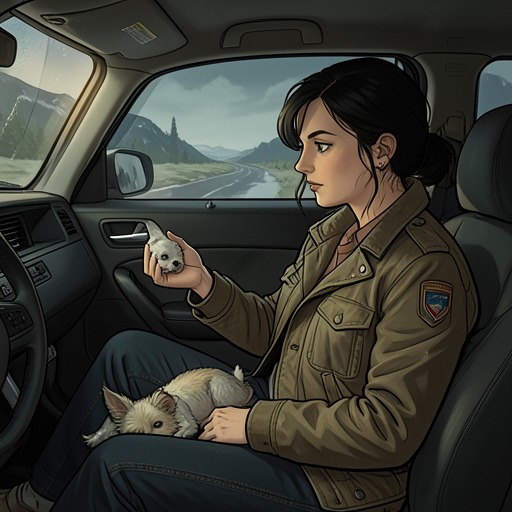
Mona
EileenMona, Eileen’s childhood Scottish terrier, is the focus of a private grief that Eileen describes as equal to her sorrow over her mother’s death. The dog’s death shortly beforehand, and her unmarked grave in the backyard at X-ville, make Mona a lasting presence in Eileen’s memories: loved, mourned, and difficult to separate from the home she may leave behind.
Identity and Place in Eileen’s Life
Mona had been Eileen’s dog since childhood. She was a Scottish terrier and the runt of her litter, details that place her within the ordinary, intimate history of Eileen’s family rather than in a separate or exceptional world. Eileen does not describe Mona as a pet she had recently acquired; the dog belongs to the long span of her upbringing and to the home and routines that shaped it.
Eileen’s account makes the depth of this attachment explicit. She says that her heart broke as much over Mona’s death as over her mother’s. For a long time, she considered the comparison shameful, as if grief for an animal had to be defended against grief for a person. The confession nonetheless establishes Mona as more than a background detail in the family history: Eileen’s loss of her was a major emotional wound in its own right.
Death and Burial
Mona died in the backyard, where Eileen found her while taking laundry outside. Eileen cried quietly and left the wet laundry behind. She covered Mona with a pillowcase, but needed until the following day to return to the task of burial. The delay records how difficult it was for her to approach the loss, even when practical responsibilities remained unfinished.
Eileen eventually dug a grave with a trowel. She could not bring herself to touch Mona with her hands, and used her foot to move the body into the hole before covering it with earth. The account is restrained but specific about the limits of what Eileen could manage: she carried out the burial herself, yet kept physical distance from the dog she had loved. She did not place a marker at the grave.
The burial remained within the family’s everyday landscape, but Eileen did not tell anyone what had happened. A week later, her father kicked over Mona’s dish of stale food; Eileen threw it away and stayed silent. Her father’s brief dismissal contrasts with the private importance Mona held for Eileen. The dog’s death was not recognized as a shared family mourning, leaving Eileen to tend to the grave and the memory on her own.
Grief, Memory, and the Mother’s Death
Mona died in the week before Eileen’s mother. Eileen recalls that she cried quietly over the dog, then let her tears flow openly when her mother died a few days later. The sequence makes the losses distinct without diminishing either: the later bereavement does not erase the earlier one, and Mona’s death remains the first of the two wounds in Eileen’s account.
The memory is not presented as perfectly reliable. Eileen calls the story romantic and allows that it may no longer be accurate, because she has gone over it repeatedly whenever she felt it necessary or useful to cry. That qualification makes the recollection both an account of events and an acknowledged act of remembrance. Mona’s place in Eileen’s emotional life is clear, even as Eileen questions the exact shape that repeated retelling has given the story.
The Unmarked Grave and Mona’s Afterlife in Memory
Later, while looking out over the icy backyard at night, Eileen cries again for Mona. She is sorry that the dog must remain in X-ville for eternity, and considers digging up the bones to take them along. Because the grave has no marker, Eileen imagines that she would have to find it by intuition. She considers preparing for the work but does not go outside to dig.
This later impulse links mourning to departure without making the imagined recovery real: Mona stays buried, and Eileen leaves the grave undisturbed. The unmarked patch of ground thus becomes a tangible limit on what Eileen can carry away from her past. Mona’s death also stands in contrast to the composed face Eileen says she learned to wear at Moorehead to conceal her sensitivity. In memory, the controlled public manner gives way to repeated, unhidden grief. Mona remains the measure of a tenderness Eileen once felt she had reason to be ashamed of, but could not forget.