Charlie Dunlop’s persecutory delusions
EileenCharlie Dunlop’s persecutory delusions make an imagined conspiracy the organizing reality of his later life. He sees unseen watchers around X-ville and inside his home, interprets police contact as part of a protective performance, and treats drinking as a way to withstand the threat. In Eileen’s retrospective account, the delusions are not isolated episodes: they reshape ordinary conversations, contribute to dangerous behavior, and leave his daughter to contain their practical consequences.
The imagined conspiracy
Charlie Dunlop describes shadowy figures he calls “hoodlums” and “black ghosts.” He says they move too quickly for him to see clearly, hiding beneath porches, in bushes and trees, and in other dark places while watching and taunting him. He interprets his own snowballs thrown from a window as a way of signaling that he knows they are there. The threat is therefore both unseen and, to him, constant: even when he cannot identify the figures directly, he reads the signs around him as evidence that they are present.
The conspiracy extends into the house. Charlie Dunlop suspects the figures enter through the basement and move through the rooms as if they belong there. He imagines them living inside the walls, and compares the sounds he attributes to them to rats. He believes the mob has sent them. In this account, the house is not a refuge from his fears but another territory occupied by them, with ordinary noises and spaces absorbed into the same explanation.
Police, drinking, and shifting moods
Charlie Dunlop also gives the police a role in his imagined story. He believes they visit to protect him and that their admonitions are meant to make his situation look ordinary, as though he were merely an old man losing his mind. He casts himself as a man who has done important work for the town and is now beset by enemies. Eileen’s account sharply undercuts that heroic picture: she says he had done little police work in X-ville beyond routine traffic stops. The gap between his imagined public importance and her recollection makes the delusion a story about persecution and self-importance at once.
The perceived danger supplies a rationale for drinking. Charlie Dunlop says the figures torment him day and night and presents alcohol as necessary to calm his nerves. When Eileen tells him he is drunk, he insists that he has not been drunk in years and distinguishes the drink in his hand from drunkenness. His explanation does not dislodge her view of what is happening; instead, it shows how completely the conspiracy has become part of his account of his own behavior. Eileen observes that he can turn abruptly from terror to cruel laughter, and his response to her concern is an insult about her face. Fear and humiliation thus occupy the same domestic exchange.
Everyday life under the delusion
A later conversation shows how the delusional framework coexists with fragments of ordinary family life. Charlie Dunlop hears the supposed figures as unusually active and links their behavior to the fact that it is Saturday, imagining them as hungry. He finishes whiskey, retrieves a bottle of gin from beneath the blanket on his lap, then asks how the movie was and how Joanie is. His questions about his daughters sit beside his suspicions without resolving them; in the same scene, Eileen describes his mind as not quite right and answers him simply that Joanie is fine.
His persecution narrative also appears alongside disorientation and confusion about his family. Charlie Dunlop speaks of needing witness protection because of his supposed work against the mob, while Eileen tries to tell him that the danger is in his mind and that nobody is pursuing him. He dismisses her and pats her head as if she were a child. She recognizes that his accusations and cruelty come from a man who has lost his grasp on reality, but that recognition does not make the relationship painless. Her account keeps both facts in view: his beliefs are delusional, and his words still reach her.
Escalation and consequences
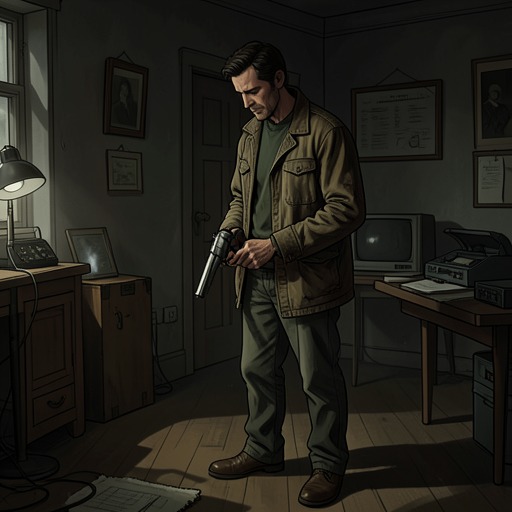
After Charlie Dunlop retires, his behavior makes the imagined threat more than a matter of talk. The chief of police takes away his driver’s license after he drives the wrong way on a freeway and later parks in a public cemetery. On foot, he continues to act on his suspicions: he goes outside during a blackout, knocks on neighbors’ doors to conduct searches he has invented, draws his gun at shadows, and lies in the gutter or in the road. Police officers quietly bring him home and sometimes scold Eileen for allowing matters to get out of hand. Their response makes her both the person left with the practical burden and the person blamed for conduct she cannot control.
One extended absence leads Eileen to a hospital two counties away, where she collects him after a six-day bender. Afterward, she gathers his shoes and locks them in the trunk of the car so he cannot set out on foot as easily. She keeps the car key around her neck. These measures are concrete adaptations to the risks created by his wandering, but they also show how the delusion reorganizes her own daily life: the key becomes an object she must carry because his movements cannot be reliably predicted.
Eileen’s perspective and the state’s significance
Eileen does not present Charlie Dunlop as a figure whose beliefs can be separated neatly from the rest of family life. She understands that he is confused, recognizes the role of alcohol, and knows that the mob he fears does not exist in X-ville. At the same time, she recalls his indifference and insults, and describes his loyalty as belonging to gin and his imaginary war rather than to her. Her account distinguishes explanation from absolution: his impaired grasp of reality helps explain his behavior, but it does not erase its emotional consequences for his daughter.
The delusions also unsettle the boundary between apparent danger and actual danger. Charlie Dunlop repeatedly treats shadows as enemies, while his real conduct—erratic driving, intrusive searches, and drawing a gun at what he takes to be a threat—creates concrete risks. The narrative lets the imagined figures remain unseen while showing the consequences of believing in them. His persecution is therefore both an inward ordeal and a force that reaches outward, turning the home, the road, and his relationship with Eileen into places where she must respond to dangers he cannot distinguish from his inventions.