Moorehead’s abusive regime
EileenMoorehead’s abusive regime is not confined to the blows and threats delivered by its guards. It also operates through rules governing movement, speech, family contact, punishment, and daily routine, turning a juvenile institution into a place where children are treated as subjects to be controlled rather than people to be cared for. Eileen’s account exposes this system through what she sees at work and through the procedures she herself administers: its violence is direct, but its reach is also bureaucratic and ordinary.
Custody and Discipline
The boys remain at Moorehead until their sentences expire or they turn eighteen; the youngest resident Eileen recalls seeing was nine and a half. The warden uses the threat of an early transfer to an adult prison to intimidate larger or troublesome boys, presenting the harsher institution as the punishment that awaits them. His warnings make the threat of future violence part of the discipline already imposed inside Moorehead.
The restrictions extend well beyond preventing escape or immediate harm. The boys are forbidden to dance, sing, gesture, speak loudly, listen to music, or lie down without permission. Eileen describes guards who strike boys with batons and restrain them with choke holds. In one episode she witnesses an officer humiliating a boy on the floor, telling him he is worth less than dirt and forcing him to submit to a degrading command. She looks away, but the scene shows that the institution’s control is enacted through both bodily force and the deliberate destruction of a child’s dignity.
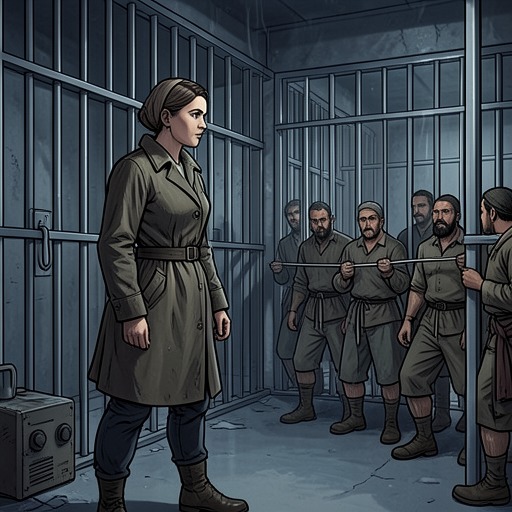
Isolation gives this discipline a separate, institutional form. Boys punished for misconduct must do extra work washing pots and pans and are confined in a former meat locker behind the kitchen, known as the Cave. Its heavy iron door is padlocked. A boy inside is allowed out only to shower and wash dishes; he eats there and must use a bucket as a toilet. Eileen recalls a boy who had been kept in the room for several weeks, sitting on his cot and staring at the wall. The conditions make confinement more than separation from other residents: ordinary necessities and privacy are brought under the institution’s control as well.
Rules, Records, and Family Contact
The regime is maintained through administrative routines as well as guards’ actions. Eileen keeps a file cabinet of reports, statements, and other documents for every inmate, including descriptions of crimes, police reports, and confessions. She reads the files and learns the boys’ histories without speaking to them. The record system gives staff access to extensive information about residents while the rules sharply limit the boys’ opportunities to communicate or act for themselves.
Visitation makes that imbalance visible to families. Moorehead permits only one visit at a time, leaving mothers and children to wait in the hallway. Visits last seven minutes. Eileen must record visitors, summon boys one by one, and administer security checks because there are no female guards. She recalls patting down mothers while Randy stood nearby guarding the visitation-room door; the women seemed passive and remorseful, and none carried a concealed weapon or other prohibited item. Men rarely visited, a pattern Eileen connects to the possibility that many boys lacked fathers, though she also notes work schedules as a likely explanation.
Rules about what visitors may give the boys turn family care into another point of institutional control. During one visit, a twelve-year-old boy who had burned down his family’s house begins to cry, and his mother reaches out with a handkerchief. Randy blocks the gesture. Eileen explains that gifts are prohibited for security reasons, although she knows that this explanation is not the real purpose of the rule. She understands that preventing gifts keeps the boys desperate, yet she enforces the procedure. Her participation shows how institutional power is carried not only by force but by staff members who repeat official explanations and perform routine duties.
The Holiday as Discipline
Moorehead’s Christmas activities do not suspend its restrictive order. Church volunteers decorate the halls with religious and holiday portraits, and Dr. Frye encourages the boys to sing carols and make cards. Eileen recalls that singing humiliates them and provokes fights, while cards are often filled with insults, threats, or obscene drawings. Correctional officers confiscate the cards and circulate them among staff before Eileen is told to file them. A practice presented as festive therefore becomes another means by which the boys’ expressions are monitored and exposed.
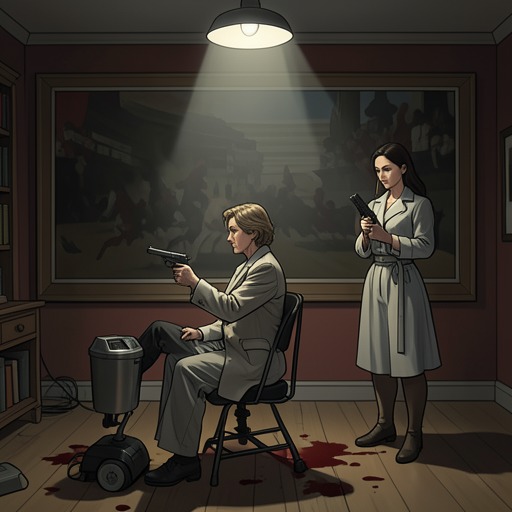
At the Christmas assembly, the warden presents the holiday as a lesson in moral improvement and demands that the boys remain quiet, warning that laughter or other interruptions will send them to the Cave. He introduces Dr. Morris as a new mental-health professional and Rebecca Saint John as an education expert, while describing her appearance to the assembled boys. The performance that follows uses a prison cell as its stage set. Against that theatrical image of reform stands the real institution: the boys are ordered to watch silently under threat of solitary confinement. The ceremony makes discipline part of the holiday spectacle rather than an interruption of it.
Staff Complicity and Eileen’s Composure
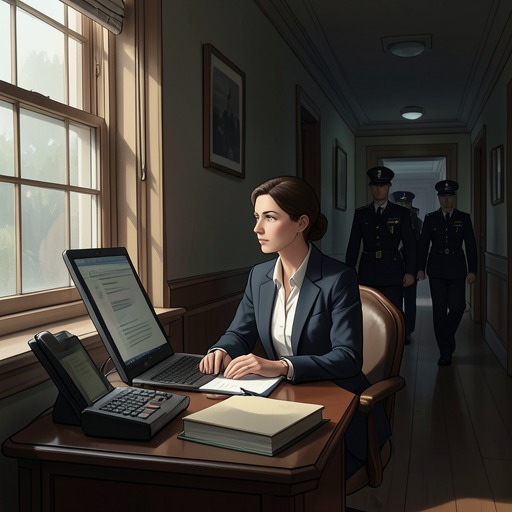
Eileen’s position as an office employee places her near the machinery of control without making her one of the guards who directly restrain the boys. She tries to look away when violence occurs and watches the clock when the work becomes difficult. At the same time, she maintains records, manages visiting procedures, and enforces rules she recognizes as harmful. Her account does not present participation as equivalent to the guards’ violence; instead, it shows how compliance and delegated tasks allow the regime to function throughout the institution.
The same tension shapes her public manner. At work Eileen practices a composed expression based on plaster death masks, which she calls her death mask. She uses that expression to conceal sensitivity and avoid showing distress in a place surrounded, as she recalls it, by misery and shame. During visiting hours she is expected to deal with grieving mothers, and she takes a drink and eats stolen mint chocolates beforehand because their visits make her nervous. The face she presents is a kind of emotional labor: it helps her remain at her desk and carry out her duties, but it also makes her harder to read and allows her to continue within a system she finds disturbing.
When the boys’ suffering becomes difficult to contain, Eileen describes retreating to an empty room and using a private physical ritual to bring her distress under control. Her response does not change the rules or aid the residents; it enables her to return to her assigned role. This contrast—between the boys’ restricted bodies and Eileen’s concealed distress—reveals different positions within the same institution, without erasing the difference between those who are imprisoned and those who work there.
Violence Beyond the Visible
In retrospect, Eileen also recalls rumors that guards pressured boys to fight, humiliated and beat them, and subjected them to other abuses. She says that the implications did not register with her at the time. Those recollections are presented as rumors rather than as episodes she personally witnessed, a distinction that matters: her account combines direct observation with later recognition of what she had failed to understand. The visible restrictions and punishments already establish a coercive environment, while the rumors suggest harms that remained obscure to the staff member who processed the boys’ files and watched their visits.
Moorehead’s regime thus relies on a continuum of control: threats of transfer, physical punishment, solitary confinement, restrictions on ordinary activity, surveillance of family contact, and paperwork that turns individual lives into institutional files. Its stated language of moral and educational improvement sits beside procedures that isolate, humiliate, and deny comfort. Eileen’s retrospective narration makes the system legible not through a single confrontation but through recurring tasks, rules, and scenes that she once accepted or endured without fully reckoning with their consequences.