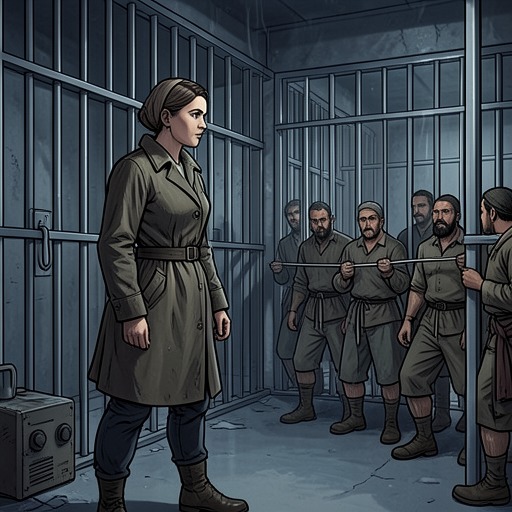
Moorehead’s punitive disciplinary system
EileenMoorehead’s punitive disciplinary system made deprivation an everyday instrument of institutional control: boys were restricted in how they moved and communicated, family visits were tightly regulated, and the warden treated distress as a possible route to reform. The system’s reach extended beyond the inmates. It organized Eileen Dunlop’s routine, required her to enforce rules she knew were misleading, and taught her to perform composure while witnessing the effects of confinement.
Institutional Rules and Classification
Eileen maintained a file cabinet of reports, statements, police records, and confessions for each boy. Inmates remained at Moorehead until their sentences ended or they turned eighteen; the youngest boy she recalled seeing was nine and a half. The warden also used the prospect of early transfer to the adult prison as a threat, especially against boys considered troublesome. In this arrangement, the file classified each child through his offense, while the threat of transfer made punishment seem capable of becoming still harsher.
The rules reached into ordinary conduct. Boys could not dance or sing, gesture freely, speak loudly, listen to music, or lie down without permission. Eileen thought many of them seemed like decent people given their circumstances, and recognized that most people might become irritable under similar restrictions. Yet she did not speak with them. She knew them through their files, whose accounts of crimes and official statements supplied the institution’s authorized picture of each boy. The distance between her impression of them and their written classifications exposes how Moorehead made surveillance and paperwork part of daily discipline.
Visits and Deliberate Deprivation
Only close relatives could visit inmates. At the start of visiting hours, Eileen directed visitors to sign a ledger and wait on molded orange plastic chairs in the hallway. With no women officers available, she was also assigned to conduct security checks on female visitors. She recalled the procedure as perfunctory and said she never found a concealed weapon or poison among the visiting mothers. The checks nevertheless made her responsible for managing the boundary between family contact and institutional control.
A visit by a boy’s mother shows the rules operating at the level of a small, ordinary kindness. A young arsonist sat across from his mother with his arms crossed and his attention turned away, as the younger boys often did. When he looked at her distressed face, he began to cry. His mother offered him a handkerchief, but Randy blocked the exchange and explained that it was not allowed. Eileen added the familiar explanation that the restriction existed to keep the children safe. She knew that explanation was untrue: the rule was not really about protecting a boy from a handkerchief.
Eileen understood the warden’s stated rationale as a deliberate effort to sustain desperation. In his theory, a boy had to become sufficiently desperate to feel remorse for his sins; sufficiently deep remorse would make him yield and become pliable enough to be transformed. The restriction on gifts, which extended beyond handkerchiefs to items such as toys, comics, magazines, and books, therefore did more than regulate security. It withheld comfort as a technique of reform. The boy’s tears and his mother’s blocked gesture show the immediate human cost of that theory without making the institution’s language of improvement equivalent to care.
Eileen’s Work and Performed Composure
The system depended on employees to make its procedures look routine. Eileen presented a carefully controlled face at work, which she called her death mask. She had studied casts of famous dead men in a library book and practiced in a mirror, aiming for an expression of calm endurance. Although she was young and sensitive to Moorehead’s misery and shame, she was determined not to show that sensitivity in the workplace. Her composed appearance became part of her job: distress had to be concealed even as she administered the institution’s rules.
Her preparations for visiting hours reveal the strain beneath that performance. She kept sweet vermouth and mint chocolates in her locker, and stole the chocolates from a drugstore in X-ville. Before receiving visitors, she drank vermouth and ate several chocolates because the visits made her nervous, particularly when she had to deal with the mothers of imprisoned boys. The ledger, waiting area, and security checks made reception a procedural task, but her account shows it also required emotional management. She treated the mothers’ distress as something to move past in order to maintain her flat composure.
That composure could coexist with strict obedience. Eileen followed Moorehead’s procedures and was afraid of being punished, questioned, or singled out. She reasoned that enforcing the rules helped demonstrate that she was good, even though she recognized the false explanation offered for denying gifts. Her own deprivation also shaped how she judged the boys’ needs: she resented the prospect that they might receive tenderness she had not been given. The system thus worked not only through direct orders but through an employee’s fear, self-justification, and learned expectation that comfort should be withheld.
Education, Punishment, and the System’s Limits
Rebecca’s later criticism brought a competing account of Moorehead’s purpose into view. She objected to the plan for a single blanket curriculum for boys of different ages and abilities, arguing that teaching required testing and trial and error. She wanted them to encounter literature, history, philosophy, and the sciences, and insisted that the boys could learn. In her view, the warden regarded them as cattle rather than as people with minds. The contrast was between education that recognized individual thought and a disciplinary structure that treated a uniform routine as sufficient for a population of distinct children.
Rebecca also criticized the warden’s religious rhetoric and his focus on punishing boys for private sexual behavior. She pointed out that Leonard Polk had been confined in the Cave for what the institution called inappropriate touching. Her criticism casts the system’s discipline as moral regulation as well as control of movement and visits: behavior was judged through the warden’s religious framework, and punishment substituted for an account of the boys’ needs. The evidence presents Rebecca’s view as a challenge to that framework, not as proof that she herself offered an uncomplicated alternative.
Eileen’s later reflections further unsettle Moorehead’s official justification. She recalled that she once had little compassion for anyone unless another person’s suffering allowed her to dwell on her own. She also came to understand that the boys’ treatment involved abuses beyond the visible visiting rules. Her account connects the regime’s ordinary procedures with a broader environment of mistreatment, while distinguishing what she knew at the time from what she recognized later. The punitive system’s significance lies in that gap: it named deprivation and remorse as tools of reform, but the scenes Eileen describes show an institution that restricted contact and individual expression while demanding that its employees present those restrictions as proper procedure.