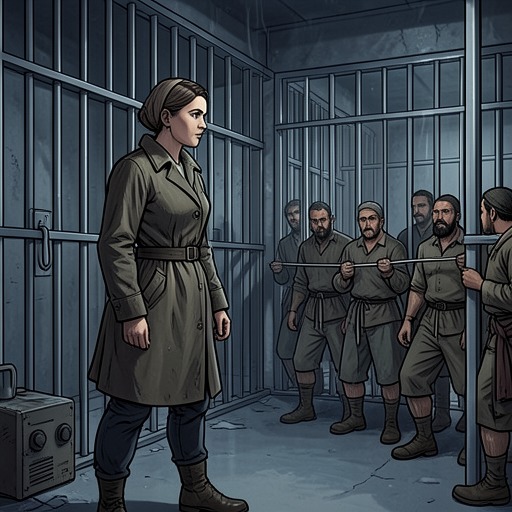
Lee Polk’s solitary confinement
EileenLeonard Polk’s solitary confinement at Moorehead turns the prison’s routine discipline into a concrete, enclosed condition: he is held for weeks in a locked former meat locker, apart from other boys and without visitors. Eileen encounters him through the room’s small window, then learns from his file that the quiet, withdrawn boy has been charged with killing his father and has not spoken since the crime. His confinement is both a punishment and a form of enforced invisibility, though the institution’s records and Eileen’s watching make him an object of attention even in isolation.
Institutional Setting and Purpose
Moorehead’s boys were subject to restrictions that reached into ordinary movement and expression. They could be forbidden to sing, dance, gesture, speak loudly, listen to music, or lie down without permission. Routes through the sleeping quarters were marked on the floor, directing where boys should stand for announcements, kneel for prayer, and walk to the showers or cafeteria. The regimented space offers a larger context for Leonard’s isolation: confinement is not an exception to a generally free routine, but an intensified form of control within an already regulated institution.
The prison maintained files of reports, statements, and other documents for each inmate. Boys remained at Moorehead until their sentences ended or they turned eighteen; Eileen had seen a boy as young as nine and a half. The warden also threatened to transfer larger or troublesome boys to the men’s prison early. These details place the cave within a disciplinary system that classified, monitored, and threatened boys at different stages of their confinement. The records could preserve an inmate’s history, but the institution’s language also reduced complex lives to offenses, conduct, and administrative decisions.
The Cave and Its Conditions
The room used for solitary confinement had once been a meat locker behind the kitchen. Its original stainless-steel door had been replaced by a heavy iron one with a small window, and the door was secured with a padlock. A boy sent there could leave only to shower and wash dishes. His meals were brought to him, and a bucket served as a toilet. The room’s former purpose, its locked door, and the narrow limits on leaving it made the cave a distinct space within the prison: not simply another sleeping room, but a place where daily needs and movement were controlled.
Solitary confinement was connected to additional labor. Boys punished for bad behavior could be assigned double duty washing pots and pans, and the cave’s occupant was required to wash dishes as well. This arrangement joined isolation to work rather than treating the two as separate penalties. The kitchen, ordinarily a place where food was prepared for the institution, also supplied the setting for a system of discipline in which an inmate’s time and access to basic routines were tightly managed.
Leonard Polk’s Confinement
Eileen found Leonard in the cave several weeks after he had arrived at Moorehead. He sat on his cot facing the wall. She recognized him from the intake procedure, when he had been silent and withdrawn. He was thin, broad-shouldered, and appeared older than his actual age; Eileen later learned he was fourteen, though she had initially taken him for someone around nineteen or twenty. At the point she watched him through the small window, she did not know the full story behind his placement there.
Eileen’s account emphasizes the narrowness of her access to him. She observed him from outside the locked room and did not know whether he saw her. The window allowed a view but did not permit conversation or contact. In a later recollection, she describes watching him during a private moment, an episode that makes her own position part of the scene: he was confined and exposed to observation, while she remained outside, able to look in but not to know him. She says she does not think he ever knew her name. The asymmetry is central to the encounter; the institution isolates Leonard, while Eileen’s gaze briefly crosses the barrier without overcoming it.
His isolation also coincides with an absence of visitors. Eileen tells Rebecca that she has never seen Leonard outside the room and that he has had no visitors. The wider visitation regime reinforces how controlled contact could be at Moorehead: in another visit, staff prevent a mother from passing a handkerchief to her son, and Eileen repeats the institution’s explanation that gifts are prohibited for security. Leonard’s lack of visitors is a specific fact about him, while the restrictions on family contact show how the prison managed even ordinary gestures of care.
File, Offense, and Narrative Significance
When Eileen asks Mrs. Stephens why Leonard was put in solitary, Mrs. Stephens dismisses him as a troublemaker. After the office staff have left, Eileen retrieves his file. It classifies his crime as patricide, and a newspaper clipping reports that he killed his father while the man slept. The report says Leonard had no prior history of violence; neighbors remembered him as quiet and well mannered. The contrast between that description and the enormity of the offense leaves his history unexplained rather than resolving it into a simple portrait of a habitual offender.
The file also contains notes by Dr. Frye, mostly dates, times, and medical terminology that Eileen cannot make out. Under comments, Eileen herself has written that Leonard has been mute since the day of the crime, in her schoolgirl handwriting. The record therefore holds different kinds of knowledge together: a newspaper account of the killing, professional observations, and Eileen’s brief annotation of his silence. None supplies a complete account of what he thinks or feels in the cave. His silence is presented as a continuing fact of his confinement, not as an explanation of the crime.
Leonard’s solitary confinement is significant because the narrative makes the prison legible through small arrangements of space and procedure: the padlock, the window, the cot, the dishwashing, the restricted visits, and the file. Eileen’s attention to these details does not make her an advocate for the boys; elsewhere she admits that her concern for their welfare was limited. Here, however, her recollection preserves a boy whom the institution’s labels might otherwise flatten into a criminal case. The cave separates Leonard from the prison’s shared life, while the story’s movement between observation and paperwork shows how little can be known about him even when he is watched, described, and classified.