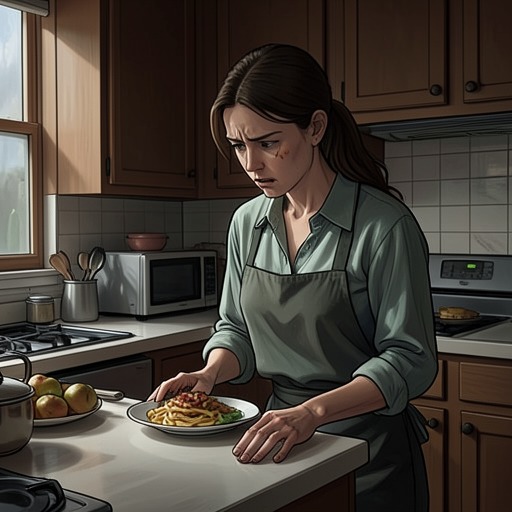
Eileen’s disordered eating and laxative abuse
EileenEileen’s disordered eating and laxative abuse form a recurring system of restriction, discomfort, and short-lived relief rather than an isolated episode. At twenty-four, she describes eating very little, fearing that food will add weight, and relying on laxatives to manage bowel movements. The routine reaches into her use of the house: when privacy feels unavailable, she retreats to the attic or basement, making bodily care part of her broader isolation.
Pattern and Setting
On a snowy Saturday, Eileen stays in bed in the attic for as long as she can, unwilling to face the cold. When her father’s moods make her hole up there, she has a large mason jar available as an improvised substitute for the bathroom. She is wearing her mother’s old nightgown and an Irish wool sweater, and later empties the jar from the attic window. The episode places bodily management within the practical limits of her home life: the nearest bathroom is downstairs and shared with her father, while the attic offers distance and some control over when she has to leave her room.
The basement offers a different kind of privacy. Eileen uses its toilet because the room is secluded enough for her to be alone afterward; she assumes her father thinks she is doing laundry. Yet the basement also carries memories of her mother, who spent long stretches there and came upstairs with laundry while telling Eileen to clean her room, brush her hair, read, or leave her alone. Eileen associates the basement with unresolved family secrets and her father’s dark imaginings, but notes that these memories and fears do not always prevent her from feeling safe there. Her choice of bathroom therefore shifts with circumstance: a space associated with dread can still serve as a refuge when privacy matters most.
Food, Weight, and Bodily Shame
At twenty-four, Eileen regards the management of eating and bowel movements as a complicated, constant preoccupation. She knows she should drink water and eat healthful food, but dislikes both. Fruits and vegetables repel her, and she sometimes passes whole days on little more than nuts or raisins and a crust of bread. When she wants sweets, she may chew them and spit them out because she fears that eating them will put weight on her bones. The pattern combines desire for food with an effort to avoid its perceived consequences; even a pleasurable taste becomes something she must interrupt.
Her account connects this restriction to shame about her body and her womanliness. In the shower, she examines her naked body in the mirror, describing herself as markedly thin, with a small frame, prominent ribs, and hips that jut out. She presents the inspection from the perspective of an older self looking back at her twenty-four-year-old body, setting its youth against the lines and softness of her present age. The mirror does not resolve her discomfort: the detailed act of looking sits beside her continuing embarrassment about puberty and femininity. Her body is both closely monitored and experienced as a source of unease.
Care of the body is inconsistent in other ways, too. Eileen hates showering, particularly in winter, when the hot water is unreliable, and delays washing as long as she can tolerate. At the same time, she worries that other people can smell her and judge her for it. Her father has told her that she smells bad, intensifying a concern that is already part of her self-consciousness. The contrast between avoiding the shower and fearing others’ judgment shows how neglect and scrutiny coexist: she does not feel at ease in caring for her body, but remains anxious about how it is perceived.
Laxative Dependence and Its Effects
Eileen says her bowel movements occur irregularly, perhaps once or twice a week, and rarely without assistance. When she feels bloated, she may swallow a dozen or more laxative pills. Without them, she experiences prolonged difficulty and discomfort; with them, the result is much more forceful, and she can be left dizzy and depleted. She nevertheless describes the period afterward as a valued interval of emptiness and lightness. The relief is temporary, but it gives the routine a powerful reward: the pills are not only a response to discomfort but also a way to reach a state she actively seeks.
That relief depends on privacy. Eileen uses the basement toilet and lies down afterward, alone, while the world seems to turn around her. The basement’s separation from the rest of the house lets her keep the episode out of view, just as the attic lets her remain apart from the household when she does not want to get up. Her father is not described as managing or treating the problem; instead, Eileen organizes it herself around the house’s available spaces and her need not to be interrupted.
The routine recurs in an ordinary domestic moment after she has driven home. Eileen drinks water from the tap, takes a handful of laxatives kept beneath the kitchen sink, and then sits down with a beer. On the following morning, after a night when she has used the basement toilet, she makes scrambled eggs with ketchup and heats a beer, which she calls her preferred hangover remedy. She feels as though she has a clean beginning, although she does not think she showers. Eating, purging, drinking, and washing appear not as separate concerns but as parts of the same unsettled daily pattern.
Retrospective Account and Significance
The narrative repeatedly frames these habits through Eileen’s later knowledge. She recounts the Saturday in winter and then recalls inspecting her body at twenty-four from the position of an older woman. She also looks back on her food choices with an awareness that she knew what would be healthier but did not want to eat or drink it. That retrospective distance makes the routine legible without suggesting that Eileen had control over it simply because she could describe it. The account records its practical details and consequences while preserving her uncertainty about why she neglected herself.
The basement and attic give this bodily state a domestic geography. In the attic, Eileen avoids the cold and the demand to leave bed; in the basement, she can be alone after taking laxatives. Both spaces offer distance from her father, but the basement is also entangled with memories of her mother and family secrecy. Privacy is thus neither simple comfort nor a permanent escape. It is something Eileen assembles from the corners of a house where she feels watched, constrained, or reluctant to appear.
The pattern’s central contradiction is that Eileen seeks both to diminish her body through restricted eating and to obtain a brief feeling of release through laxatives, while remaining intensely attentive to weight, discomfort, and other people’s judgments. Her account does not reduce these habits to a single motive. Instead, it shows how they organize time, appetite, movement through the house, and the rare moments when she can be alone. The result is a portrait of bodily distress as an ongoing condition of daily life, not a single dramatic event.