Eileen's mother
EileenEileen's mother is remembered less as a fully recoverable person than as an absence that shapes Eileen's account of family, grief, and memory. She dies when Eileen is nineteen, and Eileen later recalls her through uncertain images, the room where she lay, and a small set of details that do not settle into a complete portrait. The tension between Eileen's mother's praise of her daughter's thinness and Eileen's own distress about her body gives those memories an especially difficult intimacy.
Identity and Recollection
Eileen has no family photographs from the home she left in X-ville. Her memories therefore serve as her only record, but she describes them as shifting rather than fixed. She can picture Charlie Dunlop as he was when she left him and can call up a distinct image of Joanie as a young woman; Eileen's mother is harder for her to picture. The contrast does not mean that the mother mattered less. Instead, it shows how the past survives unevenly: some people remain sharply visible in memory, while this central family figure comes back only in partial images.
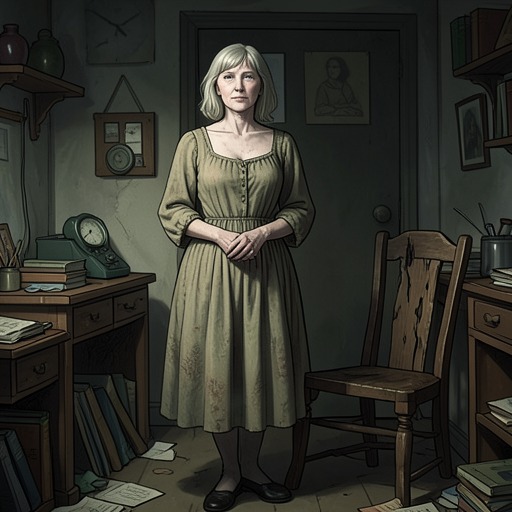
The detail Eileen can summon most clearly is her mother's graying hair. She remembers her mother dead in bed, and remembers herself beside her before she went to tell Charlie Dunlop. This fragment is anchored not in a broad account of the mother's life but in the circumstances of loss and in the effort to face what had happened. Eileen's account gives the mother a presence through the limits of what can be recalled: the image is vivid, but the person around it remains difficult to reconstruct.
Death and Its Aftermath
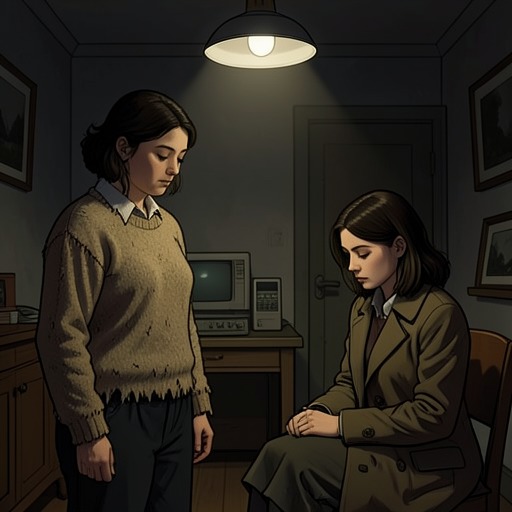
Eileen places her mother's death when Eileen was nineteen. In the recollection of the immediate aftermath, she leaves her mother in the bedroom and tells Charlie Dunlop, who has already been drinking heavily for weeks. His response is to ask whether Eileen is sure. The brief exchange marks a painful difference between the event Eileen has witnessed and her father's apparent difficulty taking it in. The account does not offer a fuller explanation of his reaction; it records the question as part of the loneliness Eileen associates with that morning.
Eileen remembers going to the bathroom to cry and seeing her own swollen, red eyes in the mirror. She then describes shaking and sobbing in the shower. These details place grief in ordinary private spaces rather than in a shared family ritual: first the bedroom where her mother has died, then the bathroom where Eileen is alone with her reflection. The sequence makes the death consequential not only as a loss, but as an experience Eileen had to absorb and carry without a remembered scene of comfort from another family member.
The bedroom remains associated with her mother even in a later memory of Charlie Dunlop. After Eileen gives him gin and he grows sleepy, she helps him to her mother's bedroom, lays him down, and kisses his hand. This later use of the room does not restore the mother or resolve the earlier grief. Rather, it shows how the space remains part of the family's emotional geography: the room first recalled as the place of death becomes the place where Eileen tends to her living father.
Eileen's Body and Maternal Praise
Eileen says she was thin as a rail by the time her mother died and that her mother had praised her for being thin. The account places this praise beside Eileen's bodily distress, including her shaking and crying after the death. It does not establish that her mother's praise caused Eileen's difficulties with food or her feelings about her body. It does, however, preserve an unsettling connection between maternal approval and a physical condition that Eileen describes as part of a period of distress.
A bottle of her mother's pain pills also appears among the objects Eileen carries in her purse. When she produces it, she identifies the pills as her mother's and says they are for pain. The recollection does not specify why Eileen has them, how long she has carried them, or whether they were connected to her mother's death. Their appearance is therefore a small but concrete trace of continued attachment, not an explanation of the loss. Like the memory of the bedroom, the bottle links the absent mother to the practical objects that remain after her death.
An Imagined Mother and Narrative Significance
Eileen's mother also appears in Eileen's imagined version of a conventional Christmas. The figure in that imagined scene wears pearl earrings and belongs to a loving family gathered around a lavish meal, with a gentle grandfather, a dog, and a fire. This is not presented as a factual description of Eileen's own mother or childhood Christmases. It is a wished-for family image, set against Eileen's expectation that leaving X-ville alone on Christmas morning might otherwise have filled her with regret. The idealized mother consequently reveals what Eileen longs to have had, not what the surviving memories prove she received.
That imagined ideal sits beside Eileen's inability to picture her actual mother clearly. The contrast prevents the wished-for maternal figure from replacing the deceased woman entirely: one is an emblem in a counterfactual holiday scene, while the other is recalled through a death, a room, a handful of physical details, and a remembered pattern of praise. Eileen's mother's narrative significance lies in that unresolved gap. She remains central to Eileen's sense of family and loss, yet the account refuses to turn fragmentary memory into a complete biography.