Escape and self-reinvention
EileenEscape and self-reinvention is the double movement at the heart of Eileen's departure from X-ville: she seeks a way out of a life that feels confining, while imagining that a new place could make her into someone different. The change first takes shape in fantasies of altered clothes, hair, and name, then narrows to what she can actually carry. In retrospect, escape is neither a simple liberation nor a completed reinvention. It is a choice made with limited foresight, remembered through the small objects that accompanied it and the map that continued to connect her to home.
Imagining another self
As Eileen anticipates leaving, New York City becomes the setting for a projected identity. She imagines changing her appearance through different clothes, a new haircut or hair color, a long wig, or false glasses. Changing her name also seems possible; she considers Rebecca a usable name. These possibilities express more than a wish to look different. They suggest that distance from X-ville might loosen the hold of an identity she has come to experience as fixed, allowing her to decide how she will be seen.
That vision is not yet a settled plan. Eileen tells herself that there will be time to work out the future later. Her attention turns instead to Rebecca, whose presence in X-ville makes the prospect of leaving more complicated. Eileen wonders whether Rebecca might go with her and imagines their future together, even as she remains uncertain about what either of them will do. The imagined escape is therefore at once geographic and relational: it promises a different life, but Eileen pictures that life through her hope of being beside Rebecca.
The contrast between fantasy and preparation is visible on Christmas Eve, which Eileen later identifies as the last one of her life in X-ville. She has six hundred forty-seven dollars in her jewelry box, her life savings, and the Father's gun. The weapon had belonged to her father and had served first as a symbol of authority and later as a prop in his claims about unseen criminals. In Eileen's hands, it seems to give her confidence and to make freedom appear attainable. She imagines using it to clear her way, and even pictures a romantic outing with Rebecca in which they would shoot at trees, the moon, or stars. The gun belongs to a serious plan for self-protection, but her imagined uses also show how readily the prospect of escape acquires a theatrical, almost celebratory cast.
What she carries out
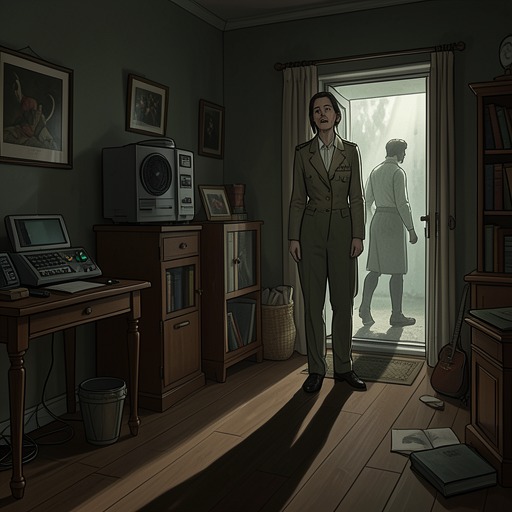
On the evening she leaves for Rebecca's house, Eileen dresses from her mother's wardrobe. She chooses a gray linen suit because she thinks Rebecca will approve of it, interpreting its subdued, mature appearance as suitable to the person she hopes to be in Rebecca's company. In later reflection, she recognizes the outfit as a kind of service uniform: an attempt to be unobtrusive, useful, and accepted. She puts on a white nylon slip, navy pantyhose, snow boots, and her mother's camel coat. These are not merely the clothes she selects for the evening; they are also the only pieces of her mother's wardrobe she ultimately takes from X-ville.
Her preparation includes a small but telling reversal. Eileen initially considers her lipstick part of how she presents herself, but decides to go without makeup, partly because Rebecca wears none. Wanting closeness and acceptance makes it easier for her to be seen without the cosmetic mask she had relied on. The change is modest: she has not yet become the transformed person imagined in her plans for New York City. But even before she leaves, her idea of reinvention is shaped by another person's approval and example.
The map of X-ville makes the departure concrete. Eileen retrieves it from the car and carries it back through the snow before setting out for Rebecca's house. She studies the route and notices that Rebecca's home appears to be on the wrong side of the tracks, a detail that barely registers with her then. The map remains with her for years, eventually pinned to the back of her closet door. She carries it around and cries over it. Its meaning expands beyond navigation: in her later account it holds together childhood, sadness, an idealized home, and a place associated with suffering. The object preserves the connection that escape was supposed to break.
The limits of departure
Eileen's later perspective unsettles the idea that leaving X-ville was a straightforward passage to safety. She describes her younger self as inexperienced, heedless of danger, and driven by a kind of bravery that she now calls foolish. New York City, the destination she had imagined as a place for remaking herself, proves dangerous for a young woman alone. She recalls being groped and grabbed on the subway, along with heartbreak, closed doors, and damage to her confidence. These experiences do not erase the reasons she left, but they expose how little she understood about the risks beyond the life she was escaping.
The retrospective account also resists a simple story of escape as triumph. Eileen says that, had she known how dangerous the place she was going to would be, she might never have left X-ville. That possibility remains hypothetical, but it gives her departure a painful counterweight: the choice offered freedom from one setting without guaranteeing security in another. Her younger self's confidence in the gun and her elaborate plans for appearance stand beside the older narrator's knowledge that a new location could bring harms she had not imagined.
Memory and self-reinvention
The surviving details of Eileen's departure are deliberately ordinary: a gray suit, winter clothes, money, a gun, and a folded map. Their significance lies in the gap between what she envisioned and what she actually carried away. The imagined transformation could include disguises and a new name; the realized departure depended on the clothes on her back and a few portable resources. Reinvention begins as a picture of unlimited choice, then takes the form of a specific, materially constrained act.
The map's continuing presence makes the separation equally incomplete. Eileen remembers it not only as a route but as the record of the home she left, a place she can regard with gratitude and disgust. That divided response complicates the meaning of escape: leaving does not require her to forget X-ville or settle its place in her memory. Instead, the map allows her later self to hold departure and attachment together. Escape and self-reinvention thus names both a decisive break and the long afterlife of the world from which Eileen broke away.